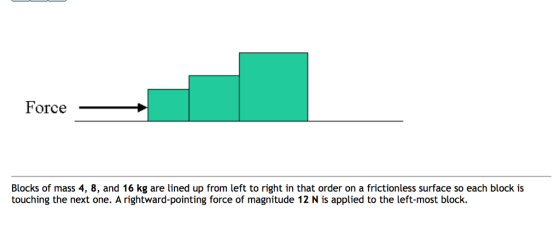
1. What is the magnitude of the force that the middle block exerts on the rightmost one?
Fright, middle =
2. What is the magnitude of the force that the leftmost block exerts on the middle one?
Fmiddle, left =
3. Suppose now that the left-right order of the blocks is reversed. Now find the magnitude of the force that the leftmost block exerts on the middle one?
F'middle, left =
Homework Answers
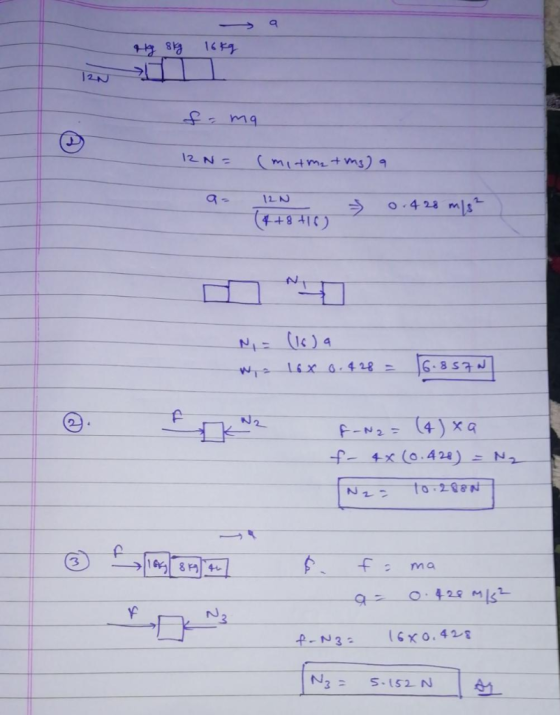
Add Answer to:
1. What is the magnitude of the force that the middle block
exerts on the rightmost...
Two blocks are in contact with each other on a frictionless surface. The left block (block...
Two blocks are in contact with each other on a frictionless surface. The left block (block 1) weighs 2kg and the right block (block 2) weighs 3kg. A rightward force of 20N is applied to the left block and a leftward force of 10N is applied to the right block. Determine the force that each block exerts on the other.
Consider the two adjacent blocks shown in the figure below. A horizontal external force, F, is...
 Consider the two adjacent blocks shown in the figure below. A
horizontal external force, F, is applied rightward to the small
block on the left. The horizontal surface on which the blocks slide
is frictionless. If M = 1.0 kg and F = 16.7 N, determine magnitude
of the force applied by the small block onto the large block.
4M
Consider the two adjacent blocks shown in the figure below. A
horizontal external force, F, is applied rightward to the small
block on the left. The horizontal surface on which the blocks slide
is frictionless. If M = 1.0 kg and F = 16.7 N, determine magnitude
of the force applied by the small block onto the large block.
4M
in animation 1 a 1.5-kg block receives a push and in the process pushes against a...
in animation 1 a 1.5-kg block receives a push and in the process pushes against a 4.5-kg block. (position is in meters and time is in seconds). Conversely, in animation 2,the same 4.5-kg block receives the same push, now from the opposite direction, and in the process pushes against the 1.5-kg block as shown. All surfaces are frictionless. The magnitude of the finger applied by the finger is calculated to be 15.6N since the acceleration is 2.612. 1.a the force...
NTSB-QRT19: STUDENT PUSHES TWO SLOWING BLOCKS-FORCE ON BLOCK A student pushes the two blocks to the...
 NTSB-QRT19: STUDENT PUSHES TWO SLOWING BLOCKS-FORCE ON BLOCK A student pushes the two blocks to the right. Block A has more mass than block B There is friction between the blocks and the table. (i) For the situation where the blocks are slowing down, which of the following statements is true about the magnitude of the forces a) The force that block exerts on block is greater than the force that block exerts on block b) The force that block....
A 10 kg block is dragged by an applied force of 20N, which makes an angle...
A 10 kg block is dragged by an applied force of 20N, which makes an angle of 600 with the horizontal. The coefficient of friction of the surface is. The block starts from rest and is pulled a distance of 7m. Calculate the work done by the applied force? Calculate the work done by the force of friction? What is the resultant work done? What is the final velocity of the block? Recall: work done equals change in kinetic...
force p is applied to block 2 parallel to an inclined smooth surface
 Force \(P\) is applied to Block 2 parallel to an inclined smooth surface to hold the two blocks in equilibrium (see figure). The blocks are connected by a cable that runs over a frictionless pulley at \(A\).(a) Find the required range of values of force \(P\) to maintain equilibrium.(b) Revise your solution if friction between Block 2 and the inclined surface \(\left(\mu_{s}=0.2\right)\) is now considered. Let \(W_{1}=10\) kips, \(W_{2}=40\) kips, \(\theta_{2}=60^{\circ}\), and \(\theta_{1}=30^{\circ}\).
Three identical 6.0-kg cubes are placed on a horizontal frictionless surface in contact with one another....
Three identical 6.0-kg cubes are placed on a horizontal frictionless surface in contact with one another. The cubes are lined up from left to right and a force is applied to the left side of the left cube causing all three cubes to accelerate to the right at 3.0 m/s2. What is the magnitude of the force exerted on the right cube by the middle cube in this case? a. 18 N b. none of the above c. 12 N...
A 4.7 kg block is being pushed across a frictionless horizontal surface by a horizontal force....
A 4.7 kg block is being pushed across a frictionless horizontal surface by a horizontal force. The block accelerates at 3.8 m/s2. What is the magnitude of the normal force the surface exerts on the block? Express your answer in newtons and round to one decimal place.
A 3.9 kg block is being pushed across a frictionless horizontal surface by a horizontal force....
A 3.9 kg block is being pushed across a frictionless horizontal surface by a horizontal force. The block accelerates at 5.6 m/s2. What is the magnitude of the normal force the surface exerts on the block? Express your answer in newtons and round to one decimal place.
Problem 3 (20 points) In the following figure, a horizontal force F is applied to a...
 Problem 3 (20 points) In the following figure, a horizontal force F is applied to a large block of mass M with a massless pulley attached to it. While the block M is moving to the right, the other two blocks mi and m2 remain stationary problem relative to M. All surfaces are frictionless for this (a) Draw separate free body diagrams for M(including the massless pulley), mi, and m2 respectively. On the free body diagrams, please only draw and...
 Consider the two adjacent blocks shown in the figure below. A
horizontal external force, F, is applied rightward to the small
block on the left. The horizontal surface on which the blocks slide
is frictionless. If M = 1.0 kg and F = 16.7 N, determine magnitude
of the force applied by the small block onto the large block.
4M
Consider the two adjacent blocks shown in the figure below. A
horizontal external force, F, is applied rightward to the small
block on the left. The horizontal surface on which the blocks slide
is frictionless. If M = 1.0 kg and F = 16.7 N, determine magnitude
of the force applied by the small block onto the large block.
4M
 NTSB-QRT19: STUDENT PUSHES TWO SLOWING BLOCKS-FORCE ON BLOCK A student pushes the two blocks to the right. Block A has more mass than block B There is friction between the blocks and the table. (i) For the situation where the blocks are slowing down, which of the following statements is true about the magnitude of the forces a) The force that block exerts on block is greater than the force that block exerts on block b) The force that block....
 Problem 3 (20 points) In the following figure, a horizontal force F is applied to a large block of mass M with a massless pulley attached to it. While the block M is moving to the right, the other two blocks mi and m2 remain stationary problem relative to M. All surfaces are frictionless for this (a) Draw separate free body diagrams for M(including the massless pulley), mi, and m2 respectively. On the free body diagrams, please only draw and...
Most questions answered within 3 hours.
-
Where is the error in this code sequence?
String s1 = "Hello";
String s2 = "ello";...
asked 11 months ago -
Financial data for Joel de Paris, Inc., for last year
follow:
Joel de Paris, Inc.
Balance...
asked 11 months ago -
Consider this reaction:
Al2(SO4)3 (aq)+ BaCl3
(aq) Al2Cl6 (aq)- +
3BaSO4(s) . What is the...
asked 11 months ago -
Suppose that Savneet is considering increasing her
recent random sample from 20 car rentals to 40...
asked 11 months ago -
Trucks arrive at an unloading terminal at an average rate of 120
per hour.
Trucks arrive...
asked 11 months ago -
Why are methanol and ethanol completely soluble in water while
octanol is not very little soluble....
asked 11 months ago -
A facilities manager at a university reads in a research report
that the mean amount of...
asked 11 months ago -
When the CuSO4 is rehydrated by adding water to the anhydrous
compound, is this an endothermic...
asked 11 months ago -
A ray of sunlight is passing from diamond into crown glass; the
angle of incidence is...
asked 11 months ago -
A block of mass 0.249 kg is placed on top of a light, vertical
spring of...
asked 11 months ago -
how do the kidneys compensate in the presences of acidosis
a) trigger hyperventilate
b) reserve acid...
asked 11 months ago -
Question 501 pts
The rental rate of capital to the firm increases. Which of the
following...
asked 11 months ago