
Homework Answers
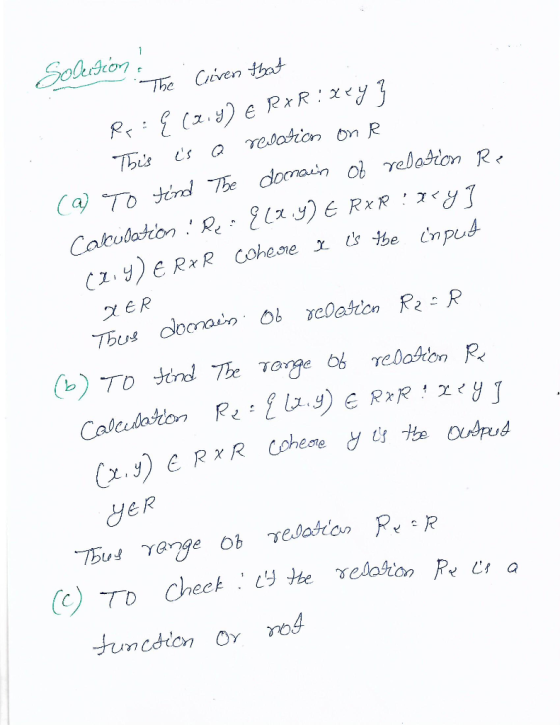
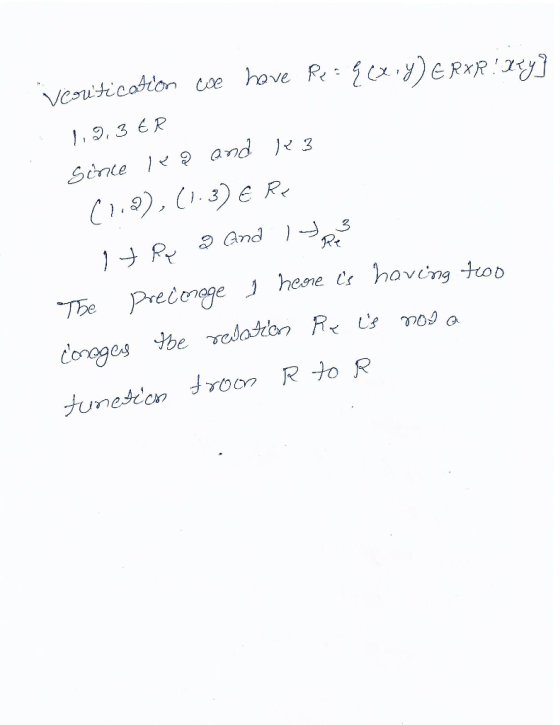
10. [4] Let R be the relation on the set {0, {f}, {y}, {x,y}} defined by...
 10. [4] Let R be the relation on the set {0, {f}, {y}, {x,y}} defined by R= {(S, T): SUT|=2} (a) Represent the relation R as a set of ordered pairs. (b) Represent the relation R as a relational digraph.
13 pts) Let R be the relation on R deÖned by xRy means "sin2 (x) +...
 13 pts) Let R be the relation on R deÖned by
xRy means "sin2 (x) + cos2 (y) = 1".
Recall the Pythagorean identity: 8u 2 R we have sin2 (u) +
cos2 (u) = 1.
(a) (9 pts) PROVE that R is an equivalence relation on
R.
(b) (4 pts) Describe all elements of the (inÖnite) equivalence
class [0].
Recall: sin(0) = 0 and cos(0) = 1.
2. (13 pts) Let R be the relation on R defined by...
13 pts) Let R be the relation on R deÖned by
xRy means "sin2 (x) + cos2 (y) = 1".
Recall the Pythagorean identity: 8u 2 R we have sin2 (u) +
cos2 (u) = 1.
(a) (9 pts) PROVE that R is an equivalence relation on
R.
(b) (4 pts) Describe all elements of the (inÖnite) equivalence
class [0].
Recall: sin(0) = 0 and cos(0) = 1.
2. (13 pts) Let R be the relation on R defined by...
Let B C R" be any set. Define C = {x € R" | d(x,y) <...
 Let B C R" be any set. Define C = {x € R" | d(x,y) < 1 for some y E B) Show that C is open.
3. (a) (5 points) On the set A= R\{0}, let x ~ y if and only...
 3. (a) (5 points) On the set A= R\{0}, let x ~ y if and only if x · y > 0. Is this relation an equivalence relation? Prove your answer. (b) (5 points) Let B = {1, 2, 3, 4, 5} and C = {1,3}. On the set of subsets of B, let D ~ E if and only if DAC = EnC. Is this relation an equivalence relation? Prove your answer.
2. Let R be the region R = {(X,Y)|X2 + y2 < 2} and let (X,Y)...
 2. Let R be the region R = {(X,Y)|X2 + y2 < 2} and let (X,Y) be a pair of random variables that is distributed uniformly on this region. That is fx,y(x, y) is constant in this region and 0 elsewhere. State the sample space and find the probability that the random variable x2 + y2 is less than 1, P[X2 +Y? < 1].
5. (10 points) Let p="x < y", q="x < 1", and r="y > 0". Using ~,...
 5. (10 points) Let p="x < y", q="x < 1", and r="y > 0". Using ~, 1, V write the following statements in terms of the symbols p, q, and r. (a) 0 <y < x < 1. (b) 1 < x <y<0.
2) We define the relation R between two elements of S as: R= {(x,y) ifx is...
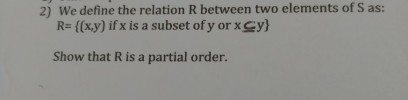 2) We define the relation R between two elements of S as: R= {(x,y) ifx is a subset of y or x-y) Show that R is a partial order.
Discrete Mathematics. Let A = {2,4,6,8,10}, and define a relation R on A as ∀x,y ∈...
Discrete Mathematics. Let A = {2,4,6,8,10}, and define a relation R on A as ∀x,y ∈ A,xRy ↔ 4|(x−y). (a) Show R is an equivalence relation. (b) Give R explicitly in terms of its elements. (c) Draw the directed graph of R. (d) List all the distinct equivalence classes of R.
Discrete Mathematics. Let A = {2,3,4,6,8,9,12,18}, and define a relation R on A as ∀x,y ∈...
Discrete Mathematics. Let A = {2,3,4,6,8,9,12,18}, and define a relation R on A as ∀x,y ∈ A,xRy ↔ x|y. (a) Is R antisymmetric? Prove, or give a counterexample. (b) Draw the Hasse diagram for R. (c) Find the greatest, least, maximal, and minimal elements of R (if they exist). (d) Find a topological sorting for R that is different from the ≤ relation.
3. Let f : (a,b) +R be a function such that for all x, y €...
 3. Let f : (a,b) +R be a function such that for all x, y € (a, b) and all t € (0.1) we have (tx + (1 - t)y)<tf(x) + (1 - t)f(y). Prove that f is continuous on (a,b).
 10. [4] Let R be the relation on the set {0, {f}, {y}, {x,y}} defined by R= {(S, T): SUT|=2} (a) Represent the relation R as a set of ordered pairs. (b) Represent the relation R as a relational digraph.
 13 pts) Let R be the relation on R deÖned by
xRy means "sin2 (x) + cos2 (y) = 1".
Recall the Pythagorean identity: 8u 2 R we have sin2 (u) +
cos2 (u) = 1.
(a) (9 pts) PROVE that R is an equivalence relation on
R.
(b) (4 pts) Describe all elements of the (inÖnite) equivalence
class [0].
Recall: sin(0) = 0 and cos(0) = 1.
2. (13 pts) Let R be the relation on R defined by...
13 pts) Let R be the relation on R deÖned by
xRy means "sin2 (x) + cos2 (y) = 1".
Recall the Pythagorean identity: 8u 2 R we have sin2 (u) +
cos2 (u) = 1.
(a) (9 pts) PROVE that R is an equivalence relation on
R.
(b) (4 pts) Describe all elements of the (inÖnite) equivalence
class [0].
Recall: sin(0) = 0 and cos(0) = 1.
2. (13 pts) Let R be the relation on R defined by...
 Let B C R" be any set. Define C = {x € R" | d(x,y) < 1 for some y E B) Show that C is open.
 3. (a) (5 points) On the set A= R\{0}, let x ~ y if and only if x · y > 0. Is this relation an equivalence relation? Prove your answer. (b) (5 points) Let B = {1, 2, 3, 4, 5} and C = {1,3}. On the set of subsets of B, let D ~ E if and only if DAC = EnC. Is this relation an equivalence relation? Prove your answer.
 2. Let R be the region R = {(X,Y)|X2 + y2 < 2} and let (X,Y) be a pair of random variables that is distributed uniformly on this region. That is fx,y(x, y) is constant in this region and 0 elsewhere. State the sample space and find the probability that the random variable x2 + y2 is less than 1, P[X2 +Y? < 1].
 5. (10 points) Let p="x < y", q="x < 1", and r="y > 0". Using ~, 1, V write the following statements in terms of the symbols p, q, and r. (a) 0 <y < x < 1. (b) 1 < x <y<0.
 2) We define the relation R between two elements of S as: R= {(x,y) ifx is a subset of y or x-y) Show that R is a partial order.
 3. Let f : (a,b) +R be a function such that for all x, y € (a, b) and all t € (0.1) we have (tx + (1 - t)y)<tf(x) + (1 - t)f(y). Prove that f is continuous on (a,b).
Most questions answered within 3 hours.
-
Where is the error in this code sequence?
String s1 = "Hello";
String s2 = "ello";...
asked 11 months ago -
Financial data for Joel de Paris, Inc., for last year
follow:
Joel de Paris, Inc.
Balance...
asked 11 months ago -
Consider this reaction:
Al2(SO4)3 (aq)+ BaCl3
(aq) Al2Cl6 (aq)- +
3BaSO4(s) . What is the...
asked 11 months ago -
Suppose that Savneet is considering increasing her
recent random sample from 20 car rentals to 40...
asked 11 months ago -
Trucks arrive at an unloading terminal at an average rate of 120
per hour.
Trucks arrive...
asked 11 months ago -
Why are methanol and ethanol completely soluble in water while
octanol is not very little soluble....
asked 11 months ago -
A facilities manager at a university reads in a research report
that the mean amount of...
asked 11 months ago -
When the CuSO4 is rehydrated by adding water to the anhydrous
compound, is this an endothermic...
asked 11 months ago -
A ray of sunlight is passing from diamond into crown glass; the
angle of incidence is...
asked 11 months ago -
A block of mass 0.249 kg is placed on top of a light, vertical
spring of...
asked 11 months ago -
how do the kidneys compensate in the presences of acidosis
a) trigger hyperventilate
b) reserve acid...
asked 11 months ago -
Question 501 pts
The rental rate of capital to the firm increases. Which of the
following...
asked 11 months ago