
Homework Answers
Primary structure of protein as well as secondary, tertiary and quarternary are made of covalent bond. Primary and secondary structure of protein are made of hydrogen bonds namely peptide bonds. Tertiary structure and quarternary structure is made of covalent bonds, hydrogen bonds, ionic bonds, and Van Der Waals interactions.
Add Answer to:
11) Proteins may have up to four levels of structure. For each type, describe the kind...
20 Marks) Question 3 a) The structure of proteins is described at four levels: primary, secondary,...
 20 Marks) Question 3 a) The structure of proteins is described at four levels: primary, secondary, tertiary and quaternary Briefly explain what is referred to by each of these terms. Why are these distinctions useful? [5 marks] b) Each level of protein structure is stabilised by chemical bonds and interactions: List the bonds and/or effects primarily responsible for stabilising each level of structure. [5 marks] c) The illustration below shows a molecule of haemoglobin. Describe TWO (2) aspects of haemoglobin...
Review| Constants| Periodic Table Protein structure is conceptually divided into four levels, from most basic to...
 Review| Constants| Periodic Table Protein structure is conceptually divided into four levels, from most basic to higher order Primary structure describes the order of amino acids in the peptide chain. Secondary structure describes the basic three-dimensional structures, a-helices and B sheets. Tertiary structure describes how the secondary structures come together to form an individual globular protein. Quatemary structure results from individual proteins coming together to form multi-subunit protein complexes Part A Complete the following vocabulary exercise relating to the level...
You may want to reference (Page) Section 10.3 while completing this problem. Determine whether each of...
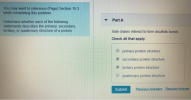 You may want to reference (Page) Section 10.3 while completing this problem. Determine whether each of the following statements describes the primary, secondary tertiary, or quaternary structure of a protein. Part A Side chains interact to form disulfide bonds Check all that apply. primary protein structure secondary protein structure tertiary protein structure quaternary protein structure Submit Previous Answers Request Answer What type of interaction would you expect between the side chains of each of the following pairs of amino acids...
QUESTION 1 To study how proteins fold, scientists must be able to purify the protein of...
QUESTION 1 To study how proteins fold, scientists must be able to purify the protein of interest, use solvents like urea to denature the folded protein, and observe the process of refolding at successive time points. What is the effect of the solvents used in the denaturation process? a. The solvents break all noncovalent interactions. b. The solvents break all covalent interactions. c. The solvents create a new folded conformation. d. The solvents break some of the noncovalent interactions, resulting...
Multiple Choice (2 pts each) 6: Calculate the pH of a buffer containing 0.010 M lactic...
 Multiple Choice (2 pts each) 6: Calculate the pH of a buffer containing 0.010 M lactic acid (pK,-3.86) and 0.050 M sodium lactate 1: The aqueous environment of cells: A. Is generally irrelevant to biochemical structures and processes B. Serves as a source of energy for biochemical A. 3.16 B. 4.56 processes С. 3.82 D. 3.9 C. Provides an appropriate context for polar molecules and H-bonding that are critical for life D. Allows biochemical molecules to move freely in solution...
t How are donaturation and varovalo airterent a. Rydrolysis resulte to the formation of water. Hydrolysis...
 t How are donaturation and varovalo airterent a. Rydrolysis resulte to the formation of water. Hydrolysis only takes place in the cytopa c. Hydrolysis results in breakingole d. Hydrolysis results in breaking ovalent bo How is folding related to function? • Folding and function are not related.. Proper folding results in propertune 0. Proper folding results in reduced un roper folding results in arratiefunct Molecules that a t folding are called a. Foldons which cellular environment is . Cytoplasm c....
Cyw Ala Ατα Ile Ausn Lou Asp aly Lys Ser Which molecule below is asubunit of...
 Cyw Ala Ατα Ile Ausn Lou Asp aly Lys Ser Which molecule below is asubunit of peptide chains a. Acetic acid b. Alanine O. ATP d. Gracil Report the charge on most aqueous aspartie acid molecules at pH-7. Report the approximate p values for the amino acid whose titration curve is shown below (note there may be more slots for answer than answers). A) Value 1 B) Value 2 c) Value 3 c) Value 4 The structure of a rare...
The smallest chemical units of matter are atoms b) molecules c) protons d) neutrons e) electrons...
 The smallest chemical units of matter are atoms b) molecules c) protons d) neutrons e) electrons . Which of the following would have the largest size? a) an atom b) a molecule c) a proton d) a neutron e) an electron 3. Isotopes of an element differ in the number of a) protons in the nucleus b) electrons in the nucleus © neutrons in the nucleus d) electron clouds e) energy levels they contain 4. VO The atomic number represents...
e. 18 Test Your Knowledge MULTIPLE CHOICE: Choose the one best answer. 1. Each element has...
 e. 18 Test Your Knowledge MULTIPLE CHOICE: Choose the one best answer. 1. Each element has its own characteristic atom in which a. the atomic mass is constant. b. the atomic number is constant. c. the mass number is constant. d. Two of the above are correct. e. All of the above are correct. 2. Which of the following is not a trace element in the human body? a. iodine b. zinc c. iron d. calcium e. fluorine 3. A...
SHORT ANSWER. Write the word or phrase that best completes each statement or answers the question....
 SHORT ANSWER. Write the word or phrase that best completes each statement or answers the question. 00 OA Figure 2.1 Using Figure 2.1, match the following: 1) Tertiary (protein) structure, 2) Monosaccharide 3) Nucleotide 4) Lipid 5) Functional protein 6) Polymer 7) Polysaccharide TRUE FALSE. Write T if the statement is true and F if the statement is false, 8) Final preparation for cell division is made during the cell life cycle subphase called G2. SHORT ANSWER. Write the word...
 20 Marks) Question 3 a) The structure of proteins is described at four levels: primary, secondary, tertiary and quaternary Briefly explain what is referred to by each of these terms. Why are these distinctions useful? [5 marks] b) Each level of protein structure is stabilised by chemical bonds and interactions: List the bonds and/or effects primarily responsible for stabilising each level of structure. [5 marks] c) The illustration below shows a molecule of haemoglobin. Describe TWO (2) aspects of haemoglobin...
 Review| Constants| Periodic Table Protein structure is conceptually divided into four levels, from most basic to higher order Primary structure describes the order of amino acids in the peptide chain. Secondary structure describes the basic three-dimensional structures, a-helices and B sheets. Tertiary structure describes how the secondary structures come together to form an individual globular protein. Quatemary structure results from individual proteins coming together to form multi-subunit protein complexes Part A Complete the following vocabulary exercise relating to the level...
 You may want to reference (Page) Section 10.3 while completing this problem. Determine whether each of the following statements describes the primary, secondary tertiary, or quaternary structure of a protein. Part A Side chains interact to form disulfide bonds Check all that apply. primary protein structure secondary protein structure tertiary protein structure quaternary protein structure Submit Previous Answers Request Answer What type of interaction would you expect between the side chains of each of the following pairs of amino acids...
 Multiple Choice (2 pts each) 6: Calculate the pH of a buffer containing 0.010 M lactic acid (pK,-3.86) and 0.050 M sodium lactate 1: The aqueous environment of cells: A. Is generally irrelevant to biochemical structures and processes B. Serves as a source of energy for biochemical A. 3.16 B. 4.56 processes С. 3.82 D. 3.9 C. Provides an appropriate context for polar molecules and H-bonding that are critical for life D. Allows biochemical molecules to move freely in solution...
 t How are donaturation and varovalo airterent a. Rydrolysis resulte to the formation of water. Hydrolysis only takes place in the cytopa c. Hydrolysis results in breakingole d. Hydrolysis results in breaking ovalent bo How is folding related to function? • Folding and function are not related.. Proper folding results in propertune 0. Proper folding results in reduced un roper folding results in arratiefunct Molecules that a t folding are called a. Foldons which cellular environment is . Cytoplasm c....
 Cyw Ala Ατα Ile Ausn Lou Asp aly Lys Ser Which molecule below is asubunit of peptide chains a. Acetic acid b. Alanine O. ATP d. Gracil Report the charge on most aqueous aspartie acid molecules at pH-7. Report the approximate p values for the amino acid whose titration curve is shown below (note there may be more slots for answer than answers). A) Value 1 B) Value 2 c) Value 3 c) Value 4 The structure of a rare...
 The smallest chemical units of matter are atoms b) molecules c) protons d) neutrons e) electrons . Which of the following would have the largest size? a) an atom b) a molecule c) a proton d) a neutron e) an electron 3. Isotopes of an element differ in the number of a) protons in the nucleus b) electrons in the nucleus © neutrons in the nucleus d) electron clouds e) energy levels they contain 4. VO The atomic number represents...
 e. 18 Test Your Knowledge MULTIPLE CHOICE: Choose the one best answer. 1. Each element has its own characteristic atom in which a. the atomic mass is constant. b. the atomic number is constant. c. the mass number is constant. d. Two of the above are correct. e. All of the above are correct. 2. Which of the following is not a trace element in the human body? a. iodine b. zinc c. iron d. calcium e. fluorine 3. A...
 SHORT ANSWER. Write the word or phrase that best completes each statement or answers the question. 00 OA Figure 2.1 Using Figure 2.1, match the following: 1) Tertiary (protein) structure, 2) Monosaccharide 3) Nucleotide 4) Lipid 5) Functional protein 6) Polymer 7) Polysaccharide TRUE FALSE. Write T if the statement is true and F if the statement is false, 8) Final preparation for cell division is made during the cell life cycle subphase called G2. SHORT ANSWER. Write the word...
Most questions answered within 3 hours.
-
Where is the error in this code sequence?
String s1 = "Hello";
String s2 = "ello";...
asked 11 months ago -
Financial data for Joel de Paris, Inc., for last year
follow:
Joel de Paris, Inc.
Balance...
asked 11 months ago -
Consider this reaction:
Al2(SO4)3 (aq)+ BaCl3
(aq) Al2Cl6 (aq)- +
3BaSO4(s) . What is the...
asked 11 months ago -
Suppose that Savneet is considering increasing her
recent random sample from 20 car rentals to 40...
asked 11 months ago -
Trucks arrive at an unloading terminal at an average rate of 120
per hour.
Trucks arrive...
asked 11 months ago -
Why are methanol and ethanol completely soluble in water while
octanol is not very little soluble....
asked 11 months ago -
A facilities manager at a university reads in a research report
that the mean amount of...
asked 11 months ago -
When the CuSO4 is rehydrated by adding water to the anhydrous
compound, is this an endothermic...
asked 11 months ago -
A ray of sunlight is passing from diamond into crown glass; the
angle of incidence is...
asked 11 months ago -
A block of mass 0.249 kg is placed on top of a light, vertical
spring of...
asked 11 months ago -
how do the kidneys compensate in the presences of acidosis
a) trigger hyperventilate
b) reserve acid...
asked 11 months ago -
Question 501 pts
The rental rate of capital to the firm increases. Which of the
following...
asked 11 months ago