
Homework Answers
Add Answer to:
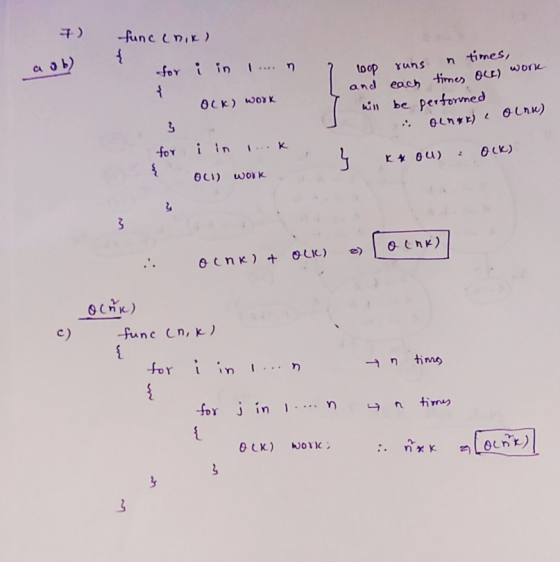
7) Given the following pseudocode outline: funcin, k) foriin I..n ...e(k) work for i in1.k ...(k)...
Question 1 (25 pts) Find the running time complexity for the following code fragments. Express yo...
 Question 1 (25 pts)
Find the running time complexity for the following code
fragments. Express your answers using either the Big-O or Big-Θ
notations, and the tightest bound possible. Justify your
answers.
for(int count O , i -0; i < n* n; i++) for(int i0 ; j <i; j++) count++
for(int count O , i -0; i
Question 1 (25 pts)
Find the running time complexity for the following code
fragments. Express your answers using either the Big-O or Big-Θ
notations, and the tightest bound possible. Justify your
answers.
for(int count O , i -0; i < n* n; i++) for(int i0 ; j <i; j++) count++
for(int count O , i -0; i
Let A be an array containing n numbers (positive and negative). Develop a divide and conquer algo...
 need help in this algorithm question
Let A be an array containing n numbers (positive and negative). Develop a divide and conquer algorithm that finds the two indices 1 sisjsn such that A[k] (the sum of the elements from i to j) is maximized. For example, in the array A [10,-5,-6,5, 7,-2,4, -11], the sub-array A[4:6] has the sum 5+ 7-2+4-14 and no other sub-array contains elements that sum to a value greater than 14, so for this input the...
need help in this algorithm question
Let A be an array containing n numbers (positive and negative). Develop a divide and conquer algorithm that finds the two indices 1 sisjsn such that A[k] (the sum of the elements from i to j) is maximized. For example, in the array A [10,-5,-6,5, 7,-2,4, -11], the sub-array A[4:6] has the sum 5+ 7-2+4-14 and no other sub-array contains elements that sum to a value greater than 14, so for this input the...
urgent L. Consider the following pseudocode for finding binomial coefficients: Binom(n, r) Input: integers n and r Output: n choose r if r-0 or r-n thern return 1 end else return Binom(n-1, r-1) B...
 urgent
L. Consider the following pseudocode for finding binomial coefficients: Binom(n, r) Input: integers n and r Output: n choose r if r-0 or r-n thern return 1 end else return Binom(n-1, r-1) Binom(n-1, r); end running time of this algorithm. Prove your bound for the upper bound. (5 points) Rewrite the above algorithm so that it is efficient. (You have 2 choices!) Analyze the worst case time of your new algorithm. (5 points) Find the edit distance between "SPOKE...
urgent
L. Consider the following pseudocode for finding binomial coefficients: Binom(n, r) Input: integers n and r Output: n choose r if r-0 or r-n thern return 1 end else return Binom(n-1, r-1) Binom(n-1, r); end running time of this algorithm. Prove your bound for the upper bound. (5 points) Rewrite the above algorithm so that it is efficient. (You have 2 choices!) Analyze the worst case time of your new algorithm. (5 points) Find the edit distance between "SPOKE...
URGENT Question 3 25 pts ArrayMystery: Input: n: a positive integer Pseudocode: Let output be an...
 URGENT
Question 3 25 pts ArrayMystery: Input: n: a positive integer Pseudocode: Let output be an empty array For i = 1 to n j = 1 While ij <= n Addj to the end of output j - j + 1 Return output Answer the following questions about the ArrayMystery algorithm above. a) How many times will the inner while loop iterate? You should express your answer in terms of i and n, using Big-Oh notation. Briefly justify your...
URGENT
Question 3 25 pts ArrayMystery: Input: n: a positive integer Pseudocode: Let output be an empty array For i = 1 to n j = 1 While ij <= n Addj to the end of output j - j + 1 Return output Answer the following questions about the ArrayMystery algorithm above. a) How many times will the inner while loop iterate? You should express your answer in terms of i and n, using Big-Oh notation. Briefly justify your...
For each of the following problems, simplify and express your answer as Θ(nk) or Θ(nk(log n...
 For each of the following problems, simplify and express your answer as Θ(nk) or Θ(nk(log n wherever possible. If the asymptotic running time is exponential, then just give exponential lower bounds. Random(n) generates a random number between 1 and n with uniform distribution (every integer between 1 and n is equally likely.) CoinFlip) returns heads or tails with equal probability. Consider the following ution: Func5 (A, n) A is an array of inlegers 1 if (n <10 the retur (A])...
4. Big-Oh and Rune time Analysis: describe the worst case running time of the following pseudocode...
 4. Big-Oh and Rune time Analysis: describe the worst case running time of the following pseudocode functions in Big-Oh notation in terms of the variable n. howing your work is not required (although showing work may allow some partial t in the case your answer is wrong-don't spend a lot of time showing your work.). You MUST choose your answer from the following (not given in any particular order), each of which could be re-used (could be the answer for...
Part I: Pseudocode The first part of this assignment is to create pseudocode that reflects the...
Part I: Pseudocode The first part of this assignment is to create pseudocode that reflects the main elements of the logic that will drive the code. This section should not be produced using actual code. However, you should include important variables, calculations, relationships, and/or any critical components of the problem. Using the How to Write Pseudocode document for guidance, address the following: A. Analyze the given problem statement. B. Break the problem down into distinct steps of pseudocode that will...
(a) Given a graph G = (V, E) and a number k (1 ≤ k ≤...
(a) Given a graph G = (V, E) and a number k (1 ≤ k ≤ n), the CLIQUE problem asks us whether there is a set of k vertices in G that are all connected to one another. That is, each vertex in the ”clique” is connected to the other k − 1 vertices in the clique; this set of vertices is referred to as a ”k-clique.” Show that this problem is in class NP (verifiable in polynomial time)...
Consider the following pseudo-code: // Assume i, j, k are integers for i = 1 to...
Consider the following pseudo-code: // Assume i, j, k are integers for i = 1 to n do for j = n-i+1 to n { k = 1; while (k*k <= j) { perform <op>; k = k + 1; } } Find an expression for f(n), the number of times is performed. Find g(n) so that f(n) is Θ(g(n)). Prove your answer.
3. Consider the following Matlab code. s-0; clear s.norm for i 1:10000 r-rand(1); % generate a uniform random, numb...
 3. Consider the following Matlab code. s-0; clear s.norm for i 1:10000 r-rand(1); % generate a uniform random, number on [0,1] S-S+(3+rr) s.norm(i)-S/i end plot( 1:10000,s.norm) % make a plot of s.norma) versus i (5 pts) What will the plot look like? (10 pts) Will the function/vector s.norm(n) converge to something as n gets large? If so, what? If not, why not? Justify your answer. (5 pts) If we were to run this code multiple times - overlaying the plots...
 Question 1 (25 pts)
Find the running time complexity for the following code
fragments. Express your answers using either the Big-O or Big-Θ
notations, and the tightest bound possible. Justify your
answers.
for(int count O , i -0; i < n* n; i++) for(int i0 ; j <i; j++) count++
for(int count O , i -0; i
Question 1 (25 pts)
Find the running time complexity for the following code
fragments. Express your answers using either the Big-O or Big-Θ
notations, and the tightest bound possible. Justify your
answers.
for(int count O , i -0; i < n* n; i++) for(int i0 ; j <i; j++) count++
for(int count O , i -0; i
 need help in this algorithm question
Let A be an array containing n numbers (positive and negative). Develop a divide and conquer algorithm that finds the two indices 1 sisjsn such that A[k] (the sum of the elements from i to j) is maximized. For example, in the array A [10,-5,-6,5, 7,-2,4, -11], the sub-array A[4:6] has the sum 5+ 7-2+4-14 and no other sub-array contains elements that sum to a value greater than 14, so for this input the...
need help in this algorithm question
Let A be an array containing n numbers (positive and negative). Develop a divide and conquer algorithm that finds the two indices 1 sisjsn such that A[k] (the sum of the elements from i to j) is maximized. For example, in the array A [10,-5,-6,5, 7,-2,4, -11], the sub-array A[4:6] has the sum 5+ 7-2+4-14 and no other sub-array contains elements that sum to a value greater than 14, so for this input the...
 urgent
L. Consider the following pseudocode for finding binomial coefficients: Binom(n, r) Input: integers n and r Output: n choose r if r-0 or r-n thern return 1 end else return Binom(n-1, r-1) Binom(n-1, r); end running time of this algorithm. Prove your bound for the upper bound. (5 points) Rewrite the above algorithm so that it is efficient. (You have 2 choices!) Analyze the worst case time of your new algorithm. (5 points) Find the edit distance between "SPOKE...
urgent
L. Consider the following pseudocode for finding binomial coefficients: Binom(n, r) Input: integers n and r Output: n choose r if r-0 or r-n thern return 1 end else return Binom(n-1, r-1) Binom(n-1, r); end running time of this algorithm. Prove your bound for the upper bound. (5 points) Rewrite the above algorithm so that it is efficient. (You have 2 choices!) Analyze the worst case time of your new algorithm. (5 points) Find the edit distance between "SPOKE...
 URGENT
Question 3 25 pts ArrayMystery: Input: n: a positive integer Pseudocode: Let output be an empty array For i = 1 to n j = 1 While ij <= n Addj to the end of output j - j + 1 Return output Answer the following questions about the ArrayMystery algorithm above. a) How many times will the inner while loop iterate? You should express your answer in terms of i and n, using Big-Oh notation. Briefly justify your...
URGENT
Question 3 25 pts ArrayMystery: Input: n: a positive integer Pseudocode: Let output be an empty array For i = 1 to n j = 1 While ij <= n Addj to the end of output j - j + 1 Return output Answer the following questions about the ArrayMystery algorithm above. a) How many times will the inner while loop iterate? You should express your answer in terms of i and n, using Big-Oh notation. Briefly justify your...
 For each of the following problems, simplify and express your answer as Θ(nk) or Θ(nk(log n wherever possible. If the asymptotic running time is exponential, then just give exponential lower bounds. Random(n) generates a random number between 1 and n with uniform distribution (every integer between 1 and n is equally likely.) CoinFlip) returns heads or tails with equal probability. Consider the following ution: Func5 (A, n) A is an array of inlegers 1 if (n <10 the retur (A])...
 4. Big-Oh and Rune time Analysis: describe the worst case running time of the following pseudocode functions in Big-Oh notation in terms of the variable n. howing your work is not required (although showing work may allow some partial t in the case your answer is wrong-don't spend a lot of time showing your work.). You MUST choose your answer from the following (not given in any particular order), each of which could be re-used (could be the answer for...
 3. Consider the following Matlab code. s-0; clear s.norm for i 1:10000 r-rand(1); % generate a uniform random, number on [0,1] S-S+(3+rr) s.norm(i)-S/i end plot( 1:10000,s.norm) % make a plot of s.norma) versus i (5 pts) What will the plot look like? (10 pts) Will the function/vector s.norm(n) converge to something as n gets large? If so, what? If not, why not? Justify your answer. (5 pts) If we were to run this code multiple times - overlaying the plots...
Most questions answered within 3 hours.
-
Where is the error in this code sequence?
String s1 = "Hello";
String s2 = "ello";...
asked 11 months ago -
Financial data for Joel de Paris, Inc., for last year
follow:
Joel de Paris, Inc.
Balance...
asked 11 months ago -
Consider this reaction:
Al2(SO4)3 (aq)+ BaCl3
(aq) Al2Cl6 (aq)- +
3BaSO4(s) . What is the...
asked 11 months ago -
Suppose that Savneet is considering increasing her
recent random sample from 20 car rentals to 40...
asked 11 months ago -
Trucks arrive at an unloading terminal at an average rate of 120
per hour.
Trucks arrive...
asked 11 months ago -
Why are methanol and ethanol completely soluble in water while
octanol is not very little soluble....
asked 11 months ago -
A facilities manager at a university reads in a research report
that the mean amount of...
asked 11 months ago -
When the CuSO4 is rehydrated by adding water to the anhydrous
compound, is this an endothermic...
asked 11 months ago -
A ray of sunlight is passing from diamond into crown glass; the
angle of incidence is...
asked 11 months ago -
A block of mass 0.249 kg is placed on top of a light, vertical
spring of...
asked 11 months ago -
how do the kidneys compensate in the presences of acidosis
a) trigger hyperventilate
b) reserve acid...
asked 11 months ago -
Question 501 pts
The rental rate of capital to the firm increases. Which of the
following...
asked 11 months ago