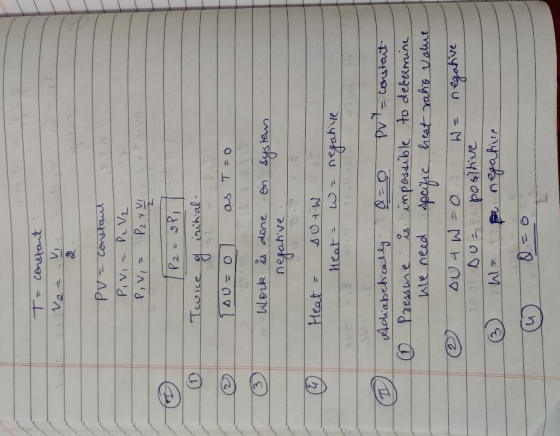
![An ideal gas is compressed isothermally to half of its initial volume. The final pressure is [Select] The change in thermal e](http://img.homeworklib.com/questions/5934b4a0-d8ad-11ea-b502-f3d6298cbc93.png?x-oss-process=image/resize,w_560)
![An ideal gas is compressed adiabatically to half of its initial volume. The final pressure is [Select] The change in thermal](http://img.homeworklib.com/questions/59b56720-d8ad-11ea-91ed-9198b0f6cd4d.png?x-oss-process=image/resize,w_560)
Answer choices for final pressure: twice the initial pressure, half the initial pressure, unchanged, impossible to determine
change in thermal energy:positive, negative, zero, impossible to determine
work for the process: positive, negative, zero
heat for the process: positive, negative, zero
Homework Answers
Add Answer to:
Answer choices for final pressure: twice the initial pressure,
half the initial pressure, unchanged, impossible to...
105Pa, initial temperature T-300K, and an initial 1. An ideal gas with initial pressure 2 volume V - 1m3 expands isothermally to a final volume of 2m3. Then, the gas returns to its initial state, fir...
 105Pa, initial temperature T-300K, and an initial 1. An ideal gas with initial pressure 2 volume V - 1m3 expands isothermally to a final volume of 2m3. Then, the gas returns to its initial state, first by constant pressure (isobaric) contraction, and then by a change at constant volume (isochoric) a) Draw a PV diagram of this process. What's the total change in thermal energy of the entire process? b) What's the work done by the environment on the gas?...
An ideal monatomic gas undergoes changes in pressure and volume, as shown in the pV diagram...
 An ideal monatomic gas undergoes changes in pressure and volume, as shown in the pV diagram below. The initial volume is 0.02 m3 and the final volume is 0.10 m3 20 10 01 (a) Calculate the magnitude, or absolute value, of the Work done on the gas in this process. (Be careful with units. Your answer should be in Joules. 1 atm 1.013x 10⁵ Pa.) (b)The work done ON the gas is: O positive O negative (c) The initial temperature...
physic 3. 2 moles of an ideal gas at 17°C has a pressure of 760mm mercury,...
 physic
3. 2 moles of an ideal gas at 17°C has a pressure of 760mm mercury, and is compressed once isothermally and then adiabatically until its volume is halved in each case reversibly and from identical initial conditions). The gas constant is 8.314J/kg. The density of the mercury is 13.60g/cm? [Express all your answers in MKS units e.g. volume in cubic meter, pressure in Pascal, Temperature in Kelvin, etc.) (a) Express the pressure of the gas in units of Pascal....
physic
3. 2 moles of an ideal gas at 17°C has a pressure of 760mm mercury, and is compressed once isothermally and then adiabatically until its volume is halved in each case reversibly and from identical initial conditions). The gas constant is 8.314J/kg. The density of the mercury is 13.60g/cm? [Express all your answers in MKS units e.g. volume in cubic meter, pressure in Pascal, Temperature in Kelvin, etc.) (a) Express the pressure of the gas in units of Pascal....
Propane is compressed from an initial state with a pressure of 100 lbf/in2 and a quality...
Propane is compressed from an initial state with a pressure of 100 lbf/in2 and a quality of 0.40 to a final saturated liquid state with a temperature is 50°F. Is it possible for this process to occur adiabatically? Justify your answer. Air is contained in a rigid, well-insulated container of volume 3 m3. The air undergoes a process from an initial state with a pressure of 200 kPa and temperature of 300 K. During the process, the air receives 720...
A gas contracts from an initial volume of 3.83 L to a final volume of 2.33L...
 A gas contracts from an initial volume of 3.83 L to a final volume of 2.33L against an external pressure of 810. mmHg. During the contraction the gas absorbs 10. J of heat. The gas is the system. Which of the following is true: Heat flows into the system from the surroundings and the sign of a sys will be positive and the sign of w sys is positive. The system is doing work on the surroundings. Need more information...
1.2 moles of ideal gas in a cylinder are compressed isothermally from an initial pressure of...
1.2 moles of ideal gas in a cylinder are compressed isothermally from an initial pressure of 120 kPa and a volume of 0.025 m3 to a final volume of 0.004 m3. Calculate the temperature and the final pressure of the gas; and also estimate the work done on the gas.
An ideal gas is allowed to expand isothermally until it reaches its final volume. It is...
 An ideal gas is allowed to expand isothermally until it reaches its final volume. It is then heated at constant volume until it reaches its final pressure. The initial state of the gas is P1 = 2.93 atm, V1 = 1.00 L, and Eint 1 = 414 J, and its final state has volume V2 = 2.93 L and Eint 2 = 951 J. 1) Calculate the work done by the gas. Be careful with signs: if the work you...
In an engine, an almost ideal gas is compressed adiabatically (see Note below) to half its...
In an engine, an almost ideal gas is compressed adiabatically (see Note below) to half its volume. In doing so, 2630 Joules of work is done on the gas. (a) How much heat flows into or out of the gas? (b) What is the change in internal energy of the gas? (c) Does its temperature rise or fall? Note: An adiabatic process is one that occurs without transfer of heat or matter between a thermodynamic system and its surroundings. In...
Five moles of the monatomic gas argon expand isothermally at 302 K from an initial volume...
Five moles of the monatomic gas argon expand isothermally at 302 K from an initial volume of 0.020 m3 to a final volume of 0.050m3. Assuming that argon is an ideal gas, find (a) the work done by the gas, (b) the change in internal energy of the gas, and (c) the heat supplied to the gas. Four mole of gas at temperature 320 K expands isothermally from an initial volume of 1.5 L to 7 L. (a) What is...
4. (25pts) 20L nitrogen gas is compressed in a tank at 10 bar and 25°C. Calculate the maximum work (in joules) that can be obtained when the gas is allowed to expand reversibly to a pressure of 1...
 4. (25pts) 20L nitrogen gas is compressed in a tank at 10 bar and 25°C. Calculate the maximum work (in joules) that can be obtained when the gas is allowed to expand reversibly to a pressure of 1 bar; (a) (10pts) isothermally (b) (15pts) adiabatically The molar heat apacity of nitrogen at constant volume is 20.8 J/K mol. Assume that nitrogen behaves as an ideal gas
4. (25pts) 20L nitrogen gas is compressed in a tank at 10 bar and...
4. (25pts) 20L nitrogen gas is compressed in a tank at 10 bar and 25°C. Calculate the maximum work (in joules) that can be obtained when the gas is allowed to expand reversibly to a pressure of 1 bar; (a) (10pts) isothermally (b) (15pts) adiabatically The molar heat apacity of nitrogen at constant volume is 20.8 J/K mol. Assume that nitrogen behaves as an ideal gas
4. (25pts) 20L nitrogen gas is compressed in a tank at 10 bar and...
 105Pa, initial temperature T-300K, and an initial 1. An ideal gas with initial pressure 2 volume V - 1m3 expands isothermally to a final volume of 2m3. Then, the gas returns to its initial state, first by constant pressure (isobaric) contraction, and then by a change at constant volume (isochoric) a) Draw a PV diagram of this process. What's the total change in thermal energy of the entire process? b) What's the work done by the environment on the gas?...
 An ideal monatomic gas undergoes changes in pressure and volume, as shown in the pV diagram below. The initial volume is 0.02 m3 and the final volume is 0.10 m3 20 10 01 (a) Calculate the magnitude, or absolute value, of the Work done on the gas in this process. (Be careful with units. Your answer should be in Joules. 1 atm 1.013x 10⁵ Pa.) (b)The work done ON the gas is: O positive O negative (c) The initial temperature...
 physic
3. 2 moles of an ideal gas at 17°C has a pressure of 760mm mercury, and is compressed once isothermally and then adiabatically until its volume is halved in each case reversibly and from identical initial conditions). The gas constant is 8.314J/kg. The density of the mercury is 13.60g/cm? [Express all your answers in MKS units e.g. volume in cubic meter, pressure in Pascal, Temperature in Kelvin, etc.) (a) Express the pressure of the gas in units of Pascal....
physic
3. 2 moles of an ideal gas at 17°C has a pressure of 760mm mercury, and is compressed once isothermally and then adiabatically until its volume is halved in each case reversibly and from identical initial conditions). The gas constant is 8.314J/kg. The density of the mercury is 13.60g/cm? [Express all your answers in MKS units e.g. volume in cubic meter, pressure in Pascal, Temperature in Kelvin, etc.) (a) Express the pressure of the gas in units of Pascal....
 A gas contracts from an initial volume of 3.83 L to a final volume of 2.33L against an external pressure of 810. mmHg. During the contraction the gas absorbs 10. J of heat. The gas is the system. Which of the following is true: Heat flows into the system from the surroundings and the sign of a sys will be positive and the sign of w sys is positive. The system is doing work on the surroundings. Need more information...
 An ideal gas is allowed to expand isothermally until it reaches its final volume. It is then heated at constant volume until it reaches its final pressure. The initial state of the gas is P1 = 2.93 atm, V1 = 1.00 L, and Eint 1 = 414 J, and its final state has volume V2 = 2.93 L and Eint 2 = 951 J. 1) Calculate the work done by the gas. Be careful with signs: if the work you...
 4. (25pts) 20L nitrogen gas is compressed in a tank at 10 bar and 25°C. Calculate the maximum work (in joules) that can be obtained when the gas is allowed to expand reversibly to a pressure of 1 bar; (a) (10pts) isothermally (b) (15pts) adiabatically The molar heat apacity of nitrogen at constant volume is 20.8 J/K mol. Assume that nitrogen behaves as an ideal gas
4. (25pts) 20L nitrogen gas is compressed in a tank at 10 bar and...
4. (25pts) 20L nitrogen gas is compressed in a tank at 10 bar and 25°C. Calculate the maximum work (in joules) that can be obtained when the gas is allowed to expand reversibly to a pressure of 1 bar; (a) (10pts) isothermally (b) (15pts) adiabatically The molar heat apacity of nitrogen at constant volume is 20.8 J/K mol. Assume that nitrogen behaves as an ideal gas
4. (25pts) 20L nitrogen gas is compressed in a tank at 10 bar and...
Most questions answered within 3 hours.
-
Where is the error in this code sequence?
String s1 = "Hello";
String s2 = "ello";...
asked 10 months ago -
Financial data for Joel de Paris, Inc., for last year
follow:
Joel de Paris, Inc.
Balance...
asked 10 months ago -
Consider this reaction:
Al2(SO4)3 (aq)+ BaCl3
(aq) Al2Cl6 (aq)- +
3BaSO4(s) . What is the...
asked 10 months ago -
Suppose that Savneet is considering increasing her
recent random sample from 20 car rentals to 40...
asked 10 months ago -
Trucks arrive at an unloading terminal at an average rate of 120
per hour.
Trucks arrive...
asked 10 months ago -
Why are methanol and ethanol completely soluble in water while
octanol is not very little soluble....
asked 10 months ago -
A facilities manager at a university reads in a research report
that the mean amount of...
asked 10 months ago -
When the CuSO4 is rehydrated by adding water to the anhydrous
compound, is this an endothermic...
asked 10 months ago -
A ray of sunlight is passing from diamond into crown glass; the
angle of incidence is...
asked 10 months ago -
A block of mass 0.249 kg is placed on top of a light, vertical
spring of...
asked 10 months ago -
how do the kidneys compensate in the presences of acidosis
a) trigger hyperventilate
b) reserve acid...
asked 10 months ago -
Question 501 pts
The rental rate of capital to the firm increases. Which of the
following...
asked 10 months ago