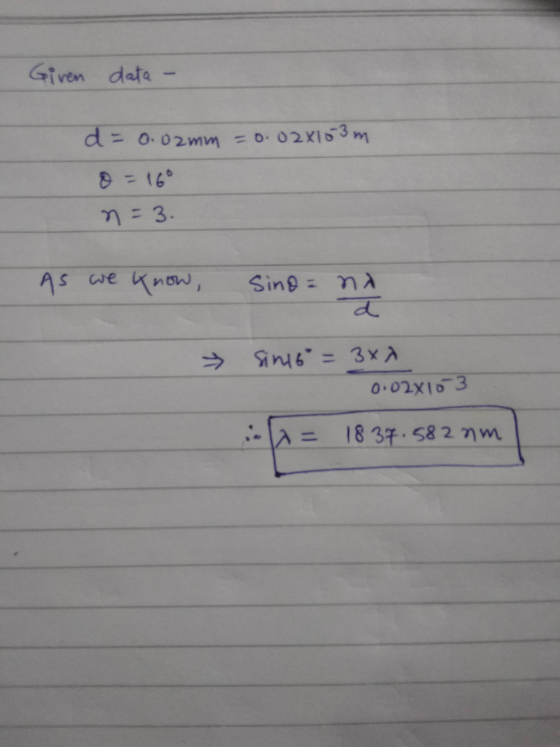
Suppose you pass light from a laser through two slits separated by 0.02 mm and find...
- Suppose you pass light from a laser through two slits separated by 0.02 mm and find that the third bright line on a screen is formed at an angle of 16º relative to the incident beam. What is the wavelength of the light?
Homework Answers
Add Answer to:
Suppose you pass light from a laser through two slits separated
by 0.02 mm and find...
4. Light from a green laser pointer shines through two small slits separated by 0.01200 mm....
 4. Light from a green laser pointer shines through two small slits separated by 0.01200 mm. The third bright line is formed on a screen at an angle of 7.64°. (a) What is the wavelength of the light? (b) What is the highest order constructive interference possible? [No picture required]
A laser beam is incident on two slits with a separation of 0.195 mm, and a...
A laser beam is incident on two slits with a separation of 0.195 mm, and a screen is placed 5.15 m from the slits. If the bright interference fringes on the screen are separated by 1.60 cm, what is the wavelength of the laser light? nm
A laser beam is incident on two slits with a separation of 0.230 mm, and a...
 A laser beam is incident on two slits with a separation of 0.230 mm, and a screen is placed 4.90 m from the slits. If the bright interference fringes on the screen are separated by 1.55 cm, what is the wavelength of the laser light? nm
A laser beam is incident on two slits with a separation of 0.180 mm, and a...
A laser beam is incident on two slits with a separation of 0.180 mm, and a screen is placed 4.90 m from the slits. If the bright interference fringes on the screen are separated by 1.57 cm, what is the wavelength of the laser light? nm
A laser beam is incident on two slits with a separation of 0.215 mm, and a...
A laser beam is incident on two slits with a separation of 0.215 mm, and a screen is placed 4.95 m from the slits. If the bright interference fringes on the screen are separated by 1.55 cm, what is the wavelength of the laser light? ___ nm
Two thin slits separated by 0.0765 mm are illuminated by light from a He-Ne laser (λ...
Two thin slits separated by 0.0765 mm are illuminated by light from a He-Ne laser (λ = 633 nm), producing interference fringes on a distant screen. Find the angle between the centers of the central bright fringe and the next bright fringe.
Two thin slits separated by 2.2 mm are illuminated by light from a He-Ne laser (λ...
Two thin slits separated by 2.2 mm are illuminated by light from a He-Ne laser (λ = 633 nm), producing interference fringes on a distant screen. Find the angle between the centers of the central bright fringe and the next bright fringe. (in degrees)
D24-01: Monochromatic light is incident on a pair of slits that are separated by 0.200 mm....
D24-01: Monochromatic light is incident on a pair of slits that are separated by 0.200 mm. The screen is 2.50 m away from the slits. a) If the distance between the central bright fringe and either of the adjacent bright fringes is 1.67 cm, find the wavelength of the incident light. b) At what angle does the next set of bright fringes appear?
1. Light of wavelength 640 nm is incident on two slits separated by 0.880 mm. An...
1. Light of wavelength 640 nm is incident on two slits separated by 0.880 mm. An interference pattern is observed on a screen 2.20 m away. a) Using the small angle approximation (tan θ sinθ), find the distance between the central maximum and the first bright fringe. b) What percent of error is made in locating of the seventh-order bright fringe if the small angle approximation is used compared to using the exact trigonometric function? c) How does the...
Light of wavelength 4.0 um passes through two slits, such that the second order bright line...
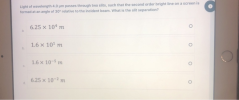 Light of wavelength 4.0 um passes through two slits, such that the second order bright line on a screen is formed at an angle of 30° relative to the incident beam. What is the slit separation? 6.25 x 10⁴ m a 1.6 x 101 m 1.6 x 10⁻⁵ m 6.25 x 10⁻² m o
 4. Light from a green laser pointer shines through two small slits separated by 0.01200 mm. The third bright line is formed on a screen at an angle of 7.64°. (a) What is the wavelength of the light? (b) What is the highest order constructive interference possible? [No picture required]
 A laser beam is incident on two slits with a separation of 0.230 mm, and a screen is placed 4.90 m from the slits. If the bright interference fringes on the screen are separated by 1.55 cm, what is the wavelength of the laser light? nm
 Light of wavelength 4.0 um passes through two slits, such that the second order bright line on a screen is formed at an angle of 30° relative to the incident beam. What is the slit separation? 6.25 x 10⁴ m a 1.6 x 101 m 1.6 x 10⁻⁵ m 6.25 x 10⁻² m o
Most questions answered within 3 hours.
-
Where is the error in this code sequence?
String s1 = "Hello";
String s2 = "ello";...
asked 10 months ago -
Financial data for Joel de Paris, Inc., for last year
follow:
Joel de Paris, Inc.
Balance...
asked 10 months ago -
Consider this reaction:
Al2(SO4)3 (aq)+ BaCl3
(aq) Al2Cl6 (aq)- +
3BaSO4(s) . What is the...
asked 10 months ago -
Suppose that Savneet is considering increasing her
recent random sample from 20 car rentals to 40...
asked 10 months ago -
Trucks arrive at an unloading terminal at an average rate of 120
per hour.
Trucks arrive...
asked 10 months ago -
Why are methanol and ethanol completely soluble in water while
octanol is not very little soluble....
asked 10 months ago -
A facilities manager at a university reads in a research report
that the mean amount of...
asked 10 months ago -
When the CuSO4 is rehydrated by adding water to the anhydrous
compound, is this an endothermic...
asked 10 months ago -
A ray of sunlight is passing from diamond into crown glass; the
angle of incidence is...
asked 10 months ago -
A block of mass 0.249 kg is placed on top of a light, vertical
spring of...
asked 10 months ago -
how do the kidneys compensate in the presences of acidosis
a) trigger hyperventilate
b) reserve acid...
asked 10 months ago -
Question 501 pts
The rental rate of capital to the firm increases. Which of the
following...
asked 10 months ago