Homework Answers
Request Answer!
We need at least 10 more requests to produce the answer.
0 / 10 have requested this problem solution
The more requests, the faster the answer.
Add Answer to:
help with calculating theoretical and percent yield? This is a
grignard reaction which converts phenyagnesium bromide...
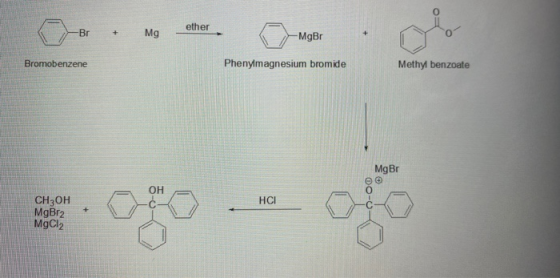
What is the theoretical yield and the percent yield of this Grignard reaction which converts phenyagnesiumbromide...
 What is the theoretical yield and the percent yield of this
Grignard reaction which converts phenyagnesiumbromide into
triphenylmethanol?
actual yield of final product is 0.00958grams
also would the limiting reagent be magnesium??
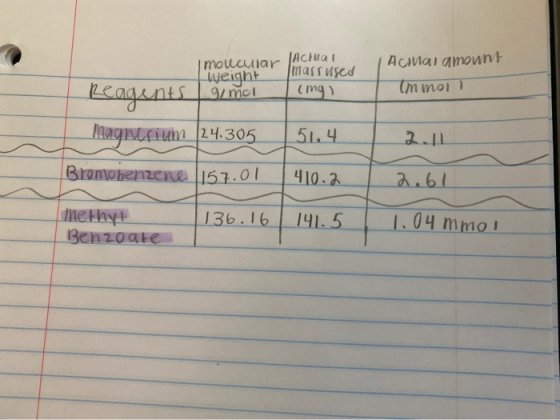
Reagent Amountured maghlesinm 51.4 mg Bromo benzene 4.10.2 2 mg methyl benzoatel 141.5 mg
What is the theoretical yield and the percent yield of this
Grignard reaction which converts phenyagnesiumbromide into
triphenylmethanol?
actual yield of final product is 0.00958grams
also would the limiting reagent be magnesium??
Reagent Amountured maghlesinm 51.4 mg Bromo benzene 4.10.2 2 mg methyl benzoatel 141.5 mg
Preparation of Triphenylmethanol Using the Grignard Reaction. RH ROOH CO TO R-R MgBr 1.ether 2.11-SO/10 Icther...
 Preparation of Triphenylmethanol Using the Grignard Reaction.
RH ROOH CO TO R-R MgBr 1.ether 2.11-SO/10 Icther Grignard reagents are highly reactive and can undergo undesirable RCOH TH₂O side reactions if impurities such as water, carbon dioxide, or oxygen are present. If the organohalogen is added to the R-Mg-X magnesium too quickly, undesired coupling reactions can also occur. In this experiment, you will use 0.015 moles of either benzophenone or ethyl benzoate as the recipient of the phenylmagnesium bromide and this...
Preparation of Triphenylmethanol Using the Grignard Reaction.
RH ROOH CO TO R-R MgBr 1.ether 2.11-SO/10 Icther Grignard reagents are highly reactive and can undergo undesirable RCOH TH₂O side reactions if impurities such as water, carbon dioxide, or oxygen are present. If the organohalogen is added to the R-Mg-X magnesium too quickly, undesired coupling reactions can also occur. In this experiment, you will use 0.015 moles of either benzophenone or ethyl benzoate as the recipient of the phenylmagnesium bromide and this...
Grignard reagent THE GRIGNARD REAGENT-PREPARATION AND REACTION In this experiment, you will prepa...
 i need help with the postlab questions please
Grignard reagent THE GRIGNARD REAGENT-PREPARATION AND REACTION In this experiment, you will prepare a Grignard reagent, phenyl magnesium bromide, from bromobenzene and magnesium metal. The Grignard reagent will then react with methyl benzoate to form triphenylmethanol. Introduction Grignard reagents, such as organomagnesium halides, were discovered in 1910 by French chemist Victor Grignard. The Grignard reaction is one of the most general methods for carbon- carbon bond formation in all of organic chemistry....
i need help with the postlab questions please
Grignard reagent THE GRIGNARD REAGENT-PREPARATION AND REACTION In this experiment, you will prepare a Grignard reagent, phenyl magnesium bromide, from bromobenzene and magnesium metal. The Grignard reagent will then react with methyl benzoate to form triphenylmethanol. Introduction Grignard reagents, such as organomagnesium halides, were discovered in 1910 by French chemist Victor Grignard. The Grignard reaction is one of the most general methods for carbon- carbon bond formation in all of organic chemistry....
Grignard reagent THE GRIGNARD REAGENT-PREPARATION AND REACTION In this experiment, you will prepa...
 i need help with the prelab questions please
Grignard reagent THE GRIGNARD REAGENT-PREPARATION AND REACTION In this experiment, you will prepare a Grignard reagent, phenyl magnesium bromide, from bromobenzene and magnesium metal. The Grignard reagent will then react with methyl benzoate to form triphenylmethanol. Introduction Grignard reagents, such as organomagnesium halides, were discovered in 1910 by French chemist Victor Grignard. The Grignard reaction is one of the most general methods for carbon- carbon bond formation in all of organic chemistry....
i need help with the prelab questions please
Grignard reagent THE GRIGNARD REAGENT-PREPARATION AND REACTION In this experiment, you will prepare a Grignard reagent, phenyl magnesium bromide, from bromobenzene and magnesium metal. The Grignard reagent will then react with methyl benzoate to form triphenylmethanol. Introduction Grignard reagents, such as organomagnesium halides, were discovered in 1910 by French chemist Victor Grignard. The Grignard reaction is one of the most general methods for carbon- carbon bond formation in all of organic chemistry....
What is the theoretical yield (in grams) and percent yield of your triphenylmethanol product in this...
 What is the theoretical yield (in grams) and percent yield of your
triphenylmethanol product in this experiment? (Weight of
triphenylmethanol: 0.060g)
BACKGROUND AND THEORY The Grignard reaction was one of the first organometallic reactions discovered and is still one of the most useful synthetically. By reacting an organohalide (usually a bromide) with magnesium in ethereal solvent, carbon becomes a nucleophile. Grignard reagents are the starting points for the syntheses of many alkanes, primary, secondary, and tertiary alcohols, alkenes, and carboxylic...
What is the theoretical yield (in grams) and percent yield of your
triphenylmethanol product in this experiment? (Weight of
triphenylmethanol: 0.060g)
BACKGROUND AND THEORY The Grignard reaction was one of the first organometallic reactions discovered and is still one of the most useful synthetically. By reacting an organohalide (usually a bromide) with magnesium in ethereal solvent, carbon becomes a nucleophile. Grignard reagents are the starting points for the syntheses of many alkanes, primary, secondary, and tertiary alcohols, alkenes, and carboxylic...
Could you help with #2,4,3,6, please 1. Define the term "Nucleophile" and explain how a Grignard...
 Could you help with #2,4,3,6, please
1. Define the term "Nucleophile" and explain how a Grignard reagent acts as a nucleophile. Briefly explain using a chemical equation, why it is necessary to use dry apparatus and reagents during the synthesis of C6H5MgBr. phenylmagnesium bromide. 3. By referring to a textbook, write a mechanism for the reaction between phenylmagnesium bromide and the ketone butanone. In a reaction of phenylmagnesium bromide with butanone the Grignard reagent was prepared from 25 g of...
Could you help with #2,4,3,6, please
1. Define the term "Nucleophile" and explain how a Grignard reagent acts as a nucleophile. Briefly explain using a chemical equation, why it is necessary to use dry apparatus and reagents during the synthesis of C6H5MgBr. phenylmagnesium bromide. 3. By referring to a textbook, write a mechanism for the reaction between phenylmagnesium bromide and the ketone butanone. In a reaction of phenylmagnesium bromide with butanone the Grignard reagent was prepared from 25 g of...
Draw an arrow pushing mechanism and find the theoretical yield for the Grignard reaction below using...
 Draw an arrow pushing mechanism and find the theoretical yield
for the Grignard reaction below using the following amounts of
reagent with the given molecular weights:
565 microliters of 2-bromopropane (molecular weight =
123g/mol)
304 microliters of 4-methoxybenzaldehyde (molecular weight =
136.15g/mol)
molecular weight of product = 180.27g/mol
The
limiting reagent is _____________.
In this experiment, you will prepare the Grignard reagent isopropyl-magnesium bromide from 2-bromopropane. You will allow this Grignard reagent to react with 4-methoxy-benzaldehyde to form a secondary...
Draw an arrow pushing mechanism and find the theoretical yield
for the Grignard reaction below using the following amounts of
reagent with the given molecular weights:
565 microliters of 2-bromopropane (molecular weight =
123g/mol)
304 microliters of 4-methoxybenzaldehyde (molecular weight =
136.15g/mol)
molecular weight of product = 180.27g/mol
The
limiting reagent is _____________.
In this experiment, you will prepare the Grignard reagent isopropyl-magnesium bromide from 2-bromopropane. You will allow this Grignard reagent to react with 4-methoxy-benzaldehyde to form a secondary...
I need help finding the theoretical yield (in grams) of triphenyl methanol product in this experiment....
 I need help finding the theoretical yield (in grams) of
triphenyl methanol product in this experiment. PLEASE SHOW WORK, I
would like to learn the steps.
below is pictures of the procedure with amounts of chemicals
used
126 Experiment 10 EXPERIMENTAL PROCEDURE All glassware used in a Grignard reaction must be scrupulously dried, Dry the following glasstare in an af 110°C for at last 20 mini drying to Canadair 8 ml comical rial 5 ml con vial, air cond glass...
I need help finding the theoretical yield (in grams) of
triphenyl methanol product in this experiment. PLEASE SHOW WORK, I
would like to learn the steps.
below is pictures of the procedure with amounts of chemicals
used
126 Experiment 10 EXPERIMENTAL PROCEDURE All glassware used in a Grignard reaction must be scrupulously dried, Dry the following glasstare in an af 110°C for at last 20 mini drying to Canadair 8 ml comical rial 5 ml con vial, air cond glass...
 What is the theoretical yield and the percent yield of this
Grignard reaction which converts phenyagnesiumbromide into
triphenylmethanol?
actual yield of final product is 0.00958grams
also would the limiting reagent be magnesium??
Reagent Amountured maghlesinm 51.4 mg Bromo benzene 4.10.2 2 mg methyl benzoatel 141.5 mg
What is the theoretical yield and the percent yield of this
Grignard reaction which converts phenyagnesiumbromide into
triphenylmethanol?
actual yield of final product is 0.00958grams
also would the limiting reagent be magnesium??
Reagent Amountured maghlesinm 51.4 mg Bromo benzene 4.10.2 2 mg methyl benzoatel 141.5 mg
 Preparation of Triphenylmethanol Using the Grignard Reaction.
RH ROOH CO TO R-R MgBr 1.ether 2.11-SO/10 Icther Grignard reagents are highly reactive and can undergo undesirable RCOH TH₂O side reactions if impurities such as water, carbon dioxide, or oxygen are present. If the organohalogen is added to the R-Mg-X magnesium too quickly, undesired coupling reactions can also occur. In this experiment, you will use 0.015 moles of either benzophenone or ethyl benzoate as the recipient of the phenylmagnesium bromide and this...
Preparation of Triphenylmethanol Using the Grignard Reaction.
RH ROOH CO TO R-R MgBr 1.ether 2.11-SO/10 Icther Grignard reagents are highly reactive and can undergo undesirable RCOH TH₂O side reactions if impurities such as water, carbon dioxide, or oxygen are present. If the organohalogen is added to the R-Mg-X magnesium too quickly, undesired coupling reactions can also occur. In this experiment, you will use 0.015 moles of either benzophenone or ethyl benzoate as the recipient of the phenylmagnesium bromide and this...
 i need help with the postlab questions please
Grignard reagent THE GRIGNARD REAGENT-PREPARATION AND REACTION In this experiment, you will prepare a Grignard reagent, phenyl magnesium bromide, from bromobenzene and magnesium metal. The Grignard reagent will then react with methyl benzoate to form triphenylmethanol. Introduction Grignard reagents, such as organomagnesium halides, were discovered in 1910 by French chemist Victor Grignard. The Grignard reaction is one of the most general methods for carbon- carbon bond formation in all of organic chemistry....
i need help with the postlab questions please
Grignard reagent THE GRIGNARD REAGENT-PREPARATION AND REACTION In this experiment, you will prepare a Grignard reagent, phenyl magnesium bromide, from bromobenzene and magnesium metal. The Grignard reagent will then react with methyl benzoate to form triphenylmethanol. Introduction Grignard reagents, such as organomagnesium halides, were discovered in 1910 by French chemist Victor Grignard. The Grignard reaction is one of the most general methods for carbon- carbon bond formation in all of organic chemistry....
 i need help with the prelab questions please
Grignard reagent THE GRIGNARD REAGENT-PREPARATION AND REACTION In this experiment, you will prepare a Grignard reagent, phenyl magnesium bromide, from bromobenzene and magnesium metal. The Grignard reagent will then react with methyl benzoate to form triphenylmethanol. Introduction Grignard reagents, such as organomagnesium halides, were discovered in 1910 by French chemist Victor Grignard. The Grignard reaction is one of the most general methods for carbon- carbon bond formation in all of organic chemistry....
i need help with the prelab questions please
Grignard reagent THE GRIGNARD REAGENT-PREPARATION AND REACTION In this experiment, you will prepare a Grignard reagent, phenyl magnesium bromide, from bromobenzene and magnesium metal. The Grignard reagent will then react with methyl benzoate to form triphenylmethanol. Introduction Grignard reagents, such as organomagnesium halides, were discovered in 1910 by French chemist Victor Grignard. The Grignard reaction is one of the most general methods for carbon- carbon bond formation in all of organic chemistry....
 What is the theoretical yield (in grams) and percent yield of your
triphenylmethanol product in this experiment? (Weight of
triphenylmethanol: 0.060g)
BACKGROUND AND THEORY The Grignard reaction was one of the first organometallic reactions discovered and is still one of the most useful synthetically. By reacting an organohalide (usually a bromide) with magnesium in ethereal solvent, carbon becomes a nucleophile. Grignard reagents are the starting points for the syntheses of many alkanes, primary, secondary, and tertiary alcohols, alkenes, and carboxylic...
What is the theoretical yield (in grams) and percent yield of your
triphenylmethanol product in this experiment? (Weight of
triphenylmethanol: 0.060g)
BACKGROUND AND THEORY The Grignard reaction was one of the first organometallic reactions discovered and is still one of the most useful synthetically. By reacting an organohalide (usually a bromide) with magnesium in ethereal solvent, carbon becomes a nucleophile. Grignard reagents are the starting points for the syntheses of many alkanes, primary, secondary, and tertiary alcohols, alkenes, and carboxylic...
 Could you help with #2,4,3,6, please
1. Define the term "Nucleophile" and explain how a Grignard reagent acts as a nucleophile. Briefly explain using a chemical equation, why it is necessary to use dry apparatus and reagents during the synthesis of C6H5MgBr. phenylmagnesium bromide. 3. By referring to a textbook, write a mechanism for the reaction between phenylmagnesium bromide and the ketone butanone. In a reaction of phenylmagnesium bromide with butanone the Grignard reagent was prepared from 25 g of...
Could you help with #2,4,3,6, please
1. Define the term "Nucleophile" and explain how a Grignard reagent acts as a nucleophile. Briefly explain using a chemical equation, why it is necessary to use dry apparatus and reagents during the synthesis of C6H5MgBr. phenylmagnesium bromide. 3. By referring to a textbook, write a mechanism for the reaction between phenylmagnesium bromide and the ketone butanone. In a reaction of phenylmagnesium bromide with butanone the Grignard reagent was prepared from 25 g of...
 Draw an arrow pushing mechanism and find the theoretical yield
for the Grignard reaction below using the following amounts of
reagent with the given molecular weights:
565 microliters of 2-bromopropane (molecular weight =
123g/mol)
304 microliters of 4-methoxybenzaldehyde (molecular weight =
136.15g/mol)
molecular weight of product = 180.27g/mol
The
limiting reagent is _____________.
In this experiment, you will prepare the Grignard reagent isopropyl-magnesium bromide from 2-bromopropane. You will allow this Grignard reagent to react with 4-methoxy-benzaldehyde to form a secondary...
Draw an arrow pushing mechanism and find the theoretical yield
for the Grignard reaction below using the following amounts of
reagent with the given molecular weights:
565 microliters of 2-bromopropane (molecular weight =
123g/mol)
304 microliters of 4-methoxybenzaldehyde (molecular weight =
136.15g/mol)
molecular weight of product = 180.27g/mol
The
limiting reagent is _____________.
In this experiment, you will prepare the Grignard reagent isopropyl-magnesium bromide from 2-bromopropane. You will allow this Grignard reagent to react with 4-methoxy-benzaldehyde to form a secondary...
 I need help finding the theoretical yield (in grams) of
triphenyl methanol product in this experiment. PLEASE SHOW WORK, I
would like to learn the steps.
below is pictures of the procedure with amounts of chemicals
used
126 Experiment 10 EXPERIMENTAL PROCEDURE All glassware used in a Grignard reaction must be scrupulously dried, Dry the following glasstare in an af 110°C for at last 20 mini drying to Canadair 8 ml comical rial 5 ml con vial, air cond glass...
I need help finding the theoretical yield (in grams) of
triphenyl methanol product in this experiment. PLEASE SHOW WORK, I
would like to learn the steps.
below is pictures of the procedure with amounts of chemicals
used
126 Experiment 10 EXPERIMENTAL PROCEDURE All glassware used in a Grignard reaction must be scrupulously dried, Dry the following glasstare in an af 110°C for at last 20 mini drying to Canadair 8 ml comical rial 5 ml con vial, air cond glass...
Most questions answered within 3 hours.
-
Where is the error in this code sequence?
String s1 = "Hello";
String s2 = "ello";...
asked 10 months ago -
Financial data for Joel de Paris, Inc., for last year
follow:
Joel de Paris, Inc.
Balance...
asked 10 months ago -
Consider this reaction:
Al2(SO4)3 (aq)+ BaCl3
(aq) Al2Cl6 (aq)- +
3BaSO4(s) . What is the...
asked 10 months ago -
Suppose that Savneet is considering increasing her
recent random sample from 20 car rentals to 40...
asked 10 months ago -
Trucks arrive at an unloading terminal at an average rate of 120
per hour.
Trucks arrive...
asked 10 months ago -
Why are methanol and ethanol completely soluble in water while
octanol is not very little soluble....
asked 10 months ago -
A facilities manager at a university reads in a research report
that the mean amount of...
asked 10 months ago -
When the CuSO4 is rehydrated by adding water to the anhydrous
compound, is this an endothermic...
asked 10 months ago -
A ray of sunlight is passing from diamond into crown glass; the
angle of incidence is...
asked 10 months ago -
A block of mass 0.249 kg is placed on top of a light, vertical
spring of...
asked 10 months ago -
how do the kidneys compensate in the presences of acidosis
a) trigger hyperventilate
b) reserve acid...
asked 10 months ago -
Question 501 pts
The rental rate of capital to the firm increases. Which of the
following...
asked 10 months ago