Which gas phase equilibrium is least affected by changing the volume of its container? A. a)...
Which gas phase equilibrium is least affected by changing the volume of its container?
- A. a) 2NO2 ⇌ N2O4
- B. b) S3O9 ⇌ 3SO3
- C. c) 2BrCl ⇌ Br2 + Cl2
- D. d) ClF5 ⇌ ClF3 + Cl2
- E. e) none of these
Homework Answers
Request Answer!
We need at least 10 more requests to produce the answer.
0 / 10 have requested this problem solution
The more requests, the faster the answer.
Add Answer to:
Which gas phase equilibrium is least affected by changing the
volume of its container?
A. a)...
1. The following gas phase equilibrium is established in a 2.0 L container: 2 C120 (g)...
 1. The following gas phase equilibrium is established in a 2.0 L container: 2 C120 (g) 2 Cl2 (g) + O2(g) AH = - 161 kJ/mole State the direction the equilibrium will shift when the following changes (stresses) are made. Shift (right, left, or no shift) a) Increase [Cl20] b) Increase partial pressure of 02 c) Decrease the concentration of Cl2 d) Decrease the volume of the container to 1.0L e) Increase the temperature (no change in P) f) Add...
A Which one of the following will change the value of an equilibrium constant? a) Varying the initial concentrations of...
 A Which one of the following will change the value of an equilibrium constant? a) Varying the initial concentrations of reactants b) Varying the initial concentration of products c) Changing the volume of the reaction vessel d) Changing temperature e All of the above 5) The equililbrium constant for the gas phase reaction N2(g)+3H2(g) 2NH,(g) is Keg 4.34 x 10 at 300°C. At equilibrium a) products predominate b) only products are present reactants predominate d) only reactants are present roughly...
5. An ideal gas is confined to a container whose volume is fixed. If the container...
 5. An ideal gas is confined to a container whose volume is fixed. If the container holds n moles of gas, by what factor will the pressure increase if the absolute temperature is increased by a factor of 2? (A) 2/(nR) (B) 2 (C) 2nR (D) 2/n (E) 2/R 6. Two large glass containers of equal volume each hold 1 mole of gas. Container 1 is filled with hydrogen gas (2 g/mol), and Container 2 holds helium (4 g/mol). If...
The mechanism for the gas-phase reaction 2NO + Cl2 → 2NOCl is suggested to be: (1)...
The mechanism for the gas-phase reaction 2NO + Cl2 → 2NOCl is suggested to be: (1) NO + NO → N2O4 (slow) (2) N2O4 + Cl2 → 2NOCl (fast) Based on this mechanism, the rate law for the overall reaction is: Select one: a. Rate = k [NO] b. Rate = k [NO]2 c. Rate = k [NO2]2[Cl2] d. Rate = k [Cl2]
At 400 K, the equilibrium constant for the reaction Br2 (g) + Cl2 (g) <=> 2BrCl...
At 400 K, the equilibrium constant for the reaction Br2 (g) + Cl2 (g) <=> 2BrCl (g) is Kp = 7.0. A closed vessel at 400 K is charged with 1.00 atm of Br2 (g), 1.00 atm of Cl2 (g), and 2.00 atm of BrCl (g). What is the equilibrium pressure of Br2? A. 0.86 atm B. The equilibrium partial pressures of Br2 will be the same as the initial value. C. The equilibrium partial pressure of Br2 will be...
23) At 400 K, the equilibrium constant for the reaction Br2(g) + Cl2 (9) 2BrCl (9)...
 23) At 400 K, the equilibrium constant for the reaction Br2(g) + Cl2 (9) 2BrCl (9) is Kp = 70. A closed vessel at 400 K is charged with 1.00 atm of Br2 (g) 1.00 atm of Cl2 (g), and 2.00 alm of BrCl (g). Use Q to determine which of the statements below is true. A) At equilibrium, the total pressure in the vessel will be less than the initial total pressure. B) The equilibrium partial pressures of Br2....
0.200 moles N2O4 were placed in a 2.00-L container, and at certain temperature the equilibrium set...
0.200 moles N2O4 were placed in a 2.00-L container, and at certain temperature the equilibrium set up with N2O4 measured at 0.0090 M: N2O4(g) 2 NO2(g) (a) Calculate the amount (in grams) of NO2 at equilibrium. (b) Calculate the percent of the initial N2O4 dissociated into nitrogen dioxide. (c) Determine Kc for the above rxn at that temperature. (Use ICE table) d) If after the equilibrium set up, the system was compressed to one half of its initial volume,...
At 400K, the equilibrium constant for the reaction Br2(g) + Cl2(g) ⇌ 2BrCl(g) is KP =...
At 400K, the equilibrium constant for the reaction Br2(g) + Cl2(g) ⇌ 2BrCl(g) is KP = 7.0. A closed vessel at 400K is charged with 1.00 atm of Br2(g), 1.00 atm of Cl2(g), and 2.00 atm of BrCl(g). Use Q to determine which of the statements below is true. A. The equilibrium partial pressure of BrCl(g) will be less than 2.00 atm B. The reaction will go to completion since there are equal amounts of Br2 and Cl2 C. At...
Answer and reason please! 7. When a liquid is in dynamic equilibrium with its vapor in...
 Answer and reason please!
7. When a liquid is in dynamic equilibrium with its vapor in a closed container: (a) the rate at which molecules from the liquid phase enter the gas phase exactly equals the rate at which molecules from the gas phase pass into the liquid phase. (b) a change in temperature will not change the pressure in the container (c) the amount of gas in the container must exactly equal the amount of liquid. (d) molecules cannot...
Answer and reason please!
7. When a liquid is in dynamic equilibrium with its vapor in a closed container: (a) the rate at which molecules from the liquid phase enter the gas phase exactly equals the rate at which molecules from the gas phase pass into the liquid phase. (b) a change in temperature will not change the pressure in the container (c) the amount of gas in the container must exactly equal the amount of liquid. (d) molecules cannot...
Problem 1: An ideal gas fills a container. A membrane is broken which allows the gas...
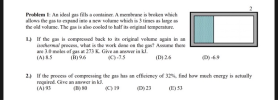 Problem 1: An ideal gas fills a container. A membrane is broken which allows the gas to expand into a new volume which is 3 times as large as the old volume. The gas is also cooled to half its original temperature. 1.) If the gas is compressed back to its original volume again in an isothermal process, what is the work done on the gas? Assume there are 3.0 moles of gas at 273 K. Give an answer in...
 1. The following gas phase equilibrium is established in a 2.0 L container: 2 C120 (g) 2 Cl2 (g) + O2(g) AH = - 161 kJ/mole State the direction the equilibrium will shift when the following changes (stresses) are made. Shift (right, left, or no shift) a) Increase [Cl20] b) Increase partial pressure of 02 c) Decrease the concentration of Cl2 d) Decrease the volume of the container to 1.0L e) Increase the temperature (no change in P) f) Add...
 A Which one of the following will change the value of an equilibrium constant? a) Varying the initial concentrations of reactants b) Varying the initial concentration of products c) Changing the volume of the reaction vessel d) Changing temperature e All of the above 5) The equililbrium constant for the gas phase reaction N2(g)+3H2(g) 2NH,(g) is Keg 4.34 x 10 at 300°C. At equilibrium a) products predominate b) only products are present reactants predominate d) only reactants are present roughly...
 5. An ideal gas is confined to a container whose volume is fixed. If the container holds n moles of gas, by what factor will the pressure increase if the absolute temperature is increased by a factor of 2? (A) 2/(nR) (B) 2 (C) 2nR (D) 2/n (E) 2/R 6. Two large glass containers of equal volume each hold 1 mole of gas. Container 1 is filled with hydrogen gas (2 g/mol), and Container 2 holds helium (4 g/mol). If...
 23) At 400 K, the equilibrium constant for the reaction Br2(g) + Cl2 (9) 2BrCl (9) is Kp = 70. A closed vessel at 400 K is charged with 1.00 atm of Br2 (g) 1.00 atm of Cl2 (g), and 2.00 alm of BrCl (g). Use Q to determine which of the statements below is true. A) At equilibrium, the total pressure in the vessel will be less than the initial total pressure. B) The equilibrium partial pressures of Br2....
 Answer and reason please!
7. When a liquid is in dynamic equilibrium with its vapor in a closed container: (a) the rate at which molecules from the liquid phase enter the gas phase exactly equals the rate at which molecules from the gas phase pass into the liquid phase. (b) a change in temperature will not change the pressure in the container (c) the amount of gas in the container must exactly equal the amount of liquid. (d) molecules cannot...
Answer and reason please!
7. When a liquid is in dynamic equilibrium with its vapor in a closed container: (a) the rate at which molecules from the liquid phase enter the gas phase exactly equals the rate at which molecules from the gas phase pass into the liquid phase. (b) a change in temperature will not change the pressure in the container (c) the amount of gas in the container must exactly equal the amount of liquid. (d) molecules cannot...
 Problem 1: An ideal gas fills a container. A membrane is broken which allows the gas to expand into a new volume which is 3 times as large as the old volume. The gas is also cooled to half its original temperature. 1.) If the gas is compressed back to its original volume again in an isothermal process, what is the work done on the gas? Assume there are 3.0 moles of gas at 273 K. Give an answer in...
Most questions answered within 3 hours.
-
Where is the error in this code sequence?
String s1 = "Hello";
String s2 = "ello";...
asked 10 months ago -
Financial data for Joel de Paris, Inc., for last year
follow:
Joel de Paris, Inc.
Balance...
asked 10 months ago -
Consider this reaction:
Al2(SO4)3 (aq)+ BaCl3
(aq) Al2Cl6 (aq)- +
3BaSO4(s) . What is the...
asked 10 months ago -
Suppose that Savneet is considering increasing her
recent random sample from 20 car rentals to 40...
asked 10 months ago -
Trucks arrive at an unloading terminal at an average rate of 120
per hour.
Trucks arrive...
asked 10 months ago -
Why are methanol and ethanol completely soluble in water while
octanol is not very little soluble....
asked 10 months ago -
A facilities manager at a university reads in a research report
that the mean amount of...
asked 10 months ago -
When the CuSO4 is rehydrated by adding water to the anhydrous
compound, is this an endothermic...
asked 10 months ago -
A ray of sunlight is passing from diamond into crown glass; the
angle of incidence is...
asked 10 months ago -
A block of mass 0.249 kg is placed on top of a light, vertical
spring of...
asked 10 months ago -
how do the kidneys compensate in the presences of acidosis
a) trigger hyperventilate
b) reserve acid...
asked 10 months ago -
Question 501 pts
The rental rate of capital to the firm increases. Which of the
following...
asked 10 months ago