
Homework Answers
Add Answer to:
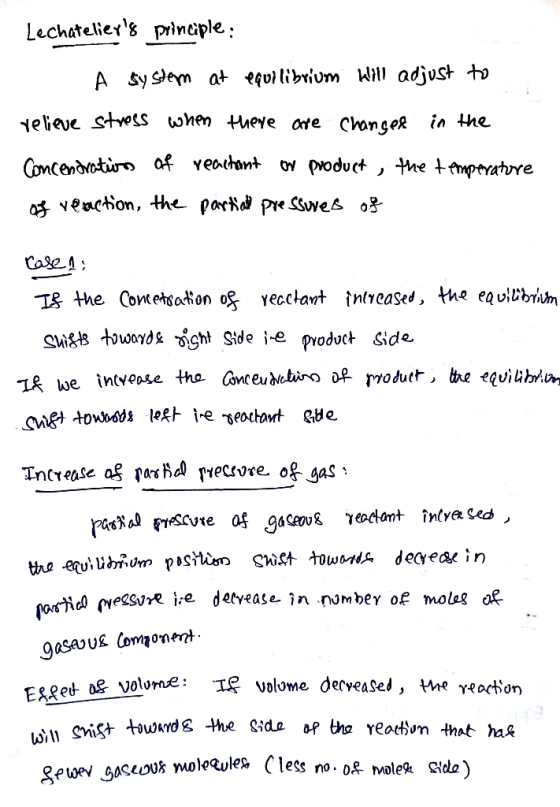
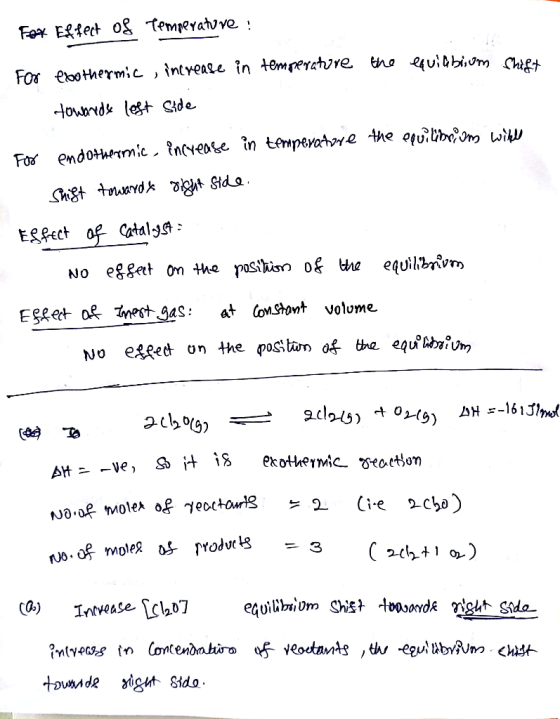
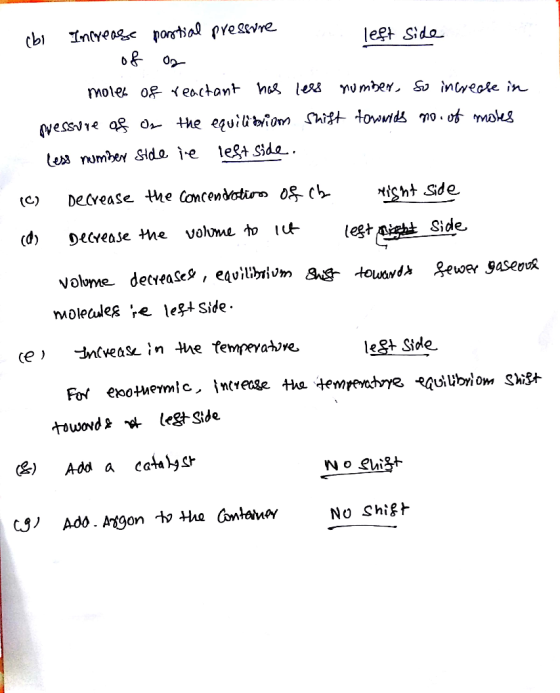
1. The following gas phase equilibrium is established in a 2.0 L container: 2 C120 (g)...
chemical prin G. Consider the equilibrium: N(g) + 3 H (9) = 2 NH(g) AH negative...
 chemical prin
G. Consider the equilibrium: N(g) + 3 H (9) = 2 NH(g) AH negative Indicate how the following perturbations affect the equilibrium position and the equilibrium constant. For the equilibrium position: Use R, L, and 0 for shift right, shift left, and no change. For the equilibrium constant: Use +, -, and 0 for increase, decrease, and no change. Perturbation Equil. Position Equil. Constant (a) Partial pressure of H. decreases. (b) Volume of the container doubles. (e) Argon...
chemical prin
G. Consider the equilibrium: N(g) + 3 H (9) = 2 NH(g) AH negative Indicate how the following perturbations affect the equilibrium position and the equilibrium constant. For the equilibrium position: Use R, L, and 0 for shift right, shift left, and no change. For the equilibrium constant: Use +, -, and 0 for increase, decrease, and no change. Perturbation Equil. Position Equil. Constant (a) Partial pressure of H. decreases. (b) Volume of the container doubles. (e) Argon...
1a. The equilibrium for the formation of HOCl in the gas phase from chlorine dioxide (C120)...
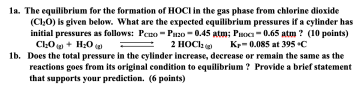 1a. The equilibrium for the formation of HOCl in the gas phase from chlorine dioxide (C120) is given below. What are the expected equilibrium pressures if a cylinder has initial pressures as follows: PC120 = PH20 = 0.45 atm; Phoci = 0.65 atm ? (10 points) Cl20 (g) + H2O (g) = 2 HOCl2 (g) Kp=0.085 at 395 °C 1b. Does the total pressure in the cylinder increase, decrease or remain the same as the reactions goes from its original...
1.For the reaction at equilibrium 2 SO3↔ 2 SO2 + O2 (∆Horxn= 198 kJ/mol), if we...
1.For the reaction at equilibrium 2 SO3↔ 2 SO2 + O2 (∆Horxn= 198 kJ/mol), if we increase the reaction temperature, the equilibrium will (1 point ) * No shift None of the above Question lacks sufficient information Shift to the right 2. For the equilibrium reaction 2 SO2(g) + O2(g) ↔ 2 SO3(g), ∆Horxn = -198 kJ/mol. Which one of these factors would cause the equilibrium constant to increase? (1 point ) * Add a catalyst Decrease the temperature None...
H(g) + 92 conta 7. Consider the equilibrium: N:(g) + O2(g) + energy > N:O(g) For...
 H(g) + 92 conta 7. Consider the equilibrium: N:(g) + O2(g) + energy > N:O(g) For each of the following situations, use the concentration-time graphs below to illustrate the disturb ance and equilibrium shift. (KU - 1.5 marks cach, 9 marks total) b) a) Increase [NO] [N:) [Na] [03) [O] b) Decrease (0) IN:0) (N2O) O c) d) IN) [N] c) Increase temperature [02] [02] [NO] (N2O) d) Decrease volume of container. f) [N2] (N2) e) Decrease [N2] [02] (O2)...
please explain, thanks 1a. The equilibrium for the formation of HOCl in the gas phase from...
 please explain, thanks
1a. The equilibrium for the formation of HOCl in the gas phase from chlorine dioxide (C120) is given below. What are the expected equilibrium pressures if a cylinder has initial pressures as follows: PC120 = PH20 = 0.45 atm; Phoci = 0.65 atm ? (10 points) Cl20 (g) + H2O (g) = 2 HOCl2 (g) Kp=0.085 at 395 °C 1b. Does the total pressure in the cylinder increase, decrease or remain the same as the reactions goes...
please explain, thanks
1a. The equilibrium for the formation of HOCl in the gas phase from chlorine dioxide (C120) is given below. What are the expected equilibrium pressures if a cylinder has initial pressures as follows: PC120 = PH20 = 0.45 atm; Phoci = 0.65 atm ? (10 points) Cl20 (g) + H2O (g) = 2 HOCl2 (g) Kp=0.085 at 395 °C 1b. Does the total pressure in the cylinder increase, decrease or remain the same as the reactions goes...
9.3 Consider the gas phase reaction: PCI3(g) Cl2(g) PCI5(g) at equilibrium at 400 K and 1...
 9.3 Consider the gas phase reaction: PCI3(g) Cl2(g) PCI5(g) at equilibrium at 400 K and 1 atm total pressure. The closed system is initially charged with 1 mole of PCI3 and 2 moles of Cl2 The standard free energy change of this reaction is -3.53 kJ/mole. What is the mole fraction of PCI5 at equilibrium?
Consider the following equilibrium reaction: 4NH3(g) + 5O2(g) <---> 4NO(g) + 6H2O(g) Heat = -904.4 kJ...
Consider the following equilibrium reaction: 4NH3(g) + 5O2(g) <---> 4NO(g) + 6H2O(g) Heat = -904.4 kJ How does each of the following changes affect the yield of NO at equilibrium? Answer increase, decrease, or no change. a. increase [NH3] b. Increase [H2O] c. Decrease [O2] d. Decrease the volume of the container in which the raction occurs. e. Add a catalyst f. Increase temperature
The following equilibrium is established at 273 K in a 5.0 L container 2NO(g) + O2(g)...
The following equilibrium is established at 273 K in a 5.0 L container 2NO(g) + O2(g) « 2NO2(g) ΔH0 = - 113 kJ / mol State and explain, using differential rates i.e. what happens to Rforwards and Rbackwards, the effects the following have on the system at equilibrium – DO NOT use LCP as an explanation as LCP does not explain anything, it just helps you predict what will happen. Selectively removing some of the NO(g) Increasing the temperature Decreasing...
Consider the following reaction at equilibrium: 2CO2(g) = 200 (g) + O2(g) AH° = -514 kJ...
 Consider the following reaction at equilibrium: 2CO2(g) = 200 (g) + O2(g) AH° = -514 kJ Le Châtelier's principle predicts that a decrease in temperature will decrease the value of the equilibrium constant O increase the value of the equilibrium constant decrease the partial pressure of CO increase the partial pressure of CO2 (g) decrease the partial pressure of O2 (g) Consider the following reaction at equilibrium: 2NH3 (g) = N2 (g) + 3H2(g) AH° = +92.4 kJ Le Châtelier's...
1) Determine the effect of each of the following changes on the equilibrium mixture for the...
 1) Determine the effect of each of the following changes on the equilibrium mixture for the following reaction: N2(g) + O2(g) + 90.2 kJ + 2NO(g) Circle an answer for each change. a. Increasing the temperature Shift to reactants No change Shift to products b. Adding a catalyst Shift to reactants No change Shift to products c. Removing nitrogen monoxide gas Shift to reactants No change Shift to products d. Decreasing the volume of the container Shift to reactants No...
 chemical prin
G. Consider the equilibrium: N(g) + 3 H (9) = 2 NH(g) AH negative Indicate how the following perturbations affect the equilibrium position and the equilibrium constant. For the equilibrium position: Use R, L, and 0 for shift right, shift left, and no change. For the equilibrium constant: Use +, -, and 0 for increase, decrease, and no change. Perturbation Equil. Position Equil. Constant (a) Partial pressure of H. decreases. (b) Volume of the container doubles. (e) Argon...
chemical prin
G. Consider the equilibrium: N(g) + 3 H (9) = 2 NH(g) AH negative Indicate how the following perturbations affect the equilibrium position and the equilibrium constant. For the equilibrium position: Use R, L, and 0 for shift right, shift left, and no change. For the equilibrium constant: Use +, -, and 0 for increase, decrease, and no change. Perturbation Equil. Position Equil. Constant (a) Partial pressure of H. decreases. (b) Volume of the container doubles. (e) Argon...
 1a. The equilibrium for the formation of HOCl in the gas phase from chlorine dioxide (C120) is given below. What are the expected equilibrium pressures if a cylinder has initial pressures as follows: PC120 = PH20 = 0.45 atm; Phoci = 0.65 atm ? (10 points) Cl20 (g) + H2O (g) = 2 HOCl2 (g) Kp=0.085 at 395 °C 1b. Does the total pressure in the cylinder increase, decrease or remain the same as the reactions goes from its original...
 H(g) + 92 conta 7. Consider the equilibrium: N:(g) + O2(g) + energy > N:O(g) For each of the following situations, use the concentration-time graphs below to illustrate the disturb ance and equilibrium shift. (KU - 1.5 marks cach, 9 marks total) b) a) Increase [NO] [N:) [Na] [03) [O] b) Decrease (0) IN:0) (N2O) O c) d) IN) [N] c) Increase temperature [02] [02] [NO] (N2O) d) Decrease volume of container. f) [N2] (N2) e) Decrease [N2] [02] (O2)...
 please explain, thanks
1a. The equilibrium for the formation of HOCl in the gas phase from chlorine dioxide (C120) is given below. What are the expected equilibrium pressures if a cylinder has initial pressures as follows: PC120 = PH20 = 0.45 atm; Phoci = 0.65 atm ? (10 points) Cl20 (g) + H2O (g) = 2 HOCl2 (g) Kp=0.085 at 395 °C 1b. Does the total pressure in the cylinder increase, decrease or remain the same as the reactions goes...
please explain, thanks
1a. The equilibrium for the formation of HOCl in the gas phase from chlorine dioxide (C120) is given below. What are the expected equilibrium pressures if a cylinder has initial pressures as follows: PC120 = PH20 = 0.45 atm; Phoci = 0.65 atm ? (10 points) Cl20 (g) + H2O (g) = 2 HOCl2 (g) Kp=0.085 at 395 °C 1b. Does the total pressure in the cylinder increase, decrease or remain the same as the reactions goes...
 9.3 Consider the gas phase reaction: PCI3(g) Cl2(g) PCI5(g) at equilibrium at 400 K and 1 atm total pressure. The closed system is initially charged with 1 mole of PCI3 and 2 moles of Cl2 The standard free energy change of this reaction is -3.53 kJ/mole. What is the mole fraction of PCI5 at equilibrium?
 Consider the following reaction at equilibrium: 2CO2(g) = 200 (g) + O2(g) AH° = -514 kJ Le Châtelier's principle predicts that a decrease in temperature will decrease the value of the equilibrium constant O increase the value of the equilibrium constant decrease the partial pressure of CO increase the partial pressure of CO2 (g) decrease the partial pressure of O2 (g) Consider the following reaction at equilibrium: 2NH3 (g) = N2 (g) + 3H2(g) AH° = +92.4 kJ Le Châtelier's...
 1) Determine the effect of each of the following changes on the equilibrium mixture for the following reaction: N2(g) + O2(g) + 90.2 kJ + 2NO(g) Circle an answer for each change. a. Increasing the temperature Shift to reactants No change Shift to products b. Adding a catalyst Shift to reactants No change Shift to products c. Removing nitrogen monoxide gas Shift to reactants No change Shift to products d. Decreasing the volume of the container Shift to reactants No...
Most questions answered within 3 hours.
-
Where is the error in this code sequence?
String s1 = "Hello";
String s2 = "ello";...
asked 10 months ago -
Financial data for Joel de Paris, Inc., for last year
follow:
Joel de Paris, Inc.
Balance...
asked 10 months ago -
Consider this reaction:
Al2(SO4)3 (aq)+ BaCl3
(aq) Al2Cl6 (aq)- +
3BaSO4(s) . What is the...
asked 10 months ago -
Suppose that Savneet is considering increasing her
recent random sample from 20 car rentals to 40...
asked 10 months ago -
Trucks arrive at an unloading terminal at an average rate of 120
per hour.
Trucks arrive...
asked 10 months ago -
Why are methanol and ethanol completely soluble in water while
octanol is not very little soluble....
asked 10 months ago -
A facilities manager at a university reads in a research report
that the mean amount of...
asked 10 months ago -
When the CuSO4 is rehydrated by adding water to the anhydrous
compound, is this an endothermic...
asked 10 months ago -
A ray of sunlight is passing from diamond into crown glass; the
angle of incidence is...
asked 10 months ago -
A block of mass 0.249 kg is placed on top of a light, vertical
spring of...
asked 10 months ago -
how do the kidneys compensate in the presences of acidosis
a) trigger hyperventilate
b) reserve acid...
asked 10 months ago -
Question 501 pts
The rental rate of capital to the firm increases. Which of the
following...
asked 10 months ago