
Homework Answers
1. The following which is involved in decomposition that connects all trophic levels is FUNGI.
Decomposers/ Detrivores derive their energy from detritus, non living organic matter and decomposition connects all trophic levels. These decomposers form a major link between primary producers and the consumers in an ecosystem. The organic matter in the ecosystem is recycled with the help of decomposers. The ecosystem main decomposers are Fungi which secrete enzymes that digest organic material and and then absorb the breakdown products.
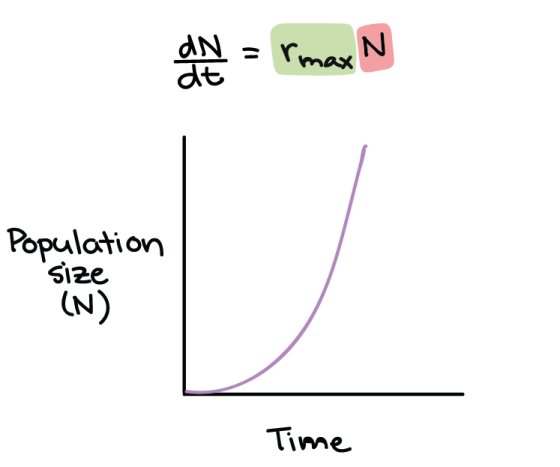
2. Exponential growth of a population is represented by dN/dT = rN
Continuous population growth is called the Exponential Growth and this growth in an unlimited environment can be modelled exponentially with the equation
dN/dT = rN
dN/dT = change in population size (instantaneous growth rate)
r = Intrinsic rate of increase or Percapita rate of increase ( equals birth rate minus death rate)
N = Population size
The percapita rate of increase (r) doesnot change though population rate increases at a larger rate.
Add Answer to:
Question 37 2 pts Which of the following is involved in decomposition that connects all trophic...
Question 47 2 pts Which of the following structures would likely develop from an apical meristem?...
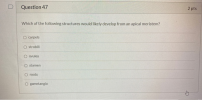 Question 47 2 pts Which of the following structures would likely develop from an apical meristem? carpels O strobili Ovules stamen O roots gametangia What is the greatest threat to plant diversity? O grazing and browsing by animals O competition with other plants pathogenic fungi O human population growth insects
Khan Academy Question 42 2 pts Which of the following causes populations to shift most quickly...
 Khan Academy Question 42 2 pts Which of the following causes populations to shift most quickly from an exponential to a logistic population growth? decreased death rate favorable climatic conditions competition for resources O removal of predators Question 43 2 pts Which of the following relationships is detrimental to both species involved? O commensalism O competition O mutualism O parasitism
Two yeast cells were placed into a special container to which food was continually added, to...
Two yeast cells were placed into a special container to which food was continually added, to keep it at a constant concentration. All other factors were set for optimal yeast growth (for example, temperature, oxygen, and pH). The population was sampled every hour for 21 hours and the results of the estimated population size were recorded in the table below. Time (hour), Number of yeast cells (0, 2) (1, 10) (2, 15) (3, 20) (4, 40) (5, 60) (6, 100)...
Equations that you may be asked to utilize N+1 = RN N(1) = N(O)At N(O) =...
 Equations that you may be asked to utilize N+1 = RN N(1) = N(O)At N(O) = N(Oert dN/dt = TN dN/dt = TN (K - N/K Average finite rate of increase = (N/N) (4) Time to reach a certain pop. size = logN, =logNo + f(logi) 2= el 1 = N/N, or Nr+/N, 1. You have been studying a species of annual plant in the local prairie for two years. You find there are currently 1256 plants, up from 989...
Question 10 1 pts A study reports the following final notation: F(2, 37) = 9.00,p <...
 Question 10 1 pts A study reports the following final notation: F(2, 37) = 9.00,p < .05; how many samples were involved in the study? O 2 O 3 37 O 40
This Question: 2 pts < 62 of 64 (37 complete) Year Population billions) The table provides...
 This Question: 2 pts < 62 of 64 (37 complete) Year Population billions) The table provides some data on real GDP and the population of Europa in 2015 and 2016 What was the growth rate of real GDP in Europa in 2016? What was the growth rate of real GDP per person in Europa in 20167 >>> Answer with a whole number The growth rate of real GDP in Europa in 2016 is percent 2015 2016 Real GOP fillions of...
Proximity to water Question 10 3 pts Which of the following would MOST quickly cause a...
 Proximity to water Question 10 3 pts Which of the following would MOST quickly cause a population to shift from an exponential to a logistic population growth? Competition for resources Removal of predators O Decreased death rate Favorable climactic conditions 3 pts Question 11
Question 6 2 pts The variation of the rate constant with temperature for the decomposition of...
 Question 6 2 pts The variation of the rate constant with temperature for the decomposition of HI to H2 and 12 is given here. What is the activation energy for this reaction? 2 HI(g) -> H2 (8) + 12 (8) Temperature (K) Rate constant, 555 3.52 x 10⁷ 781 3.95 x 10⁻² ho 1.1 x 10J/mol O 1.8 x 10$/mol 179 J/mol O 2.0x 10J/mol
Question 2 2 pts Which of the following are important processes in metapopulation models? Population growth...
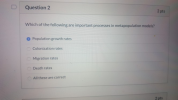 Question 2 2 pts Which of the following are important processes in metapopulation models? Population growth rates Colonization rates Migration rates Death rates All these are correct 2 pts
Question 7 1.33 pts Which types of physicians listed below are Specialists: (Level O a. All...
 Question 7 1.33 pts Which types of physicians listed below are Specialists: (Level O a. All internists b. Psychiatrists O c. All pediatricians O d. a, b and Oe. None of the above Question 8 1.33 pts The first hospitalists were trained: (Level 1) a. During the preindustrial period b. During the industrial period c. Both a and be d. None of the above Question 6 1.33 pts Some differences between allopathic and osteopathic physician include: (Level 2) O a....
 Question 47 2 pts Which of the following structures would likely develop from an apical meristem? carpels O strobili Ovules stamen O roots gametangia What is the greatest threat to plant diversity? O grazing and browsing by animals O competition with other plants pathogenic fungi O human population growth insects
 Khan Academy Question 42 2 pts Which of the following causes populations to shift most quickly from an exponential to a logistic population growth? decreased death rate favorable climatic conditions competition for resources O removal of predators Question 43 2 pts Which of the following relationships is detrimental to both species involved? O commensalism O competition O mutualism O parasitism
 Equations that you may be asked to utilize N+1 = RN N(1) = N(O)At N(O) = N(Oert dN/dt = TN dN/dt = TN (K - N/K Average finite rate of increase = (N/N) (4) Time to reach a certain pop. size = logN, =logNo + f(logi) 2= el 1 = N/N, or Nr+/N, 1. You have been studying a species of annual plant in the local prairie for two years. You find there are currently 1256 plants, up from 989...
 Question 10 1 pts A study reports the following final notation: F(2, 37) = 9.00,p < .05; how many samples were involved in the study? O 2 O 3 37 O 40
 This Question: 2 pts < 62 of 64 (37 complete) Year Population billions) The table provides some data on real GDP and the population of Europa in 2015 and 2016 What was the growth rate of real GDP in Europa in 2016? What was the growth rate of real GDP per person in Europa in 20167 >>> Answer with a whole number The growth rate of real GDP in Europa in 2016 is percent 2015 2016 Real GOP fillions of...
 Proximity to water Question 10 3 pts Which of the following would MOST quickly cause a population to shift from an exponential to a logistic population growth? Competition for resources Removal of predators O Decreased death rate Favorable climactic conditions 3 pts Question 11
 Question 6 2 pts The variation of the rate constant with temperature for the decomposition of HI to H2 and 12 is given here. What is the activation energy for this reaction? 2 HI(g) -> H2 (8) + 12 (8) Temperature (K) Rate constant, 555 3.52 x 10⁷ 781 3.95 x 10⁻² ho 1.1 x 10J/mol O 1.8 x 10$/mol 179 J/mol O 2.0x 10J/mol
 Question 2 2 pts Which of the following are important processes in metapopulation models? Population growth rates Colonization rates Migration rates Death rates All these are correct 2 pts
 Question 7 1.33 pts Which types of physicians listed below are Specialists: (Level O a. All internists b. Psychiatrists O c. All pediatricians O d. a, b and Oe. None of the above Question 8 1.33 pts The first hospitalists were trained: (Level 1) a. During the preindustrial period b. During the industrial period c. Both a and be d. None of the above Question 6 1.33 pts Some differences between allopathic and osteopathic physician include: (Level 2) O a....
Most questions answered within 3 hours.
-
Where is the error in this code sequence?
String s1 = "Hello";
String s2 = "ello";...
asked 11 months ago -
Financial data for Joel de Paris, Inc., for last year
follow:
Joel de Paris, Inc.
Balance...
asked 11 months ago -
Consider this reaction:
Al2(SO4)3 (aq)+ BaCl3
(aq) Al2Cl6 (aq)- +
3BaSO4(s) . What is the...
asked 11 months ago -
Suppose that Savneet is considering increasing her
recent random sample from 20 car rentals to 40...
asked 11 months ago -
Trucks arrive at an unloading terminal at an average rate of 120
per hour.
Trucks arrive...
asked 11 months ago -
Why are methanol and ethanol completely soluble in water while
octanol is not very little soluble....
asked 11 months ago -
A facilities manager at a university reads in a research report
that the mean amount of...
asked 11 months ago -
When the CuSO4 is rehydrated by adding water to the anhydrous
compound, is this an endothermic...
asked 11 months ago -
A ray of sunlight is passing from diamond into crown glass; the
angle of incidence is...
asked 11 months ago -
A block of mass 0.249 kg is placed on top of a light, vertical
spring of...
asked 11 months ago -
how do the kidneys compensate in the presences of acidosis
a) trigger hyperventilate
b) reserve acid...
asked 11 months ago -
Question 501 pts
The rental rate of capital to the firm increases. Which of the
following...
asked 11 months ago