Extra credit for 5 points. Answer any one and only one of the following:
Extra credit for 5 points. Answer any one and only one of the following:
a. Compare and contrast carbamoylphosphate synthetases I and II.
b. Discuss the so-called Krebs Bicycle.
Homework Answers
CPS-I:
Cellular location = Mitochondria
Nitrogen donor = Ammonia
Pathway = Urea cycle
Regulation = It is activated by NAG
CPS-II:
Cellular location = Cytoplasm
Nitrogen donor = Glutamine
Pathway = Pyrimidine biosynthesis
Regulation = It is inhibited by CTP
Kreb's bicycle involves the interaction between the TCA cycle and
the Urea cycle.
Argininosuccinate produced by the urea cycle results in the
formation of Malate that enters the TCA cycle.
Oxaloacetate is produced during the TCA cycle. It is aminated to
produce Aspartate. Aspartate combines with Citrulline to produce
Argininosuccinate in the urea cycle
Add Answer to:
Extra credit for 5 points. Answer any one and only one of the following:
Extra credit for 5 points. Answer any one and only one of the following: a. Compare...
 Extra credit for 5 points. Answer any one and only one of the following: a. Compare and contrast carbamoylphosphate synthetases I and II. b. Discuss the so-called Krebs Bicycle.
Answer any one and only one of the following:
Answer any one and only one of the following: a. Describe the mitochondrial electron transport pathway and the synthesis of ATP by mammalian mitochondria. b. Provide an overview of fatty acid synthesis and breakdown and their coordinated regulation. c. Discuss the regulation of the TCA cycle. d. Compare and contrast the KNF and MWC models.
Answer any one and only one of the following : a. Describe the mitochondrial electron...
Answer any one and only one of the following: a. Describe the mitochondrial electron transport pathway and the synthesis of ATP by mammalian mitochondria. b. Provide an overview of fatty acid synthesis and breakdown and their coordinated regulation. c. Discuss the regulation of the TCA cycle. d. Compare and contrast the KNF and MWC models.
Extra Credit, 40 points. There are 15 extra credit problems in the 4 tables below. The answers to these 15 problems are contained in the Extra Credit Answer Table Below. On your multiple choice a...
 Extra Credit, 40 points. There are 15 extra credit problems in the 4 tables below. The answers to these 15 problems are contained in the Extra Credit Answer Table Below. On your multiple choice answer sheet, write the number from the Extra Credit Answer Table that best corresponds to the 15 extra credit problems 50 Table 1. Extra Credit Problems 1-4 1. calcium nitride 2. Sr3(PO4)2 3. HCO Table 2. Extra Credit Problems 5-8 group of the periodic table. 6...
Imagine, just imagine, I am in the mood to give away 7 extra credit points among...
Imagine, just imagine, I am in the mood to give away 7 extra credit points among my (only) 4 students. If all students have the same opportunity to get any of the points, what is the probability that each student gets at least one extra point?
Please Help me Solve this (8 points Extra Credit) 5. Given the following balanced equation, answer...
 Please Help me Solve this
(8 points Extra Credit) 5. Given the following balanced equation, answer questions a-d. en t) Cua+Mg)Mga Cu) .aq) Mg2+2e-Mg Ed-2.38 V Cut2 +2e Cu Ed +0.34 V a) Write the cell line notation for the reaction above. (1 point) b) Calculate the standard cell potential, Eell(1 point) on reaction red in e c) Calculate AG at 298K. (2 points) d) Identify the oxidizing and the reducing agent. (2 points)
Please Help me Solve this
(8 points Extra Credit) 5. Given the following balanced equation, answer questions a-d. en t) Cua+Mg)Mga Cu) .aq) Mg2+2e-Mg Ed-2.38 V Cut2 +2e Cu Ed +0.34 V a) Write the cell line notation for the reaction above. (1 point) b) Calculate the standard cell potential, Eell(1 point) on reaction red in e c) Calculate AG at 298K. (2 points) d) Identify the oxidizing and the reducing agent. (2 points)
CHE 211-Extra Credit / 1) Reaction of (1) with H results in equal quantities of (II)...
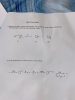 CHE 211-Extra Credit / 1) Reaction of (1) with H results in equal quantities of (II) and (III). In contrast, reaction of (1) with TSCI, Followed by OH, provides (II) as the only product. Explain. 2) Provide the structures of A-E for the following synthetic roadmap. Oy
Question 3 (5 points, plus 5 extra credit points). Imagine you want to breed cats with...
 Question 3 (5 points, plus 5 extra credit points). Imagine you want to breed cats with short legs called munchkins. The munchkin phenotype is dominant. However, you have never been able to get a pure breeding population of munchkins! Whenever you cross two munchin cats, you find that 2/3 of the kittens are munchkins and 1/3 are normal sized. A. (2.5 points) What must be the genotypes of the parents and the F1 Offspring? B. (2.5 points) Provide an explanation...
Extra Credit: What is the output of the following program? (5 points) #include <iostream> using namespace...
 Extra Credit: What is the output of the following program? (5 points) #include <iostream> using namespace std; int main ( char greetingl6]- ('H', 'e', T, T, 'o', 0'); cout <<"Greeting message: " cout< greeting << endl return 0;
Extra Credit Partial credit will be awarded for the following question! No credit will be deducted...
 Extra Credit Partial credit will be awarded for the following question! No credit will be deducted if the problem is left blank or if the answer is incorrect 4. Complete the following combination reaction by determining the chemical formula(s) of the product(s) that are predicted to form and then balancing the chemical reaction, if necessary (4 points) _H2 + B →
 Extra credit for 5 points. Answer any one and only one of the following: a. Compare and contrast carbamoylphosphate synthetases I and II. b. Discuss the so-called Krebs Bicycle.
 Extra Credit, 40 points. There are 15 extra credit problems in the 4 tables below. The answers to these 15 problems are contained in the Extra Credit Answer Table Below. On your multiple choice answer sheet, write the number from the Extra Credit Answer Table that best corresponds to the 15 extra credit problems 50 Table 1. Extra Credit Problems 1-4 1. calcium nitride 2. Sr3(PO4)2 3. HCO Table 2. Extra Credit Problems 5-8 group of the periodic table. 6...
 Please Help me Solve this
(8 points Extra Credit) 5. Given the following balanced equation, answer questions a-d. en t) Cua+Mg)Mga Cu) .aq) Mg2+2e-Mg Ed-2.38 V Cut2 +2e Cu Ed +0.34 V a) Write the cell line notation for the reaction above. (1 point) b) Calculate the standard cell potential, Eell(1 point) on reaction red in e c) Calculate AG at 298K. (2 points) d) Identify the oxidizing and the reducing agent. (2 points)
Please Help me Solve this
(8 points Extra Credit) 5. Given the following balanced equation, answer questions a-d. en t) Cua+Mg)Mga Cu) .aq) Mg2+2e-Mg Ed-2.38 V Cut2 +2e Cu Ed +0.34 V a) Write the cell line notation for the reaction above. (1 point) b) Calculate the standard cell potential, Eell(1 point) on reaction red in e c) Calculate AG at 298K. (2 points) d) Identify the oxidizing and the reducing agent. (2 points)
 CHE 211-Extra Credit / 1) Reaction of (1) with H results in equal quantities of (II) and (III). In contrast, reaction of (1) with TSCI, Followed by OH, provides (II) as the only product. Explain. 2) Provide the structures of A-E for the following synthetic roadmap. Oy
 Question 3 (5 points, plus 5 extra credit points). Imagine you want to breed cats with short legs called munchkins. The munchkin phenotype is dominant. However, you have never been able to get a pure breeding population of munchkins! Whenever you cross two munchin cats, you find that 2/3 of the kittens are munchkins and 1/3 are normal sized. A. (2.5 points) What must be the genotypes of the parents and the F1 Offspring? B. (2.5 points) Provide an explanation...
 Extra Credit: What is the output of the following program? (5 points) #include <iostream> using namespace std; int main ( char greetingl6]- ('H', 'e', T, T, 'o', 0'); cout <<"Greeting message: " cout< greeting << endl return 0;
 Extra Credit Partial credit will be awarded for the following question! No credit will be deducted if the problem is left blank or if the answer is incorrect 4. Complete the following combination reaction by determining the chemical formula(s) of the product(s) that are predicted to form and then balancing the chemical reaction, if necessary (4 points) _H2 + B →
Most questions answered within 3 hours.
-
Where is the error in this code sequence?
String s1 = "Hello";
String s2 = "ello";...
asked 10 months ago -
Financial data for Joel de Paris, Inc., for last year
follow:
Joel de Paris, Inc.
Balance...
asked 10 months ago -
Consider this reaction:
Al2(SO4)3 (aq)+ BaCl3
(aq) Al2Cl6 (aq)- +
3BaSO4(s) . What is the...
asked 10 months ago -
Suppose that Savneet is considering increasing her
recent random sample from 20 car rentals to 40...
asked 10 months ago -
Trucks arrive at an unloading terminal at an average rate of 120
per hour.
Trucks arrive...
asked 10 months ago -
Why are methanol and ethanol completely soluble in water while
octanol is not very little soluble....
asked 10 months ago -
A facilities manager at a university reads in a research report
that the mean amount of...
asked 10 months ago -
When the CuSO4 is rehydrated by adding water to the anhydrous
compound, is this an endothermic...
asked 10 months ago -
A ray of sunlight is passing from diamond into crown glass; the
angle of incidence is...
asked 10 months ago -
A block of mass 0.249 kg is placed on top of a light, vertical
spring of...
asked 10 months ago -
how do the kidneys compensate in the presences of acidosis
a) trigger hyperventilate
b) reserve acid...
asked 10 months ago -
Question 501 pts
The rental rate of capital to the firm increases. Which of the
following...
asked 10 months ago