Account for discrepancies between the calculated and measured values of VR1, for frequencies greater than 10kHz.
Account for discrepancies between the calculated and measured values of VR1, for frequencies greater than 10kHz.
Homework Answers
In resistive load voltage across resistance is independent from the frequency. So at high frequency or frequency VR1 calculate is always equal but it may differ in measure value
Add Answer to:
Account for discrepancies between the calculated and measured
values of VR1, for frequencies greater than 10kHz.
Use measured resistance values and node analysis to calculate the node voltages. Use measured resistance values...
 Use measured resistance values and node analysis to calculate
the node voltages.
Use measured resistance values and mesh analysis to calculate
the mesh currents.
Show that the calculated values agree with the measured values
and explain any discrepancies between measured and calculated
values.
Introduction: In this pre-lab we will look at node voltages, mesh currents and bridge circuits. Bridge Circuits are used to make precision measurements, and in this lab -- -0 V2 will look at a DC Bridge Circuit...
Use measured resistance values and node analysis to calculate
the node voltages.
Use measured resistance values and mesh analysis to calculate
the mesh currents.
Show that the calculated values agree with the measured values
and explain any discrepancies between measured and calculated
values.
Introduction: In this pre-lab we will look at node voltages, mesh currents and bridge circuits. Bridge Circuits are used to make precision measurements, and in this lab -- -0 V2 will look at a DC Bridge Circuit...
Laboratory Measurements Make the circuit 2.1. Measure the voltages and currents and record the measured values...
 Laboratory Measurements Make the circuit 2.1. Measure the voltages and currents and record the measured values in Table 2.1. Make the circuit 2.2. Measure the voltages and currents and record the measured values in Table 2.2. Make the circuit 2.3. Measure the voltages and currents and record the measured values in Table 2.3 Circuit 2.1 R1 A R3 1.2kohm 2.2kohm V2 R2 18V 3.3kohm Fig. 2.1 I2- IR3 Table 2.1VRi Calculated (coded) Measured 1- LR1 IR2 Circuit 2.2 R1 R3...
Complete the calculated section of this table for just the V. 20V using the possible measured values in the...
 Complete the calculated section of this table for just the V. 20V using the possible measured values in the table. Table 1. Current Transformer Measurements Measured Oscilloscope Calculated 46 20 0.08 0.5 0.15 0.05 60 0.5 0.05 40
Complete the calculated section of this table for just the V. 20V using the possible measured values in the table. Table 1. Current Transformer Measurements Measured Oscilloscope Calculated 46 20 0.08 0.5 0.15 0.05 60 0.5 0.05 40
Complete the calculated section of this table for just the V. 20V using the possible measured values in the table. Table 1. Current Transformer Measurements Measured Oscilloscope Calculated 46 20 0.08 0.5 0.15 0.05 60 0.5 0.05 40
Find The values, C1, C2, L1, L2, R1, R2, R3. The tweeter speaker can reproduce frequencies...
 Find The values, C1, C2, L1, L2, R1, R2, R3. The tweeter speaker can reproduce frequencies greater than 6kHz, and the woofer can reproduce frequencies less than 200Hz. For proper sound, the midrange should reproduce all frequencies not produced by the subwoofer or tweeter. C2 C1 L2 V1 L1 R1 R3 R2 Midrange Tweeter Woofer Fig. 2. Equivalent model. The values of Ri, R2, R3, L1, L2, G. and C, are selected so that the filters have the same cutoff...
new audio preamp suffers from 60 Hz hum from the powerline. Assuming that the desired audio frequencies are greater than 500 Hz, design a filter that goes between the audio source and the preamp (as s...
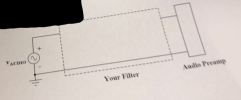 new audio preamp suffers from 60 Hz hum from the powerline.
Assuming that the desired audio frequencies are greater than 500
Hz, design a filter that goes between the audio source and the
preamp (as shown in the picture). To keep things simple, design a
filter using ONLY ONE resistor and one inductor. Determine
appropriate values for these components such that the filter has 15
dB attenuation at 60Hz. show your work/thought process please.
VAUDIO Audio Preamp Your Filter
VAUDIO...
new audio preamp suffers from 60 Hz hum from the powerline.
Assuming that the desired audio frequencies are greater than 500
Hz, design a filter that goes between the audio source and the
preamp (as shown in the picture). To keep things simple, design a
filter using ONLY ONE resistor and one inductor. Determine
appropriate values for these components such that the filter has 15
dB attenuation at 60Hz. show your work/thought process please.
VAUDIO Audio Preamp Your Filter
VAUDIO...
Design a “rumble” filter for audio. It should pass frequencies greater than 20 Hz. Assume the...
Design a “rumble” filter for audio. It should pass frequencies greater than 20 Hz. Assume the source impedance is zero (that is, the voltage supply is perfect) and 10K minimum load impedance (which means the load could be variable and have a much higher impedance). Make a figure showing the expected output of the filter designed.
23. (3 pts.) Assign the peaks in the infrared spectrum of triphenylmethanol with frequencies greater than...
 23. (3 pts.) Assign the peaks in the infrared spectrum of triphenylmethanol with frequencies greater than 1500 cm1 to specific bond vibrations AND the functional group the bond is associated with. Clearly indicate the specific bond vibration that is associated with the relevant peaks. 12 LOD 3026 1598 3062 130300 890 SD OH 1157 1450 3464 1010 1445 757 4000 2000 1500 1000 500
Please answer this following question regarding the procedure below: -Explain any errors greater than 1.0% in...
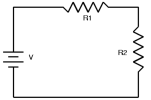 Please answer this following question regarding the procedure
below:
-Explain any errors greater than 1.0% in Table 8. Show your
schematics and calculations.
Procedure: 1MΩ Resistor Voltage Divider
Wire Figure 1 with the following values. Figure one is two
resistors in series and can be seen in the pictures below
Complete Table 8 below.
Figure 1 is seen below
w R1 w R2 Resistance (12) Voltage (Vdc) Current (Adc) Power (W) Calculated Req = 2M22 12Vdc 3μAde 36uW Vs Measured...
Please answer this following question regarding the procedure
below:
-Explain any errors greater than 1.0% in Table 8. Show your
schematics and calculations.
Procedure: 1MΩ Resistor Voltage Divider
Wire Figure 1 with the following values. Figure one is two
resistors in series and can be seen in the pictures below
Complete Table 8 below.
Figure 1 is seen below
w R1 w R2 Resistance (12) Voltage (Vdc) Current (Adc) Power (W) Calculated Req = 2M22 12Vdc 3μAde 36uW Vs Measured...
. Multiple two-point testcross experiments were performed and recombination frequencies between each gene pair were calculated....
. Multiple two-point testcross experiments were performed and recombination frequencies between each gene pair were calculated. Draw a map of the genes in the correct order. Write the distance between each gene in map units. • C – D 50% RF • C – F 46% RF • B – C 25% RF • D – F 10% RF • D - B 30% RF • B – F 20% RF
For an angle θ measured from the positive x-axis, the values of sin(θ) and cos(θ) are...
For an angle θ measured from the positive x-axis, the values of sin(θ) and cos(θ) are always which of the following? greater than −1 and less than 1 greater than +1 less than or equal to −1 or greater than or equal to 1 less than −1 greater than or equal to −1 and less than or equal to 1
 Use measured resistance values and node analysis to calculate
the node voltages.
Use measured resistance values and mesh analysis to calculate
the mesh currents.
Show that the calculated values agree with the measured values
and explain any discrepancies between measured and calculated
values.
Introduction: In this pre-lab we will look at node voltages, mesh currents and bridge circuits. Bridge Circuits are used to make precision measurements, and in this lab -- -0 V2 will look at a DC Bridge Circuit...
Use measured resistance values and node analysis to calculate
the node voltages.
Use measured resistance values and mesh analysis to calculate
the mesh currents.
Show that the calculated values agree with the measured values
and explain any discrepancies between measured and calculated
values.
Introduction: In this pre-lab we will look at node voltages, mesh currents and bridge circuits. Bridge Circuits are used to make precision measurements, and in this lab -- -0 V2 will look at a DC Bridge Circuit...
 Laboratory Measurements Make the circuit 2.1. Measure the voltages and currents and record the measured values in Table 2.1. Make the circuit 2.2. Measure the voltages and currents and record the measured values in Table 2.2. Make the circuit 2.3. Measure the voltages and currents and record the measured values in Table 2.3 Circuit 2.1 R1 A R3 1.2kohm 2.2kohm V2 R2 18V 3.3kohm Fig. 2.1 I2- IR3 Table 2.1VRi Calculated (coded) Measured 1- LR1 IR2 Circuit 2.2 R1 R3...
 Complete the calculated section of this table for just the V. 20V using the possible measured values in the table. Table 1. Current Transformer Measurements Measured Oscilloscope Calculated 46 20 0.08 0.5 0.15 0.05 60 0.5 0.05 40
Complete the calculated section of this table for just the V. 20V using the possible measured values in the table. Table 1. Current Transformer Measurements Measured Oscilloscope Calculated 46 20 0.08 0.5 0.15 0.05 60 0.5 0.05 40
Complete the calculated section of this table for just the V. 20V using the possible measured values in the table. Table 1. Current Transformer Measurements Measured Oscilloscope Calculated 46 20 0.08 0.5 0.15 0.05 60 0.5 0.05 40
 Find The values, C1, C2, L1, L2, R1, R2, R3. The tweeter speaker can reproduce frequencies greater than 6kHz, and the woofer can reproduce frequencies less than 200Hz. For proper sound, the midrange should reproduce all frequencies not produced by the subwoofer or tweeter. C2 C1 L2 V1 L1 R1 R3 R2 Midrange Tweeter Woofer Fig. 2. Equivalent model. The values of Ri, R2, R3, L1, L2, G. and C, are selected so that the filters have the same cutoff...
 new audio preamp suffers from 60 Hz hum from the powerline.
Assuming that the desired audio frequencies are greater than 500
Hz, design a filter that goes between the audio source and the
preamp (as shown in the picture). To keep things simple, design a
filter using ONLY ONE resistor and one inductor. Determine
appropriate values for these components such that the filter has 15
dB attenuation at 60Hz. show your work/thought process please.
VAUDIO Audio Preamp Your Filter
VAUDIO...
new audio preamp suffers from 60 Hz hum from the powerline.
Assuming that the desired audio frequencies are greater than 500
Hz, design a filter that goes between the audio source and the
preamp (as shown in the picture). To keep things simple, design a
filter using ONLY ONE resistor and one inductor. Determine
appropriate values for these components such that the filter has 15
dB attenuation at 60Hz. show your work/thought process please.
VAUDIO Audio Preamp Your Filter
VAUDIO...
 23. (3 pts.) Assign the peaks in the infrared spectrum of triphenylmethanol with frequencies greater than 1500 cm1 to specific bond vibrations AND the functional group the bond is associated with. Clearly indicate the specific bond vibration that is associated with the relevant peaks. 12 LOD 3026 1598 3062 130300 890 SD OH 1157 1450 3464 1010 1445 757 4000 2000 1500 1000 500
 Please answer this following question regarding the procedure
below:
-Explain any errors greater than 1.0% in Table 8. Show your
schematics and calculations.
Procedure: 1MΩ Resistor Voltage Divider
Wire Figure 1 with the following values. Figure one is two
resistors in series and can be seen in the pictures below
Complete Table 8 below.
Figure 1 is seen below
w R1 w R2 Resistance (12) Voltage (Vdc) Current (Adc) Power (W) Calculated Req = 2M22 12Vdc 3μAde 36uW Vs Measured...
Please answer this following question regarding the procedure
below:
-Explain any errors greater than 1.0% in Table 8. Show your
schematics and calculations.
Procedure: 1MΩ Resistor Voltage Divider
Wire Figure 1 with the following values. Figure one is two
resistors in series and can be seen in the pictures below
Complete Table 8 below.
Figure 1 is seen below
w R1 w R2 Resistance (12) Voltage (Vdc) Current (Adc) Power (W) Calculated Req = 2M22 12Vdc 3μAde 36uW Vs Measured...
Most questions answered within 3 hours.
-
Where is the error in this code sequence?
String s1 = "Hello";
String s2 = "ello";...
asked 10 months ago -
Financial data for Joel de Paris, Inc., for last year
follow:
Joel de Paris, Inc.
Balance...
asked 10 months ago -
Consider this reaction:
Al2(SO4)3 (aq)+ BaCl3
(aq) Al2Cl6 (aq)- +
3BaSO4(s) . What is the...
asked 10 months ago -
Suppose that Savneet is considering increasing her
recent random sample from 20 car rentals to 40...
asked 10 months ago -
Trucks arrive at an unloading terminal at an average rate of 120
per hour.
Trucks arrive...
asked 10 months ago -
Why are methanol and ethanol completely soluble in water while
octanol is not very little soluble....
asked 10 months ago -
A facilities manager at a university reads in a research report
that the mean amount of...
asked 10 months ago -
When the CuSO4 is rehydrated by adding water to the anhydrous
compound, is this an endothermic...
asked 10 months ago -
A ray of sunlight is passing from diamond into crown glass; the
angle of incidence is...
asked 10 months ago -
A block of mass 0.249 kg is placed on top of a light, vertical
spring of...
asked 10 months ago -
how do the kidneys compensate in the presences of acidosis
a) trigger hyperventilate
b) reserve acid...
asked 10 months ago -
Question 501 pts
The rental rate of capital to the firm increases. Which of the
following...
asked 10 months ago