. Multiple two-point testcross experiments were performed and recombination frequencies between each gene pair were calculated....
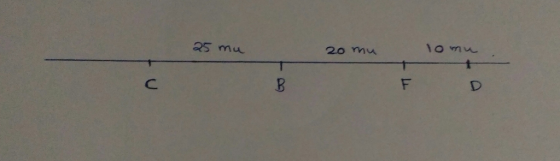
. Multiple two-point testcross experiments were performed and recombination frequencies between each gene pair were calculated. Draw a map of the genes in the correct order. Write the distance between each gene in map units.
• C – D 50% RF
• C – F 46% RF
• B – C 25% RF
• D – F 10% RF
• D - B 30% RF
• B – F 20% RF
Homework Answers
Recombination frequency is a measure of distance between genes here recombination frequency between C and D is 50% so let`s put C and D at the ends then B-D= 30% and D to F is 10% and C to F is 46% so F is far from C so it is 10 mu from D and B is 20 mu from F
Add Answer to:
. Multiple two-point testcross experiments were performed and
recombination frequencies between each gene pair were calculated....
Multiple choice: The measured distance between genes D and E in a two-point testcross is 50...
Multiple choice: The measured distance between genes D and E in a two-point testcross is 50 map units. Where are genes D and E in relation to each other? D and E are on different homologous chromosomes. D and E are on the same chromosome, at least 50 map units apart. D and E are on the same chromosome, exactly 50 map units apart. D and E are on the same chromosome, less than 50 map units apart. A) 1...
3. In a series of mapping experiments, the recombination frequencies for four different linked genes of...
 3. In a series of mapping experiments, the recombination frequencies for four different linked genes of Drosophila were determined as shown in the figure below. Wildtype (dominant) is flat wings, medium leg length, brown abdomen, and medium bristle length. w curled wings 1 short legs a - red abdomen b long bristles g23 O a 12 11 0 b 20 3 8 0 w a b The numbers in the boxes are the recombinatior frequencies in between the genes (in...
4. You are studying three genes in corn and performed a three-point cross. The three genes...
 4. You are studying three genes in corn and performed a three-point cross. The three genes are green (V) vs Viniscent (V) seedlings, blue (Pr) vs red kernels (pr) and white (B ) or brown (bm) leaf midrib color. The table below list the offspring resulting from a testcross with a female F1 heterozygote. Type of gamete (NR, SCO, DCO Phenotype Progeny Gamete from F1 heterozygote Virescent seedling red 101 kernel Red kernel 175 Red kernel, brown midrib 259 Virescent...
Gene mapping D and J are genes, each with 2 alleles. A testcross between a heterozygote...
Gene mapping D and J are genes, each with 2 alleles. A testcross between a heterozygote individual and homozygous recessive individual is performed and the following progeny are observed: D__ J__ 52 D__ jj 46 dd J__ 48 dd jj 54 Suppose D and J are in fact linked, now consider another 2 loci P and Q, each with 2 alleles, and 2 point testcrosses for genes Q and J, P and J, then D and P are performed. P__...
Data Set B presents the results of a testcross using female flies heterzygous for three traits...
 Data Set B presents the results of a testcross using female
flies heterzygous for three traits and male flies, which are
homozygous recessive for the same three traits.
Part B Data set B presents the results of a testcross using female flies heterozygous for three traits and male flies, which are homozygous recessive for the same three traits. For this part of the report do the following: a) Attach your data set to your report. b) Clearly indicate parental, SCO...
Data Set B presents the results of a testcross using female
flies heterzygous for three traits and male flies, which are
homozygous recessive for the same three traits.
Part B Data set B presents the results of a testcross using female flies heterozygous for three traits and male flies, which are homozygous recessive for the same three traits. For this part of the report do the following: a) Attach your data set to your report. b) Clearly indicate parental, SCO...
5. You started working in a Drospohila lab. You are studying two different autosomal traits, body...
 5. You started working in a Drospohila lab. You are studying two different autosomal traits, body color and antennae length. Gray body (B) is completely dominant to black body (b) and long antennae length (A) is completely dominant to short antennae length (a). You cross true-breeding gray bodied, long antennae files to true-breeding black bodied, short antennae. The F1 progeny all have gray bodies and long antennae. a. You perform a testcross to the F1 progeny produced from the parent...
SO/ do no 2. A series of 2-point crosses were carried out among 7 loci (a, b, c, d, e, f, and g. producing the following recombination frequencies. Map the 7 loci, showing their linkage groups, t...
 SO/ do no 2. A series of 2-point crosses were carried out among 7 loci (a, b, c, d, e, f, and g. producing the following recombination frequencies. Map the 7 loci, showing their linkage groups, the order of the loci in each linkage group, and distances berween the loci of each group. () | % Reco Loci % Recombination 50 26 50 50 50 50 a- b a-c a-d a- e 50 50 12 50 50 4 10 50...
(9 points) You are interested in studying recombination frequencies in wasps. You identify a queen that...
 (9 points) You are interested in studying recombination frequencies in wasps. You identify a queen that is heterozygous at three different loci on chromosome 5: G, H, and R. As queen wasps can produce haploid male offspring without fertilizing their eggs, you decide to look only at the genotypes of her male offspring in your analysis. Below is a list of the genotypes of her male offspring, and the number of individuals that fall into each genotypic class. 92 168...
genetics-please show all work 8. (9 pts) A series of two-point crosses were carried out among...
 genetics-please show all work
8. (9 pts) A series of two-point crosses were carried out among six loci (a, b, c, d, e and f), producing the following recombination frequencies. The six loci map to three different linkage groups. Map the six loci, showing their linkage groups (you can use a single line for each linkage group), the order of the loci in each linkage group, and the distances between the loci of each group. If there is only one...
genetics-please show all work
8. (9 pts) A series of two-point crosses were carried out among six loci (a, b, c, d, e and f), producing the following recombination frequencies. The six loci map to three different linkage groups. Map the six loci, showing their linkage groups (you can use a single line for each linkage group), the order of the loci in each linkage group, and the distances between the loci of each group. If there is only one...
1. 2. 13. Which statement explains why the recombination frequency between two genes is always less...
 1.
2.
13.
Which statement explains why the recombination frequency between two genes is always less than 50%? Recombination cannot be more than 50% because chromosomes are only 50 map units in length. The genotype of the F, gametes will always be 50% parental gametes and 50% recombinant gametes. Genes with a recombination frequency near 50% are unlinked and have an equal likelihood of being inherited together or separately. F1 gametes always have 50% of their alleles from each parental...
1.
2.
13.
Which statement explains why the recombination frequency between two genes is always less than 50%? Recombination cannot be more than 50% because chromosomes are only 50 map units in length. The genotype of the F, gametes will always be 50% parental gametes and 50% recombinant gametes. Genes with a recombination frequency near 50% are unlinked and have an equal likelihood of being inherited together or separately. F1 gametes always have 50% of their alleles from each parental...
 3. In a series of mapping experiments, the recombination frequencies for four different linked genes of Drosophila were determined as shown in the figure below. Wildtype (dominant) is flat wings, medium leg length, brown abdomen, and medium bristle length. w curled wings 1 short legs a - red abdomen b long bristles g23 O a 12 11 0 b 20 3 8 0 w a b The numbers in the boxes are the recombinatior frequencies in between the genes (in...
 4. You are studying three genes in corn and performed a three-point cross. The three genes are green (V) vs Viniscent (V) seedlings, blue (Pr) vs red kernels (pr) and white (B ) or brown (bm) leaf midrib color. The table below list the offspring resulting from a testcross with a female F1 heterozygote. Type of gamete (NR, SCO, DCO Phenotype Progeny Gamete from F1 heterozygote Virescent seedling red 101 kernel Red kernel 175 Red kernel, brown midrib 259 Virescent...
 Data Set B presents the results of a testcross using female
flies heterzygous for three traits and male flies, which are
homozygous recessive for the same three traits.
Part B Data set B presents the results of a testcross using female flies heterozygous for three traits and male flies, which are homozygous recessive for the same three traits. For this part of the report do the following: a) Attach your data set to your report. b) Clearly indicate parental, SCO...
Data Set B presents the results of a testcross using female
flies heterzygous for three traits and male flies, which are
homozygous recessive for the same three traits.
Part B Data set B presents the results of a testcross using female flies heterozygous for three traits and male flies, which are homozygous recessive for the same three traits. For this part of the report do the following: a) Attach your data set to your report. b) Clearly indicate parental, SCO...
 5. You started working in a Drospohila lab. You are studying two different autosomal traits, body color and antennae length. Gray body (B) is completely dominant to black body (b) and long antennae length (A) is completely dominant to short antennae length (a). You cross true-breeding gray bodied, long antennae files to true-breeding black bodied, short antennae. The F1 progeny all have gray bodies and long antennae. a. You perform a testcross to the F1 progeny produced from the parent...
 SO/ do no 2. A series of 2-point crosses were carried out among 7 loci (a, b, c, d, e, f, and g. producing the following recombination frequencies. Map the 7 loci, showing their linkage groups, the order of the loci in each linkage group, and distances berween the loci of each group. () | % Reco Loci % Recombination 50 26 50 50 50 50 a- b a-c a-d a- e 50 50 12 50 50 4 10 50...
 (9 points) You are interested in studying recombination frequencies in wasps. You identify a queen that is heterozygous at three different loci on chromosome 5: G, H, and R. As queen wasps can produce haploid male offspring without fertilizing their eggs, you decide to look only at the genotypes of her male offspring in your analysis. Below is a list of the genotypes of her male offspring, and the number of individuals that fall into each genotypic class. 92 168...
 genetics-please show all work
8. (9 pts) A series of two-point crosses were carried out among six loci (a, b, c, d, e and f), producing the following recombination frequencies. The six loci map to three different linkage groups. Map the six loci, showing their linkage groups (you can use a single line for each linkage group), the order of the loci in each linkage group, and the distances between the loci of each group. If there is only one...
genetics-please show all work
8. (9 pts) A series of two-point crosses were carried out among six loci (a, b, c, d, e and f), producing the following recombination frequencies. The six loci map to three different linkage groups. Map the six loci, showing their linkage groups (you can use a single line for each linkage group), the order of the loci in each linkage group, and the distances between the loci of each group. If there is only one...
 1.
2.
13.
Which statement explains why the recombination frequency between two genes is always less than 50%? Recombination cannot be more than 50% because chromosomes are only 50 map units in length. The genotype of the F, gametes will always be 50% parental gametes and 50% recombinant gametes. Genes with a recombination frequency near 50% are unlinked and have an equal likelihood of being inherited together or separately. F1 gametes always have 50% of their alleles from each parental...
1.
2.
13.
Which statement explains why the recombination frequency between two genes is always less than 50%? Recombination cannot be more than 50% because chromosomes are only 50 map units in length. The genotype of the F, gametes will always be 50% parental gametes and 50% recombinant gametes. Genes with a recombination frequency near 50% are unlinked and have an equal likelihood of being inherited together or separately. F1 gametes always have 50% of their alleles from each parental...
Most questions answered within 3 hours.
-
Where is the error in this code sequence?
String s1 = "Hello";
String s2 = "ello";...
asked 10 months ago -
Financial data for Joel de Paris, Inc., for last year
follow:
Joel de Paris, Inc.
Balance...
asked 10 months ago -
Consider this reaction:
Al2(SO4)3 (aq)+ BaCl3
(aq) Al2Cl6 (aq)- +
3BaSO4(s) . What is the...
asked 10 months ago -
Suppose that Savneet is considering increasing her
recent random sample from 20 car rentals to 40...
asked 10 months ago -
Trucks arrive at an unloading terminal at an average rate of 120
per hour.
Trucks arrive...
asked 10 months ago -
Why are methanol and ethanol completely soluble in water while
octanol is not very little soluble....
asked 10 months ago -
A facilities manager at a university reads in a research report
that the mean amount of...
asked 10 months ago -
When the CuSO4 is rehydrated by adding water to the anhydrous
compound, is this an endothermic...
asked 10 months ago -
A ray of sunlight is passing from diamond into crown glass; the
angle of incidence is...
asked 10 months ago -
A block of mass 0.249 kg is placed on top of a light, vertical
spring of...
asked 10 months ago -
how do the kidneys compensate in the presences of acidosis
a) trigger hyperventilate
b) reserve acid...
asked 10 months ago -
Question 501 pts
The rental rate of capital to the firm increases. Which of the
following...
asked 10 months ago