
Homework Answers
Let the time to access data from first cache be 
Let the time to access data from the memory be 
Then, time to access data from second cache will be 
Average time to access data without second cache (time 1) = (hit probability at cache 1)* (hit time at cache 1) + (miss probability at cache 1)*(time to access memory)
= 
Average time to access data with second cache (time 2)= (hit probability at cache 1)* (hit time at cache 1) + (miss probability at cache 1)*((hit probability at cache 2)*(hit time at cache 2) + (miss probability at cache 2)*(time to access memory))
=
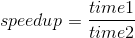

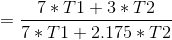
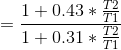
Where T2/T1 denotes how faster it is to access data from cache 1 as compared to memory.
Add Answer to:
Consider adding a fast second-level cache to a computer with only a single level cache. Suppose...
Question 4 - [25 Points] Part (a) - Average Access Time (AMAT) The average memory access time for a microprocessor with One (1) level (L1) of cache is 2.4 clock cycles - If data is present and val...
 Question 4 - [25 Points] Part (a) - Average Access Time (AMAT) The average memory access time for a microprocessor with One (1) level (L1) of cache is 2.4 clock cycles - If data is present and valid in the cache, it can be found in 1 clock cycle If data is not found in the cache, 80 clock cycles are needed to get it from off- chip memory Designers are trying to improve the average memory access time to...
1. Cache memory (8pts) Consider adding cache to a processor-memory system design. The microprocessor without cache needs 12 clock cycles to read a 16-bit word from the memory. With cache, it take...
 1. Cache memory (8pts) Consider adding cache to a processor-memory system design. The microprocessor without cache needs 12 clock cycles to read a 16-bit word from the memory. With cache, it takes only 4 clock cycles if the data happens to be in the cache and a total 20 clock cycles including the cache misses. a. What is the performance ratio of the cache system to the non-cache system given a hit rate of 80%? b. For what hit rate...
1. Cache memory (8pts) Consider adding cache to a processor-memory system desigrn. The microprocessor without cache needs 12 clock cycles to read a 16-bit word from the memory. With cache, it takes o...
 1. Cache memory (8pts) Consider adding cache to a processor-memory system desigrn. The microprocessor without cache needs 12 clock cycles to read a 16-bit word from the memory. With cache, it takes only 4 clock cycles if the data happens to be in the cache and a total 20 clock cycles including the cache misses a. What is the performance ratio of the cache system to the non-cache system given a hit rate of 80%? b. For what hit rate...
a) Calculate the AMAT for a cache system with one level of cache between the CPU...
a) Calculate the AMAT for a cache system with one level of cache between the CPU and Main Memory. Assume that the cache has a hit time of 1 cycle and a miss rate of 11%. Assume that the main memory requires 300 cycles to access (this is the hit time) and that all instructions and data can be found in the main memory (there are no misses). b) Let us modify the cache system from part (a) and add...
Computer system designers look for ways to improve system performance by advances in technology or change in design. Examples include the use of parallel processors, the use of a memory cache hier...
 Computer system designers look for ways to improve system performance by advances in technology or change in design. Examples include the use of parallel processors, the use of a memory cache hierarchy, and speedup in memory access time and I/O transfer rate due to technology improvements. Explain with reasons, which internal and external memories, and input/output will be used in your design to further improve computer system performance. Also, justify how you can organise/connect them all to maintain the computer...
A particular computer has a single level cache with a miss rate of 6.85%. You are...
A particular computer has a single level cache with a miss rate of 6.85%. You are required to design a second level cache that brings the global miss rate of the whole cache system to 3.98%. what would be the miss rate percent required for the second level cache?
Consider the following system: Byte addressable 16-bit addresses 256B pages Single level Page Table System The...
 Consider the following system: Byte addressable 16-bit addresses 256B pages Single level Page Table System The system utilizes a fully-associative TLB with 4 entries and an LRU replacement policy. Given the access pattern and timings below, complete the following table. Assume the TLB begins initially empty and the cache is physically addressed NOTE: Access times are not inclusive and components are accessed sequentially. Time to update the TLB is negligible, everything else that needs to be updated will require a...
suppose that execution time for a program is directly proportional to instruction access time and that...
suppose that execution time for a program is directly proportional to instruction access time and that access to an instruction in the cache is 20 times faster than access to an instruction in the main memory. assume that there is 96% chance to find the requested instruction in the cache (probability to find the requested instruction in the cache is 0.96), and also assume that if an instruction is not found in the cache, it must be first fetched from...
Consider a 64-bit computer with a simplified memory hierarchy. This hierarchy contains a single cache and...
Consider a 64-bit computer with a simplified memory hierarchy. This hierarchy contains a single cache and an unbounded backing memory. The cache has the following characteristics: • Direct-Mapped, Write-through, Write allocate. • Cache blocks are 4 words each. • The cache has 256 sets. (a) Calculate the cache’s size in bytes. (b) Consider the following code fragment in the C programming language to be run on the described computer. Assume that: program instructions are not stored in cache, arrays are...
.13 : Assume that we make an enhancement to a computer that improves some mode of...
.13 : Assume that we make an enhancement to a computer that improves some mode of execution by a factor of 10. Enhanced mode is used 50% of the time, measured as a percentage of the execution time when the enhanced mode is in use. Recall that Amdahl’s law depends on the fraction of the original, unenhanced execution time that could make use of enhanced mode. Thus, we cannot directly use this 50% measurement to compute speedup with Amdahl’s law....
 Question 4 - [25 Points] Part (a) - Average Access Time (AMAT) The average memory access time for a microprocessor with One (1) level (L1) of cache is 2.4 clock cycles - If data is present and valid in the cache, it can be found in 1 clock cycle If data is not found in the cache, 80 clock cycles are needed to get it from off- chip memory Designers are trying to improve the average memory access time to...
 1. Cache memory (8pts) Consider adding cache to a processor-memory system design. The microprocessor without cache needs 12 clock cycles to read a 16-bit word from the memory. With cache, it takes only 4 clock cycles if the data happens to be in the cache and a total 20 clock cycles including the cache misses. a. What is the performance ratio of the cache system to the non-cache system given a hit rate of 80%? b. For what hit rate...
 1. Cache memory (8pts) Consider adding cache to a processor-memory system desigrn. The microprocessor without cache needs 12 clock cycles to read a 16-bit word from the memory. With cache, it takes only 4 clock cycles if the data happens to be in the cache and a total 20 clock cycles including the cache misses a. What is the performance ratio of the cache system to the non-cache system given a hit rate of 80%? b. For what hit rate...
 Computer system designers look for ways to improve system performance by advances in technology or change in design. Examples include the use of parallel processors, the use of a memory cache hierarchy, and speedup in memory access time and I/O transfer rate due to technology improvements. Explain with reasons, which internal and external memories, and input/output will be used in your design to further improve computer system performance. Also, justify how you can organise/connect them all to maintain the computer...
 Consider the following system: Byte addressable 16-bit addresses 256B pages Single level Page Table System The system utilizes a fully-associative TLB with 4 entries and an LRU replacement policy. Given the access pattern and timings below, complete the following table. Assume the TLB begins initially empty and the cache is physically addressed NOTE: Access times are not inclusive and components are accessed sequentially. Time to update the TLB is negligible, everything else that needs to be updated will require a...
Most questions answered within 3 hours.
-
Where is the error in this code sequence?
String s1 = "Hello";
String s2 = "ello";...
asked 10 months ago -
Financial data for Joel de Paris, Inc., for last year
follow:
Joel de Paris, Inc.
Balance...
asked 10 months ago -
Consider this reaction:
Al2(SO4)3 (aq)+ BaCl3
(aq) Al2Cl6 (aq)- +
3BaSO4(s) . What is the...
asked 10 months ago -
Suppose that Savneet is considering increasing her
recent random sample from 20 car rentals to 40...
asked 10 months ago -
Trucks arrive at an unloading terminal at an average rate of 120
per hour.
Trucks arrive...
asked 10 months ago -
Why are methanol and ethanol completely soluble in water while
octanol is not very little soluble....
asked 10 months ago -
A facilities manager at a university reads in a research report
that the mean amount of...
asked 10 months ago -
When the CuSO4 is rehydrated by adding water to the anhydrous
compound, is this an endothermic...
asked 10 months ago -
A ray of sunlight is passing from diamond into crown glass; the
angle of incidence is...
asked 10 months ago -
A block of mass 0.249 kg is placed on top of a light, vertical
spring of...
asked 10 months ago -
how do the kidneys compensate in the presences of acidosis
a) trigger hyperventilate
b) reserve acid...
asked 10 months ago -
Question 501 pts
The rental rate of capital to the firm increases. Which of the
following...
asked 10 months ago