Dideoxy nucleotides that are used in DNA sequencing experiments terminate DNA synthesis because they: cannot be...
Dideoxy nucleotides that are used in DNA sequencing experiments terminate DNA synthesis because they:
|
cannot be recognized by DNA polymerases and therefore are not incorporated during synthesis. |
||
|
have no 3′ -OH group and so no additional nucleotides can be added after these nucleotides are incorporated. |
||
|
have no phosphate groups. |
||
|
are only recognized by reverse transcriptases. |
||
|
have methyl groups attached to the 5′ position of the sugar and cannot be incorporated during synthesis. |
Homework Answers
Dideoxy nucleotides have no 3'-OH group and so no additional nucleotides can be added after these nucleotides are incorporated.
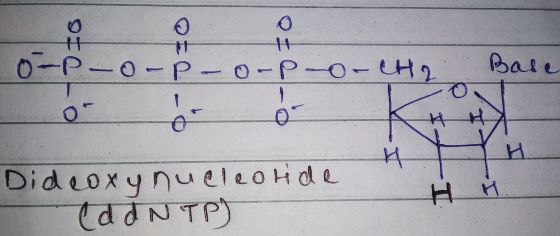
The Sanger's method of DNA sequencing is based upon chain termination, which occurs due to the incorporation of dideoxy nucleotides. Sample DNA, that needs to be sequenced, is divided into four tubes. To each of the four tubes, primer sequence, DNA polymerase and standard deoxy nucleotides are added. One additional ingredient added into these tubes is dideoxy nucleotides. Synthesis of new DNA is allowed to take place. New deoxy nucleotides are continued to be added, but as a dideoxy nucleotide is added, extension terminates. The structure of the dideoxy nucleotide is responsible for this termination. Dideoxy nucleotides, unlike deoxy nucleotides, do not have 3'-OH group, on the other hand, phosphodiester bond is created between the 3'-OH of the last incorporated nucleotide and the 5'-phosphate of the incoming nucleotide. In the absence of 3'-OH group, DNA polymerase cannot add new nucleotides. Hence, addition of dideoxy nucleotides terminates DNA synthesis.
The structure of a dideoxy nucleotide has been given below-
Add Answer to:
Dideoxy nucleotides that are used in DNA sequencing experiments
terminate DNA synthesis because they:
cannot be...
Dideoxy NTPs (ddNTPs) are used in sequencing reaction to terminate DNA polymerization reaction at various chain...
 Dideoxy NTPs (ddNTPs) are used in sequencing reaction to terminate DNA polymerization reaction at various chain lengths. Which OH group on the carbohydrate (ribose) molecule is deoxidized in ddNTP, thus causes DNA polymerization to stop? O OH group on 1' carbon is deoxidized to-H O OH group on 2' carbon is deoxidized to-H O OH group on 3' carbon is deoxidized to -H O OH group on 4' carbon is deoxidized to-H O OH group on 5' carbon is deoxidized...
Why are next-generation DNA sequencing technologies known as sequencing-by-synthesis? Why are next-generation DNA sequencing technologies known...
Why are next-generation DNA sequencing technologies known as sequencing-by-synthesis? Why are next-generation DNA sequencing technologies known as sequencing-by-synthesis? The complete DNA strands are synthesized then sequenced. Numerous synthesized fragments of DNA are sequenced to determine which nucleotides were incorporated. The sequencing occurs during S phase of the cell cycle. RNA molecules are synthesized off of the DNA templates and the incorporated nucleotides are then determined. Incorporated nucleotides are determined while they are being added to a growing DNA strand.
To incorporate radiolabeled nucleotides into newly synthesized DNA, researchers use α-phosphorus32-labeled nucleotides, in a DNA synthesis...
To incorporate radiolabeled nucleotides into newly synthesized DNA, researchers use α-phosphorus32-labeled nucleotides, in a DNA synthesis reaction, where the α denotes the position of the radioactive phosphate moiety. Explain why the α position--rather than the β or γ positions--is the best position for the radioactive group in these experiments.
please help with all three! For DNA synthesis to take place in a Sanger sequencing reaction,...
 please help with all three!
For DNA synthesis to take place in a Sanger sequencing reaction, the DNA polymerase must catalyze a reaction between the 3'- the last nucleotide and the 5- of the next nucleotide to be added. hydroxyl group, phosphate group O phosphate group, hydroxyl group O hydroxyl group, hydroxyl group O phosphate group, phosphate group QUESTION 6 millions of individual DNA fragments are isolated and sequenced in parallel during each machine run. O traditional whole-genome sequencing O...
please help with all three!
For DNA synthesis to take place in a Sanger sequencing reaction, the DNA polymerase must catalyze a reaction between the 3'- the last nucleotide and the 5- of the next nucleotide to be added. hydroxyl group, phosphate group O phosphate group, hydroxyl group O hydroxyl group, hydroxyl group O phosphate group, phosphate group QUESTION 6 millions of individual DNA fragments are isolated and sequenced in parallel during each machine run. O traditional whole-genome sequencing O...
14.7 A number of antiviral drugs act by preventing viral DNA synthesis. These drugs are typically...
14.7 A number of antiviral drugs act by preventing viral DNA synthesis. These drugs are typically chemically similar to nucleotides with a modification. For example, the drug may contain all relevant components of a nucleotide, including a proper purine or pyrimidine base, but lack the 3' OH group. How would this modification allow this drug to prevent viral DNA synthesis? A. Once inserted into a growing DNA chain, the drug will not be able to form a normal double-helix, as...
The following diagram represents a replication bubble associated with DNA synthesis. Based on this diagram, select...
 The following diagram represents a replication bubble associated
with DNA synthesis. Based on this diagram, select all of the
options below that are true.
1 | 2 ---- Quadrants 1 and 4 are associated with lagging strand synthesis Quadrants 1 and 4 are associated with leading strand synthesis Quadrants 1 and 2 are associated with lagging strand synthesis Quadrants 3 and 4 are associated with lagging strand synthesis Synthesis of both daughter strands is completely continuous Telomerase activity is needed...
The following diagram represents a replication bubble associated
with DNA synthesis. Based on this diagram, select all of the
options below that are true.
1 | 2 ---- Quadrants 1 and 4 are associated with lagging strand synthesis Quadrants 1 and 4 are associated with leading strand synthesis Quadrants 1 and 2 are associated with lagging strand synthesis Quadrants 3 and 4 are associated with lagging strand synthesis Synthesis of both daughter strands is completely continuous Telomerase activity is needed...
1- Sucrose does not react with Fehling's reagent because A- Sucrose is not a reducing sugar....
1- Sucrose does not react with Fehling's reagent because A- Sucrose is not a reducing sugar. B) The anomeric carbon of glucose is involved in the glucose- fructose bond and hence is not free to form the aldehyde in solution. C) The monosaacharide constituents of sucrose no longer have an anomeric carbon with a free potential aldehyde or ketone group, and therefore no longer exhibits reducing properties. D) sucrose is a disaccharide of glucose and fructose in which the oxygen...
What are the three functional groups that comprise a nucleotide? What do nucleotides have in common...
What are the three functional groups that comprise a nucleotide? What do nucleotides have in common with amino acids or simple sugars? When the structure of DNA was first elucidated, many biologists quickly saw how this structure explained the passage of information from one generation to another. How does the structure of DNA explain generation-to-generation flow of information? In other words, give a brief description of the structure of DNA and tell how this structure allows for replication. Which of...
Please help with 1-16!!! (two pictures are attached) Thanks! Transcription . Although both prokaryotes and eukaryotes...
 Please help with 1-16!!! (two pictures are attached) Thanks!
Transcription . Although both prokaryotes and eukaryotes put a cap and a tail on the mRNA, only eukaryotes have introns that have to be spliced out. (T/F) 2. The poly A tail on cukaryotic mRNA protects the RNA from rapid degradation in the cytoplasm. (T/F) 3. The polyA tail is added to eukaryotic mRNA immediatel after transport of the message from the nucleus. (T/F) 4. is usually a single stranded molecule....
Please help with 1-16!!! (two pictures are attached) Thanks!
Transcription . Although both prokaryotes and eukaryotes put a cap and a tail on the mRNA, only eukaryotes have introns that have to be spliced out. (T/F) 2. The poly A tail on cukaryotic mRNA protects the RNA from rapid degradation in the cytoplasm. (T/F) 3. The polyA tail is added to eukaryotic mRNA immediatel after transport of the message from the nucleus. (T/F) 4. is usually a single stranded molecule....
What is the Central Dogma of genetics? -- EXPLAIN Corynebacterium diptheriae, the causative agent of diptheria,...
What is the Central Dogma of genetics? -- EXPLAIN Corynebacterium diptheriae, the causative agent of diptheria, secretes a toxin that enzymatically inactivates all molecules of elongation factor in a eukaryotic cell. What immediate and long-term effects does this have on the cellular metabolism of an infected person? -- EXPLAIN What is the difference between horizontal gene transfer and vertical gene transfer? -- EXPLAIN After running gel electrophoresis, what do the black bands represent? What can those bands tell us, and...
 Dideoxy NTPs (ddNTPs) are used in sequencing reaction to terminate DNA polymerization reaction at various chain lengths. Which OH group on the carbohydrate (ribose) molecule is deoxidized in ddNTP, thus causes DNA polymerization to stop? O OH group on 1' carbon is deoxidized to-H O OH group on 2' carbon is deoxidized to-H O OH group on 3' carbon is deoxidized to -H O OH group on 4' carbon is deoxidized to-H O OH group on 5' carbon is deoxidized...
 please help with all three!
For DNA synthesis to take place in a Sanger sequencing reaction, the DNA polymerase must catalyze a reaction between the 3'- the last nucleotide and the 5- of the next nucleotide to be added. hydroxyl group, phosphate group O phosphate group, hydroxyl group O hydroxyl group, hydroxyl group O phosphate group, phosphate group QUESTION 6 millions of individual DNA fragments are isolated and sequenced in parallel during each machine run. O traditional whole-genome sequencing O...
please help with all three!
For DNA synthesis to take place in a Sanger sequencing reaction, the DNA polymerase must catalyze a reaction between the 3'- the last nucleotide and the 5- of the next nucleotide to be added. hydroxyl group, phosphate group O phosphate group, hydroxyl group O hydroxyl group, hydroxyl group O phosphate group, phosphate group QUESTION 6 millions of individual DNA fragments are isolated and sequenced in parallel during each machine run. O traditional whole-genome sequencing O...
 The following diagram represents a replication bubble associated
with DNA synthesis. Based on this diagram, select all of the
options below that are true.
1 | 2 ---- Quadrants 1 and 4 are associated with lagging strand synthesis Quadrants 1 and 4 are associated with leading strand synthesis Quadrants 1 and 2 are associated with lagging strand synthesis Quadrants 3 and 4 are associated with lagging strand synthesis Synthesis of both daughter strands is completely continuous Telomerase activity is needed...
The following diagram represents a replication bubble associated
with DNA synthesis. Based on this diagram, select all of the
options below that are true.
1 | 2 ---- Quadrants 1 and 4 are associated with lagging strand synthesis Quadrants 1 and 4 are associated with leading strand synthesis Quadrants 1 and 2 are associated with lagging strand synthesis Quadrants 3 and 4 are associated with lagging strand synthesis Synthesis of both daughter strands is completely continuous Telomerase activity is needed...
 Please help with 1-16!!! (two pictures are attached) Thanks!
Transcription . Although both prokaryotes and eukaryotes put a cap and a tail on the mRNA, only eukaryotes have introns that have to be spliced out. (T/F) 2. The poly A tail on cukaryotic mRNA protects the RNA from rapid degradation in the cytoplasm. (T/F) 3. The polyA tail is added to eukaryotic mRNA immediatel after transport of the message from the nucleus. (T/F) 4. is usually a single stranded molecule....
Please help with 1-16!!! (two pictures are attached) Thanks!
Transcription . Although both prokaryotes and eukaryotes put a cap and a tail on the mRNA, only eukaryotes have introns that have to be spliced out. (T/F) 2. The poly A tail on cukaryotic mRNA protects the RNA from rapid degradation in the cytoplasm. (T/F) 3. The polyA tail is added to eukaryotic mRNA immediatel after transport of the message from the nucleus. (T/F) 4. is usually a single stranded molecule....
Most questions answered within 3 hours.
-
Where is the error in this code sequence?
String s1 = "Hello";
String s2 = "ello";...
asked 10 months ago -
Financial data for Joel de Paris, Inc., for last year
follow:
Joel de Paris, Inc.
Balance...
asked 10 months ago -
Consider this reaction:
Al2(SO4)3 (aq)+ BaCl3
(aq) Al2Cl6 (aq)- +
3BaSO4(s) . What is the...
asked 10 months ago -
Suppose that Savneet is considering increasing her
recent random sample from 20 car rentals to 40...
asked 10 months ago -
Trucks arrive at an unloading terminal at an average rate of 120
per hour.
Trucks arrive...
asked 10 months ago -
Why are methanol and ethanol completely soluble in water while
octanol is not very little soluble....
asked 10 months ago -
A facilities manager at a university reads in a research report
that the mean amount of...
asked 10 months ago -
When the CuSO4 is rehydrated by adding water to the anhydrous
compound, is this an endothermic...
asked 10 months ago -
A ray of sunlight is passing from diamond into crown glass; the
angle of incidence is...
asked 10 months ago -
A block of mass 0.249 kg is placed on top of a light, vertical
spring of...
asked 10 months ago -
how do the kidneys compensate in the presences of acidosis
a) trigger hyperventilate
b) reserve acid...
asked 10 months ago -
Question 501 pts
The rental rate of capital to the firm increases. Which of the
following...
asked 10 months ago