
Homework Answers
Add Answer to:
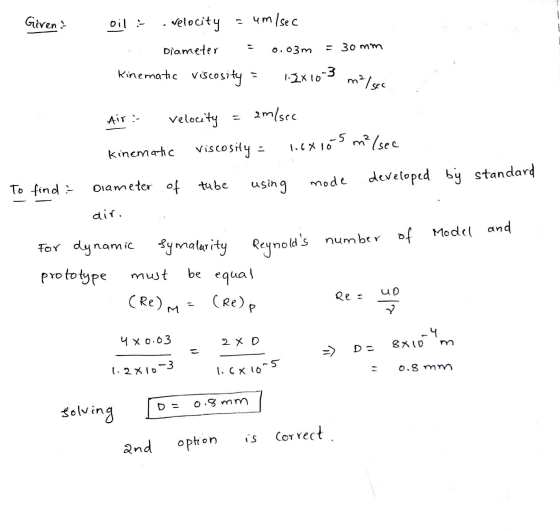
Oil flows with a velocity of 4 m/s through a 30 mm diameter tube. A model...
Question 4 Oil flows with a velocity of 4 m/s through a 30 mm diameter tube....
 Question 4 Oil flows with a velocity of 4 m/s through a 30 mm diameter tube. A model of this system is to be developed using standard air as the model fluid. The air velocity is to be 2 m/s. What tube diameter is required for the model if dynamic similarity is to be maintained between model and prototype? Kinematic viscosity of air = 16 x 105 m2/s, Kinematic viscosity of oil 1,2 x 10³ m2/s 0.45 mm 0.8 mm...
A 25 mm diameter shaft is rotated at 200 rpm in a lubricated cylindrical bearing of...
A 25 mm diameter shaft is rotated at 200 rpm in a lubricated cylindrical bearing of diameter 25.5 mm (the figure below). The lubrication oil (SG = 0.86) that fills the gap between the shaft and bearing has an initial kinematic viscosity of 2200 mm2/s. After 5 minutes of running the temperature of the oil increases and the dynamic viscosity decreases by 90 %. Determine the reduction in shaft torque (T) that occurs from startup to after 5 minutes of...
LECTURE Sp 1. Oil (relative density 0.85, dynamic viscosity-4.5x10⁻²kg/m-s) flows through a 75 mm diameter pipe...
 LECTURE Sp 1. Oil (relative density 0.85, dynamic viscosity-4.5x10⁻²kg/m-s) flows through a 75 mm diameter pipe with a mean velocity of 0.65 m/s. Determine i. the pressure drop in a 500 m length, ii- the friction factor, ii the head loss due to friction, iv. the maximunn velocity, and v. the velocity at 30 mm from the pipe wall. (10 marks) 46 2 9 3 8 4 5 6
Problem 6: Measurements of drag force are made on a model automobile in a towing tank...
 Problem 6: Measurements of drag force are made on a model automobile in a towing tank filled with fresh water. The model length scale is 1/5 that of the prototype. State the conditions required to ensure dynamic similarity between the model and prototype. Determine the fraction of the prototype speed in air at which the model test should be made in water to ensure dynamically similar conditions Measurements made at various speeds show that the dimensionless force ratio becomes constant...
7. Two capillary tubes are placed vertically in an open container of water. One tube has...
 7. Two capillary tubes are placed vertically in an open container of water. One tube has a diameter of 2.0 mm, and the other a diameter of 1.0 inch. In which tube will the water rise higher? 8. A sliding plate viscometer, as shown below, is used to measure the viscosity of a fluid. The plate area is 0.75 fr. A force of 1.5 x 10 lb moves the upper plate at a velocity of 10.0 ft/s. What is the...
An oil preheater consists of a single tube of 30-mm diameter and 7-m length, with its...
 An oil preheater consists of a single tube of 30-mm diameter and 7-m length, with its surface maintained at 200°C by swirling combustion gasses. The engine oil enters at 90°C and comes out at 144°C. Assume the flow is laminar and both hydraulically and thermally fully developed. Answer the following questions: (a) What flow rate must be supplied to maintain the oil outlet temperature of 144°C? (b) What is the corresponding heat transfer rate? (c) Discuss how you may refine...
(40 points) Engine oil flows at a rate of 1 kg/s through a 5-mm diameter smooth straight tube. Th...
 (40 points) Engine oil flows at a rate of 1 kg/s through a 5-mm diameter smooth straight tube. The oil has an inlet temperature of 47°C and it is desired to heat the oil to a mean temperature of 87°C at the exit of the tube. The surface of the tube is maintained at 150°C. Assuming the flow is fully developed both hydrodynamically and thermally, determine the required length of the tube. Note: by calculating Reynolds number at the entrance...
2. The kinetic viscosity of a hydraulic oil is 110cP. The oil is flowing in a 20-mm diameter commercial steel pipe with the length of 45-m. If the velocity of oil is 4-m/s and specific gravity is...
 2. The kinetic viscosity of a hydraulic oil is 110cP. The oil is flowing in a 20-mm diameter commercial steel pipe with the length of 45-m. If the velocity of oil is 4-m/s and specific gravity is 0.9 find the following a. Reynolds number b. Friction factor c. Head losses.
2. The kinetic viscosity of a hydraulic oil is 110cP. The oil is flowing in a 20-mm diameter commercial steel pipe with the length of 45-m. If the velocity of...
2. The kinetic viscosity of a hydraulic oil is 110cP. The oil is flowing in a 20-mm diameter commercial steel pipe with the length of 45-m. If the velocity of oil is 4-m/s and specific gravity is 0.9 find the following a. Reynolds number b. Friction factor c. Head losses.
2. The kinetic viscosity of a hydraulic oil is 110cP. The oil is flowing in a 20-mm diameter commercial steel pipe with the length of 45-m. If the velocity of...
A 10-mm diameter tube has a maintained surface temperature of 180°C. Engine oil enters the tube...
 A 10-mm diameter tube has a maintained surface temperature of 180°C. Engine oil enters the tube at 70°C at a flow rate of 1.3 kg/s and exits at 105°C. Find the length, in m, of the tube and well as the corresponding heat transfer rate, in W. Assume fully developed flow and use the Dittus-Boelter equation to calculate the average Nusselt number. q= W L= m
1) Air under standard conditions flows through a 5 mm diameter drawn tubing with an average...
 1) Air under standard conditions flows through a 5 mm diameter drawn tubing with an average velocity of V 40 m/s. Determine the pressure drop (Ap) and head loss (h) if the length of tube is 10 cm. Assume minor losses are zero. Air density 1.23 kg/m3 Air viscosity 0.0000179 N.s/m2
 Question 4 Oil flows with a velocity of 4 m/s through a 30 mm diameter tube. A model of this system is to be developed using standard air as the model fluid. The air velocity is to be 2 m/s. What tube diameter is required for the model if dynamic similarity is to be maintained between model and prototype? Kinematic viscosity of air = 16 x 105 m2/s, Kinematic viscosity of oil 1,2 x 10³ m2/s 0.45 mm 0.8 mm...
 LECTURE Sp 1. Oil (relative density 0.85, dynamic viscosity-4.5x10⁻²kg/m-s) flows through a 75 mm diameter pipe with a mean velocity of 0.65 m/s. Determine i. the pressure drop in a 500 m length, ii- the friction factor, ii the head loss due to friction, iv. the maximunn velocity, and v. the velocity at 30 mm from the pipe wall. (10 marks) 46 2 9 3 8 4 5 6
 Problem 6: Measurements of drag force are made on a model automobile in a towing tank filled with fresh water. The model length scale is 1/5 that of the prototype. State the conditions required to ensure dynamic similarity between the model and prototype. Determine the fraction of the prototype speed in air at which the model test should be made in water to ensure dynamically similar conditions Measurements made at various speeds show that the dimensionless force ratio becomes constant...
 7. Two capillary tubes are placed vertically in an open container of water. One tube has a diameter of 2.0 mm, and the other a diameter of 1.0 inch. In which tube will the water rise higher? 8. A sliding plate viscometer, as shown below, is used to measure the viscosity of a fluid. The plate area is 0.75 fr. A force of 1.5 x 10 lb moves the upper plate at a velocity of 10.0 ft/s. What is the...
 An oil preheater consists of a single tube of 30-mm diameter and 7-m length, with its surface maintained at 200°C by swirling combustion gasses. The engine oil enters at 90°C and comes out at 144°C. Assume the flow is laminar and both hydraulically and thermally fully developed. Answer the following questions: (a) What flow rate must be supplied to maintain the oil outlet temperature of 144°C? (b) What is the corresponding heat transfer rate? (c) Discuss how you may refine...
 (40 points) Engine oil flows at a rate of 1 kg/s through a 5-mm diameter smooth straight tube. The oil has an inlet temperature of 47°C and it is desired to heat the oil to a mean temperature of 87°C at the exit of the tube. The surface of the tube is maintained at 150°C. Assuming the flow is fully developed both hydrodynamically and thermally, determine the required length of the tube. Note: by calculating Reynolds number at the entrance...
 2. The kinetic viscosity of a hydraulic oil is 110cP. The oil is flowing in a 20-mm diameter commercial steel pipe with the length of 45-m. If the velocity of oil is 4-m/s and specific gravity is 0.9 find the following a. Reynolds number b. Friction factor c. Head losses.
2. The kinetic viscosity of a hydraulic oil is 110cP. The oil is flowing in a 20-mm diameter commercial steel pipe with the length of 45-m. If the velocity of...
2. The kinetic viscosity of a hydraulic oil is 110cP. The oil is flowing in a 20-mm diameter commercial steel pipe with the length of 45-m. If the velocity of oil is 4-m/s and specific gravity is 0.9 find the following a. Reynolds number b. Friction factor c. Head losses.
2. The kinetic viscosity of a hydraulic oil is 110cP. The oil is flowing in a 20-mm diameter commercial steel pipe with the length of 45-m. If the velocity of...
 A 10-mm diameter tube has a maintained surface temperature of 180°C. Engine oil enters the tube at 70°C at a flow rate of 1.3 kg/s and exits at 105°C. Find the length, in m, of the tube and well as the corresponding heat transfer rate, in W. Assume fully developed flow and use the Dittus-Boelter equation to calculate the average Nusselt number. q= W L= m
 1) Air under standard conditions flows through a 5 mm diameter drawn tubing with an average velocity of V 40 m/s. Determine the pressure drop (Ap) and head loss (h) if the length of tube is 10 cm. Assume minor losses are zero. Air density 1.23 kg/m3 Air viscosity 0.0000179 N.s/m2
Most questions answered within 3 hours.
-
Where is the error in this code sequence?
String s1 = "Hello";
String s2 = "ello";...
asked 11 months ago -
Financial data for Joel de Paris, Inc., for last year
follow:
Joel de Paris, Inc.
Balance...
asked 11 months ago -
Consider this reaction:
Al2(SO4)3 (aq)+ BaCl3
(aq) Al2Cl6 (aq)- +
3BaSO4(s) . What is the...
asked 11 months ago -
Suppose that Savneet is considering increasing her
recent random sample from 20 car rentals to 40...
asked 11 months ago -
Trucks arrive at an unloading terminal at an average rate of 120
per hour.
Trucks arrive...
asked 11 months ago -
Why are methanol and ethanol completely soluble in water while
octanol is not very little soluble....
asked 11 months ago -
A facilities manager at a university reads in a research report
that the mean amount of...
asked 11 months ago -
When the CuSO4 is rehydrated by adding water to the anhydrous
compound, is this an endothermic...
asked 11 months ago -
A ray of sunlight is passing from diamond into crown glass; the
angle of incidence is...
asked 11 months ago -
A block of mass 0.249 kg is placed on top of a light, vertical
spring of...
asked 11 months ago -
how do the kidneys compensate in the presences of acidosis
a) trigger hyperventilate
b) reserve acid...
asked 11 months ago -
Question 501 pts
The rental rate of capital to the firm increases. Which of the
following...
asked 11 months ago