
Homework Answers
Add Answer to:
6. Demonstrate with calculations the transfer function of the circuit below. Then calculate the pole and...
Can you help me solve this problem and show the steps? Demonstrate with calculations the transfer...
 Can you help me solve this problem and show the steps?
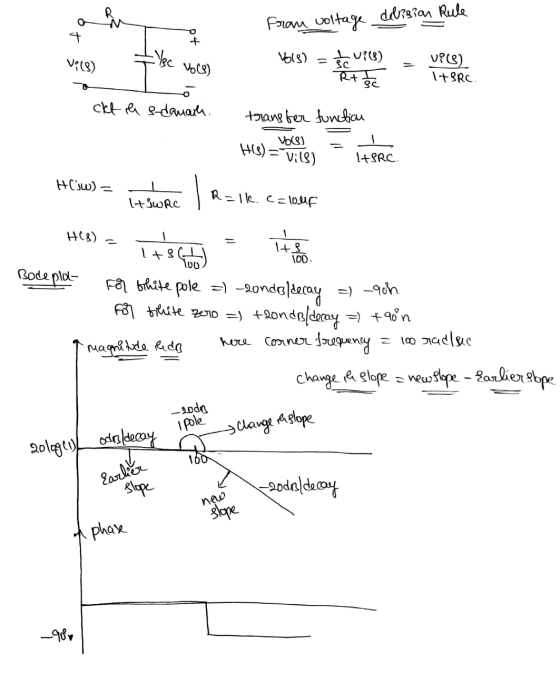
Demonstrate with calculations the transfer function of the circuit below. Then calculate the pole and zero for R = 1 kOhm and C = 10 uF (micro Farads). Then draw the magnitude and phase plots as a function of frequency. If your drawing is not square, you will lose 2 pts per crooked line. R + + Vin(t) C: Vou(t)
Can you help me solve this problem and show the steps?
Demonstrate with calculations the transfer function of the circuit below. Then calculate the pole and zero for R = 1 kOhm and C = 10 uF (micro Farads). Then draw the magnitude and phase plots as a function of frequency. If your drawing is not square, you will lose 2 pts per crooked line. R + + Vin(t) C: Vou(t)
Calculate the pole and zero for R = 1kOhm and C = 10uF. Draw magnitude and...
 Calculate the pole and zero for R = 1kOhm and C = 10uF.
Draw magnitude and phase plots as a function of
frequency.
R + + CE Yout(t) (a) R + + Vin(s) = Vour(s) SC (b) FIGURE 14.27 (a) A simple resistor-capacitor circuit, with an input voltage and output voltage specified. (b) The s-domain equivalent circuit.
Calculate the pole and zero for R = 1kOhm and C = 10uF.
Draw magnitude and phase plots as a function of
frequency.
R + + CE Yout(t) (a) R + + Vin(s) = Vour(s) SC (b) FIGURE 14.27 (a) A simple resistor-capacitor circuit, with an input voltage and output voltage specified. (b) The s-domain equivalent circuit.
For each of the transfer functions given below, draw the pole-zero plot and plot the magnitude separate from the phase as a function of frequency. Show only the asymptotic terms that make up the tra...
 For each of the transfer functions given below, draw the pole-zero plot and plot the magnitude separate from the phase as a function of frequency. Show only the asymptotic terms that make up the transfer function and then add them to show the composite plot. You can verify your plots (to some extent) by using MATLAB to generate the plots but only as a check that the work you have done is correct. The work that will count for points...
Find the transfer function T(jw) for the circuit below. Also find the magnitude response, 0 OP000...
 Find the transfer function T(jw) for the circuit below. Also find the magnitude response, 0 OP000 + + C R 1 phase response and draw the bode plots for the above circuit and derived transfer function. (10 points)
For each of the transfer functions given below, draw the pole-zero plot and using the log- semilog paper provided on Blackboard to plot the magnitude separate from the phase as a function of frequenc...
 For each of the transfer functions given below, draw the pole-zero plot and using the log- semilog paper provided on Blackboard to plot the magnitude separate from the phase as a function of frequency. Show only the asymptotic terms that make up the transfer function and then add them to show the composite plot. You can verify your plots (to some extent) by using MATLAB to generate the plots but only as a check that the work you have done...
Find the transfer function H(jω) for the circuit above as a function of jω. (Leave R...
 Find the transfer function H(jω) for the
circuit above as a function of jω. (Leave R and L as variables).
Assume V R to be the output and V S to be the input.
С L RVR(t) vs (t) A. Find the transfer function H(jo) for the circuit above as a function of jaw. (Leave R and L as variables). Assume V to be the output and V to be the input. S R B. Find the Magnitude and Phase...
Find the transfer function H(jω) for the
circuit above as a function of jω. (Leave R and L as variables).
Assume V R to be the output and V S to be the input.
С L RVR(t) vs (t) A. Find the transfer function H(jo) for the circuit above as a function of jaw. (Leave R and L as variables). Assume V to be the output and V to be the input. S R B. Find the Magnitude and Phase...
1. Find the numerical expression for the transfer function from Vi(t) to V.(t), for each circuit ...
 1. Find the numerical expression for the transfer function from Vi(t) to V.(t), for each circuit below, and sketch the magnitude and phase of the transfer function, as functions of w. For these plots, show the w axis on a log 10 scale, and show the amplitude of the transfer function on a decibel scale. 0.1uF V(t) 0.1 uF 250mH V(t) 250mH 2k2 V(t) 10k2 0.25μF Vo(t)
1. Find the numerical expression for the transfer function from Vi(t) to V.(t),...
1. Find the numerical expression for the transfer function from Vi(t) to V.(t), for each circuit below, and sketch the magnitude and phase of the transfer function, as functions of w. For these plots, show the w axis on a log 10 scale, and show the amplitude of the transfer function on a decibel scale. 0.1uF V(t) 0.1 uF 250mH V(t) 250mH 2k2 V(t) 10k2 0.25μF Vo(t)
1. Find the numerical expression for the transfer function from Vi(t) to V.(t),...
Figure 2 shows the circuit of a filter, whose half-power frequency (break frequency) is defined as...
 Figure 2 shows the circuit of a filter, whose half-power frequency (break frequency) is defined as 1 1 -j 27T fC 27TRC + + Vin V out Figure 2 Find the circuit transfer function, H() (i) [2] Given C 2uF, R= , draw the asymptotic Bode magnitude and phase plots for the (ii) circuit [7]
Figure 2 shows the circuit of a filter, whose half-power frequency (break frequency) is defined as 1 1 -j 27T fC 27TRC + + Vin...
Figure 2 shows the circuit of a filter, whose half-power frequency (break frequency) is defined as 1 1 -j 27T fC 27TRC + + Vin V out Figure 2 Find the circuit transfer function, H() (i) [2] Given C 2uF, R= , draw the asymptotic Bode magnitude and phase plots for the (ii) circuit [7]
Figure 2 shows the circuit of a filter, whose half-power frequency (break frequency) is defined as 1 1 -j 27T fC 27TRC + + Vin...
Consider the filter circuit (Figure 1) with R=500 N and C ==uF. Learning Goal: To understand...
 Consider the filter circuit (Figure 1) with R=500 N and C ==uF. Learning Goal: To understand how to find the transfer function of a filter circuit and to be able to draw the asymptotes of the Bode magnitude and phase diagrams Bode plots are used to display the amplitude and phase of a transfer function. The amplitude is typically displayed by showing the magnitude of the transfer function on the vertical axis and the frequency on the horizontal axis using...
The circuit above has the following parameters:
 The circuit above has the following parameters: R=55 Ohm, C=1.5 uF ("u"=micro), L1=3 mH, L2=4 mH; Using MATLAB (or equivalent tool) generate the transfer function H = Vo/Vi magnitude MdB(f) and Phase(f) frequency dependencies in the frequency range from 100 Hz to 12000 Hz. Define the Magntude plot of the transfer function by entering f (Hz) and M (dB) points. Do not enter units.Define the Phase plot of the transfer function by entering f (Hz) and Phase (in degrees) points. Do not enter...
 Can you help me solve this problem and show the steps?
Demonstrate with calculations the transfer function of the circuit below. Then calculate the pole and zero for R = 1 kOhm and C = 10 uF (micro Farads). Then draw the magnitude and phase plots as a function of frequency. If your drawing is not square, you will lose 2 pts per crooked line. R + + Vin(t) C: Vou(t)
Can you help me solve this problem and show the steps?
Demonstrate with calculations the transfer function of the circuit below. Then calculate the pole and zero for R = 1 kOhm and C = 10 uF (micro Farads). Then draw the magnitude and phase plots as a function of frequency. If your drawing is not square, you will lose 2 pts per crooked line. R + + Vin(t) C: Vou(t)
 Calculate the pole and zero for R = 1kOhm and C = 10uF.
Draw magnitude and phase plots as a function of
frequency.
R + + CE Yout(t) (a) R + + Vin(s) = Vour(s) SC (b) FIGURE 14.27 (a) A simple resistor-capacitor circuit, with an input voltage and output voltage specified. (b) The s-domain equivalent circuit.
Calculate the pole and zero for R = 1kOhm and C = 10uF.
Draw magnitude and phase plots as a function of
frequency.
R + + CE Yout(t) (a) R + + Vin(s) = Vour(s) SC (b) FIGURE 14.27 (a) A simple resistor-capacitor circuit, with an input voltage and output voltage specified. (b) The s-domain equivalent circuit.
 For each of the transfer functions given below, draw the pole-zero plot and plot the magnitude separate from the phase as a function of frequency. Show only the asymptotic terms that make up the transfer function and then add them to show the composite plot. You can verify your plots (to some extent) by using MATLAB to generate the plots but only as a check that the work you have done is correct. The work that will count for points...
 Find the transfer function T(jw) for the circuit below. Also find the magnitude response, 0 OP000 + + C R 1 phase response and draw the bode plots for the above circuit and derived transfer function. (10 points)
 For each of the transfer functions given below, draw the pole-zero plot and using the log- semilog paper provided on Blackboard to plot the magnitude separate from the phase as a function of frequency. Show only the asymptotic terms that make up the transfer function and then add them to show the composite plot. You can verify your plots (to some extent) by using MATLAB to generate the plots but only as a check that the work you have done...
 Find the transfer function H(jω) for the
circuit above as a function of jω. (Leave R and L as variables).
Assume V R to be the output and V S to be the input.
С L RVR(t) vs (t) A. Find the transfer function H(jo) for the circuit above as a function of jaw. (Leave R and L as variables). Assume V to be the output and V to be the input. S R B. Find the Magnitude and Phase...
Find the transfer function H(jω) for the
circuit above as a function of jω. (Leave R and L as variables).
Assume V R to be the output and V S to be the input.
С L RVR(t) vs (t) A. Find the transfer function H(jo) for the circuit above as a function of jaw. (Leave R and L as variables). Assume V to be the output and V to be the input. S R B. Find the Magnitude and Phase...
 1. Find the numerical expression for the transfer function from Vi(t) to V.(t), for each circuit below, and sketch the magnitude and phase of the transfer function, as functions of w. For these plots, show the w axis on a log 10 scale, and show the amplitude of the transfer function on a decibel scale. 0.1uF V(t) 0.1 uF 250mH V(t) 250mH 2k2 V(t) 10k2 0.25μF Vo(t)
1. Find the numerical expression for the transfer function from Vi(t) to V.(t),...
1. Find the numerical expression for the transfer function from Vi(t) to V.(t), for each circuit below, and sketch the magnitude and phase of the transfer function, as functions of w. For these plots, show the w axis on a log 10 scale, and show the amplitude of the transfer function on a decibel scale. 0.1uF V(t) 0.1 uF 250mH V(t) 250mH 2k2 V(t) 10k2 0.25μF Vo(t)
1. Find the numerical expression for the transfer function from Vi(t) to V.(t),...
 Figure 2 shows the circuit of a filter, whose half-power frequency (break frequency) is defined as 1 1 -j 27T fC 27TRC + + Vin V out Figure 2 Find the circuit transfer function, H() (i) [2] Given C 2uF, R= , draw the asymptotic Bode magnitude and phase plots for the (ii) circuit [7]
Figure 2 shows the circuit of a filter, whose half-power frequency (break frequency) is defined as 1 1 -j 27T fC 27TRC + + Vin...
Figure 2 shows the circuit of a filter, whose half-power frequency (break frequency) is defined as 1 1 -j 27T fC 27TRC + + Vin V out Figure 2 Find the circuit transfer function, H() (i) [2] Given C 2uF, R= , draw the asymptotic Bode magnitude and phase plots for the (ii) circuit [7]
Figure 2 shows the circuit of a filter, whose half-power frequency (break frequency) is defined as 1 1 -j 27T fC 27TRC + + Vin...
 Consider the filter circuit (Figure 1) with R=500 N and C ==uF. Learning Goal: To understand how to find the transfer function of a filter circuit and to be able to draw the asymptotes of the Bode magnitude and phase diagrams Bode plots are used to display the amplitude and phase of a transfer function. The amplitude is typically displayed by showing the magnitude of the transfer function on the vertical axis and the frequency on the horizontal axis using...
Most questions answered within 3 hours.
-
Where is the error in this code sequence?
String s1 = "Hello";
String s2 = "ello";...
asked 10 months ago -
Financial data for Joel de Paris, Inc., for last year
follow:
Joel de Paris, Inc.
Balance...
asked 10 months ago -
Consider this reaction:
Al2(SO4)3 (aq)+ BaCl3
(aq) Al2Cl6 (aq)- +
3BaSO4(s) . What is the...
asked 10 months ago -
Suppose that Savneet is considering increasing her
recent random sample from 20 car rentals to 40...
asked 10 months ago -
Trucks arrive at an unloading terminal at an average rate of 120
per hour.
Trucks arrive...
asked 10 months ago -
Why are methanol and ethanol completely soluble in water while
octanol is not very little soluble....
asked 10 months ago -
A facilities manager at a university reads in a research report
that the mean amount of...
asked 10 months ago -
When the CuSO4 is rehydrated by adding water to the anhydrous
compound, is this an endothermic...
asked 10 months ago -
A ray of sunlight is passing from diamond into crown glass; the
angle of incidence is...
asked 10 months ago -
A block of mass 0.249 kg is placed on top of a light, vertical
spring of...
asked 10 months ago -
how do the kidneys compensate in the presences of acidosis
a) trigger hyperventilate
b) reserve acid...
asked 10 months ago -
Question 501 pts
The rental rate of capital to the firm increases. Which of the
following...
asked 10 months ago