
Homework Answers
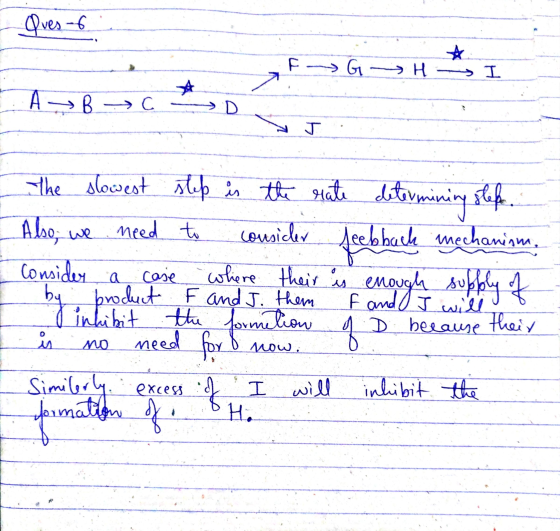
For analogy sake, consider the craving for burger, when you don't eat to eat a burger for a long time. You start craving for food, but not any food, just burger. Someone who gets to eat burgers daily will rarely get craving of it due to excess of it. Similarly if enough F and J are produced the reaction will not favour the formation of D.
Please give a thumbs up!!!!!!!!!!! Thank you!!!!!!! Ask doubts in the comment section !!!!!!!!!!
Add Answer to:
6. Below is a reaction pathway. Place an asterisk (*) by steps that may be the...
Rank from the first to the last steps to describe the correct order of events of...
 Rank from the first to the last steps to describe the
correct order of events of glycolysis.
Rank from the first to the last steps to describe the correct order of events of glycolysis. Reset Help Glyceraldehyde- 3-phosphate COOP 3-phosphoglycerate ooo ATP This reaction happens Glucose-6-phosphate OOOOOO Rearrangement P + ADP Glucose GOOOOO NAD* - Fructose-16-bisphosphate POOOOOO twice, once ADP for each glyceraldehyde- 3.phosphate bisphosphoglycerate OOOP + NADH Fructose-6-phosphate ССССССР 2-phosphoglycerate This GOO reaction happens Rearrangement twice, once Phosphoenolpyruvate for...
Rank from the first to the last steps to describe the
correct order of events of glycolysis.
Rank from the first to the last steps to describe the correct order of events of glycolysis. Reset Help Glyceraldehyde- 3-phosphate COOP 3-phosphoglycerate ooo ATP This reaction happens Glucose-6-phosphate OOOOOO Rearrangement P + ADP Glucose GOOOOO NAD* - Fructose-16-bisphosphate POOOOOO twice, once ADP for each glyceraldehyde- 3.phosphate bisphosphoglycerate OOOP + NADH Fructose-6-phosphate ССССССР 2-phosphoglycerate This GOO reaction happens Rearrangement twice, once Phosphoenolpyruvate for...
QUESTION 2 When adenosine diphosphate is phosphorylated, what small molecule is lost? H20 CO2 HCI 02...
 QUESTION 2 When adenosine diphosphate is phosphorylated, what small molecule is lost? H20 CO2 HCI 02 QUESTION 4 How many carbon atoms enter the citric acid cycle at a time? 2. 4 3 6 QUESTION 7 How many molecules of ATP (NET) are produced directly from the GLYCOLYSIS of 5 molecules of glucose? 5 12.5 10 QUESTION 8 Which of the following is(are) NOT found in the electron transport chain? O2 CO2 OH ions Fe ions QUESTION 9 Which letter...
1. Where specifically within the cell does the citric acid cycle take place?__________________________________ 2. How many...
1. Where specifically within the cell does the citric acid cycle take place?__________________________________ 2. How many carbons from the original glucose molecule enter each round of the citric acid cycle?________ 3. How many carbons exit out of the citric acid cycle during each round, as a waste product?_________ Where did the carbons in this waste product originally come from (what molecule)? 4. The role of NAD+ in the citric acid cycle is the same as in glycolysis; namely, to taxi...
5. How efficient is the conversion from glucose to ATP? 6. How many ATP molecules are...
 5. How efficient is the conversion from glucose to ATP? 6. How many ATP molecules are made from one molecule of glucose? 7. In general, what are NAP+ and FAD? 8. Define anaerobic: Aerobic: 9. Summarize the 4 phases (used to be considered 3) of Cellular Respiration: a) Glycolysis b) Prep reaction - c) Citric Acid Cycle - d) ETC-
How much ATP can be obtained by the cell from the complete oxidation of one glucose...
 How much ATP can be obtained by the cell from the complete oxidation of one glucose vs anaerobically converting to lactate or ethanol? Fill in the table below: Aerobic Oxidation of Glucose Molecule Produced ATP Made Glycolysis ATP NADH АТР 2 pyruvate acetyl-CoA NADH NADH citric acid cycle (2 rounds) FADH2/QH2 Total Anaerobically ATP made. FT
Steps 6 and 8 of the citric acid cycles are _____ reactions. phosphate-transfer hydrolysis oxidation–reduction carboxylation...
Steps 6 and 8 of the citric acid cycles are _____ reactions. phosphate-transfer hydrolysis oxidation–reduction carboxylation The 4-carbon intermediates of the citric acid cycle can be used for _____. gluconeogenesis fatty acid synthesis nucleotide synthesis glycolysis Additional oxaloacetate for the citric acid cycle can be generated in one step from pyruvate glyoxylate citrate acetyl-CoA ΔG°' for a reaction is 800 J · mol–1. What is ΔG at 37°C when the ratio of product to reactant concentrations is 0.6? 640 J...
Select ALL of the statements that correctly describe the Krebs cycle. A. Pyruvic acid must be...
Select ALL of the statements that correctly describe the Krebs cycle. A. Pyruvic acid must be converted to acetyl CoA prior to entering the cycle B. The molecule oxaloacetic acid picks up the acetyl group from acetylCoA, and in the last step of the cycle, oxaloacetic acid is regenerated. C. Electrons removed during oxidation steps are picked up by NAD or FAD. D. Each turn of the cycle generates one ATP molecule for a total of two per molecule of...
Part A Cellular respiration requires fuel (glucose) and oxygen gas. The main process that produces these...
 Part A Cellular respiration requires fuel (glucose) and oxygen gas. The main process that produces these inputs is photosynthesis glycolysis the Citric Acid cycle electron transport Submit Request Answer Part B Which part(s) of cellular respiration require(s) oxygen gas? the Citric Acid cycle the electron transport chain glycolysis a, b, and c a and b, but not Submit Request Answer Part C What is/are the most important output(s) of glycolysis? MacBook Air Part C What is/are the most important output(s)...
Question: You buy a sample of glucose that has the radioactive carbon-14 (C) isotope at the...
 Question: You buy a sample of glucose that has the radioactive carbon-14 (C) isotope at the second position (Carbon #2). All other carbon positions in the glucose molecules have the "C isotope. "C is only a label and does not alter the biochemical behavior of the molecules in which it is found. This glucose sample is mixed with all the enzymes derived from liver cells, which initially contain no other C-labeled chemicals. A) Draw the Haworth structure of glucose and...
QUESTION 1 Which of the following options lists the stages in cellular respiration in the correct...
 QUESTION 1 Which of the following options lists the stages in cellular respiration in the correct order? A. glycolysis, oxidative phosphorylation, pyruvate oxidation, and the citric acid cycle B glycolysis, pyruvate oxidation, the citric acid cycle, and oxidative phosphorylation C. pyruvate oxidation, oxidative phosphorylation, glycolysis, and the citric acid cycle D. the citric acid cycle, oxidative phosphorylation, pyruvate oxidation, and glycolysis QUESTION 2 When a glucose molecule loses a hydrogen atom as the result of an oxidation-reduction reaction, the glucose...
 Rank from the first to the last steps to describe the
correct order of events of glycolysis.
Rank from the first to the last steps to describe the correct order of events of glycolysis. Reset Help Glyceraldehyde- 3-phosphate COOP 3-phosphoglycerate ooo ATP This reaction happens Glucose-6-phosphate OOOOOO Rearrangement P + ADP Glucose GOOOOO NAD* - Fructose-16-bisphosphate POOOOOO twice, once ADP for each glyceraldehyde- 3.phosphate bisphosphoglycerate OOOP + NADH Fructose-6-phosphate ССССССР 2-phosphoglycerate This GOO reaction happens Rearrangement twice, once Phosphoenolpyruvate for...
Rank from the first to the last steps to describe the
correct order of events of glycolysis.
Rank from the first to the last steps to describe the correct order of events of glycolysis. Reset Help Glyceraldehyde- 3-phosphate COOP 3-phosphoglycerate ooo ATP This reaction happens Glucose-6-phosphate OOOOOO Rearrangement P + ADP Glucose GOOOOO NAD* - Fructose-16-bisphosphate POOOOOO twice, once ADP for each glyceraldehyde- 3.phosphate bisphosphoglycerate OOOP + NADH Fructose-6-phosphate ССССССР 2-phosphoglycerate This GOO reaction happens Rearrangement twice, once Phosphoenolpyruvate for...
 QUESTION 2 When adenosine diphosphate is phosphorylated, what small molecule is lost? H20 CO2 HCI 02 QUESTION 4 How many carbon atoms enter the citric acid cycle at a time? 2. 4 3 6 QUESTION 7 How many molecules of ATP (NET) are produced directly from the GLYCOLYSIS of 5 molecules of glucose? 5 12.5 10 QUESTION 8 Which of the following is(are) NOT found in the electron transport chain? O2 CO2 OH ions Fe ions QUESTION 9 Which letter...
 5. How efficient is the conversion from glucose to ATP? 6. How many ATP molecules are made from one molecule of glucose? 7. In general, what are NAP+ and FAD? 8. Define anaerobic: Aerobic: 9. Summarize the 4 phases (used to be considered 3) of Cellular Respiration: a) Glycolysis b) Prep reaction - c) Citric Acid Cycle - d) ETC-
 How much ATP can be obtained by the cell from the complete oxidation of one glucose vs anaerobically converting to lactate or ethanol? Fill in the table below: Aerobic Oxidation of Glucose Molecule Produced ATP Made Glycolysis ATP NADH АТР 2 pyruvate acetyl-CoA NADH NADH citric acid cycle (2 rounds) FADH2/QH2 Total Anaerobically ATP made. FT
 Part A Cellular respiration requires fuel (glucose) and oxygen gas. The main process that produces these inputs is photosynthesis glycolysis the Citric Acid cycle electron transport Submit Request Answer Part B Which part(s) of cellular respiration require(s) oxygen gas? the Citric Acid cycle the electron transport chain glycolysis a, b, and c a and b, but not Submit Request Answer Part C What is/are the most important output(s) of glycolysis? MacBook Air Part C What is/are the most important output(s)...
 Question: You buy a sample of glucose that has the radioactive carbon-14 (C) isotope at the second position (Carbon #2). All other carbon positions in the glucose molecules have the "C isotope. "C is only a label and does not alter the biochemical behavior of the molecules in which it is found. This glucose sample is mixed with all the enzymes derived from liver cells, which initially contain no other C-labeled chemicals. A) Draw the Haworth structure of glucose and...
 QUESTION 1 Which of the following options lists the stages in cellular respiration in the correct order? A. glycolysis, oxidative phosphorylation, pyruvate oxidation, and the citric acid cycle B glycolysis, pyruvate oxidation, the citric acid cycle, and oxidative phosphorylation C. pyruvate oxidation, oxidative phosphorylation, glycolysis, and the citric acid cycle D. the citric acid cycle, oxidative phosphorylation, pyruvate oxidation, and glycolysis QUESTION 2 When a glucose molecule loses a hydrogen atom as the result of an oxidation-reduction reaction, the glucose...
Most questions answered within 3 hours.
-
Where is the error in this code sequence?
String s1 = "Hello";
String s2 = "ello";...
asked 10 months ago -
Financial data for Joel de Paris, Inc., for last year
follow:
Joel de Paris, Inc.
Balance...
asked 10 months ago -
Consider this reaction:
Al2(SO4)3 (aq)+ BaCl3
(aq) Al2Cl6 (aq)- +
3BaSO4(s) . What is the...
asked 10 months ago -
Suppose that Savneet is considering increasing her
recent random sample from 20 car rentals to 40...
asked 10 months ago -
Trucks arrive at an unloading terminal at an average rate of 120
per hour.
Trucks arrive...
asked 10 months ago -
Why are methanol and ethanol completely soluble in water while
octanol is not very little soluble....
asked 10 months ago -
A facilities manager at a university reads in a research report
that the mean amount of...
asked 10 months ago -
When the CuSO4 is rehydrated by adding water to the anhydrous
compound, is this an endothermic...
asked 10 months ago -
A ray of sunlight is passing from diamond into crown glass; the
angle of incidence is...
asked 10 months ago -
A block of mass 0.249 kg is placed on top of a light, vertical
spring of...
asked 10 months ago -
how do the kidneys compensate in the presences of acidosis
a) trigger hyperventilate
b) reserve acid...
asked 10 months ago -
Question 501 pts
The rental rate of capital to the firm increases. Which of the
following...
asked 10 months ago