What changes do you observe if you
add a piece of mushroom, squash and banana into a 3% hydrogen
peroxide solution. Why? 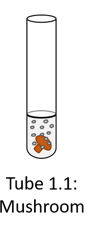
Homework Answers
Most living tissue contains catalase. When we add a piece of mushroom,squash and banana into a 3% hydrogen peroxide solution,we can observe formation of oxygen bubbles.This is due to the reason, Catalase helps change peroxides into water and oxygen.Peroxides aren’t good for living things.
Add Answer to:
What changes do you observe if you
add a piece of mushroom, squash and banana into...
PART A- Observe Normal Catalase Reaction To determine the volume of oxygen released in ml) during...
 PART A- Observe Normal Catalase Reaction To determine the volume of oxygen released in ml) during the degradation of H202 by catalase, you will first do trials using the set-up in Fig. 1. 1. Place 10 ml of the 3% hydrogen peroxide solution into a clean bottle 2. Add quickly catalase containing solution. 3. What gas is being released? 4. Throughout this investigation you will estimate the rate of the reaction (by measuring the volume of water displaced by O2...
13. If a banana is available, scrape a small amount of tissue from its surface and...
 13. If a banana is available, scrape a small amount of tissue from its surface and spread it onto a slide. Add a drop of Lugol's solution and a coverslip. Observe the preparation using high power (40x) f. How do these observations compare with what you saw in the potato? 2. Use a razor blade to slide a piece of tissue, as thin as possible, from the outer portion peeled carrot. Prepare a wet-mount slide. g. Can you see the...
4. What will you observe if you add CuSO4(aq) to a solution containing glucose? 5. If...
4. What will you observe if you add CuSO4(aq) to a solution containing glucose? 5. If you observe a white solid forming when you add AgNO3(aq) to a solution, what can you conclude is present in the solution?
2) During standardization of KMnO4 if you observe a brown precipitate, what does this indicate? Do...
 2) During standardization of KMnO4 if you observe a brown precipitate, what does this indicate? Do you continue the titration in this situation or stop and repeat it? 3) Why do we perform blank analysis in KMnO standardization? 4) Why do we add HgCl, and why do we add it quickly? Write the related reaction.
What is the "reserve ratio?” What changes do you observe during expansionary and contractionary monetary policies?
What is the "reserve ratio?” What changes do you observe during expansionary and contractionary monetary policies?
What changes do you observe in image 1 and image as you move object 1 from...
 What changes do you observe in image 1 and image as you move object 1 from focal point (do1= f1) towards the lens (do1 +0)? Your Answer:
2) Why do you think we add an excess of the relatively unstable hydrogen peroxide or...
2) Why do you think we add an excess of the relatively unstable hydrogen peroxide or hydrobromic acid to the reaction? Group of answer choices A) Some of the reagent will evaporate due to the heat of reaction B) Some of the reagent will be voted out of the flask. C) Some of the reagent will inherently not be reactive. D) Some of the reagent will be lost to decomposition without having a chance to react.
PROCEDURES and DATA COLLECTION: PART A. Observe the changes in pH of both buffered and non-bsuffered...
 PROCEDURES and DATA COLLECTION: PART A. Observe the changes in pH of both buffered and non-bsuffered selutions digital pH meters if working pH meters are available using universal pH paper and/or 1. Obtain a package of universal pH paper with a color chart and a digital pH meter if they are available. 2. Obtain 6 medium sized test tubes and label them 1-6 (confirm that the pH meter probe will fit inside) THE TEST TUBES are clean, with clean and...
You observe a piece of mRNA. A few minutes later you see this mRNA has now...
You observe a piece of mRNA. A few minutes later you see this mRNA has now been converted into DNA. How is this possible? Explain the protein responsible to do this. Also, what other sequences can this protein convert? What can this help researchers determine?
Part I Color changes of Methyl Violet. We will study the following reaction: HMV (aq) +...
 Part I Color changes of Methyl Violet. We will study the following reaction: HMV (aq) + MV (aq) + H* (aq) yellow greenish-blue violet Step 1. Place about 4 mL of distilled water in a regular test tube. Add two drops of methyl violet indicator. Record the color of the solution. Violet Next, add drop by drop, add 6M HCI. This forces equilibrium to be shifted to the left or right-circle the right answer). Adding HCl changes color from to...
 PART A- Observe Normal Catalase Reaction To determine the volume of oxygen released in ml) during the degradation of H202 by catalase, you will first do trials using the set-up in Fig. 1. 1. Place 10 ml of the 3% hydrogen peroxide solution into a clean bottle 2. Add quickly catalase containing solution. 3. What gas is being released? 4. Throughout this investigation you will estimate the rate of the reaction (by measuring the volume of water displaced by O2...
 13. If a banana is available, scrape a small amount of tissue from its surface and spread it onto a slide. Add a drop of Lugol's solution and a coverslip. Observe the preparation using high power (40x) f. How do these observations compare with what you saw in the potato? 2. Use a razor blade to slide a piece of tissue, as thin as possible, from the outer portion peeled carrot. Prepare a wet-mount slide. g. Can you see the...
 2) During standardization of KMnO4 if you observe a brown precipitate, what does this indicate? Do you continue the titration in this situation or stop and repeat it? 3) Why do we perform blank analysis in KMnO standardization? 4) Why do we add HgCl, and why do we add it quickly? Write the related reaction.
 What changes do you observe in image 1 and image as you move object 1 from focal point (do1= f1) towards the lens (do1 +0)? Your Answer:
 PROCEDURES and DATA COLLECTION: PART A. Observe the changes in pH of both buffered and non-bsuffered selutions digital pH meters if working pH meters are available using universal pH paper and/or 1. Obtain a package of universal pH paper with a color chart and a digital pH meter if they are available. 2. Obtain 6 medium sized test tubes and label them 1-6 (confirm that the pH meter probe will fit inside) THE TEST TUBES are clean, with clean and...
 Part I Color changes of Methyl Violet. We will study the following reaction: HMV (aq) + MV (aq) + H* (aq) yellow greenish-blue violet Step 1. Place about 4 mL of distilled water in a regular test tube. Add two drops of methyl violet indicator. Record the color of the solution. Violet Next, add drop by drop, add 6M HCI. This forces equilibrium to be shifted to the left or right-circle the right answer). Adding HCl changes color from to...
Most questions answered within 3 hours.
-
Where is the error in this code sequence?
String s1 = "Hello";
String s2 = "ello";...
asked 10 months ago -
Financial data for Joel de Paris, Inc., for last year
follow:
Joel de Paris, Inc.
Balance...
asked 10 months ago -
Consider this reaction:
Al2(SO4)3 (aq)+ BaCl3
(aq) Al2Cl6 (aq)- +
3BaSO4(s) . What is the...
asked 10 months ago -
Suppose that Savneet is considering increasing her
recent random sample from 20 car rentals to 40...
asked 10 months ago -
Trucks arrive at an unloading terminal at an average rate of 120
per hour.
Trucks arrive...
asked 10 months ago -
Why are methanol and ethanol completely soluble in water while
octanol is not very little soluble....
asked 10 months ago -
A facilities manager at a university reads in a research report
that the mean amount of...
asked 10 months ago -
When the CuSO4 is rehydrated by adding water to the anhydrous
compound, is this an endothermic...
asked 10 months ago -
A ray of sunlight is passing from diamond into crown glass; the
angle of incidence is...
asked 10 months ago -
A block of mass 0.249 kg is placed on top of a light, vertical
spring of...
asked 10 months ago -
how do the kidneys compensate in the presences of acidosis
a) trigger hyperventilate
b) reserve acid...
asked 10 months ago -
Question 501 pts
The rental rate of capital to the firm increases. Which of the
following...
asked 10 months ago