4. What will you observe if you add CuSO4(aq) to a solution containing glucose? 5. If...
4. What will you observe if you add CuSO4(aq) to a solution containing glucose?
5. If you observe a white solid forming when you add AgNO3(aq) to a solution, what can you conclude is present in the solution?
Homework Answers
Request Answer!
We need at least 10 more requests to produce the answer.
0 / 10 have requested this problem solution
The more requests, the faster the answer.
Add Answer to:
4. What will you observe if you add CuSO4(aq) to a solution
containing glucose?
5. If...
what is the answer of the questions? a. What is the molarity of CuSO4 solution containing...
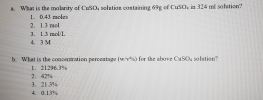 what is the answer of the questions?
a. What is the molarity of CuSO4 solution containing 69g of CuSO4 in 324 ml solution? 1. 0.43 moles 2. 1.3 mol 3. 1.3 mol/L 4. 3 M b. What is the concentration percentage (w/v%) for the above CuSO4 solution? 1. 21296.3% 2. 42% 3. 21.3% 4. 0.13%
what is the answer of the questions?
a. What is the molarity of CuSO4 solution containing 69g of CuSO4 in 324 ml solution? 1. 0.43 moles 2. 1.3 mol 3. 1.3 mol/L 4. 3 M b. What is the concentration percentage (w/v%) for the above CuSO4 solution? 1. 21296.3% 2. 42% 3. 21.3% 4. 0.13%
When ammonia is slowly added to a light blue solution of CuSO4 (aq), at first a...
When ammonia is slowly added to a light blue solution of CuSO4 (aq), at first a white precipitate forms. What is the formula of that precipitate? After more ammonia is added, a dark blue solution forms. What is the formula of the compound or ion responsible for the dark blue color?
What reagent could be used to separate Br- from SO42- when added to an aqueous solution...
What reagent could be used to separate Br- from SO42- when added to an aqueous solution containing both? A) CuSO4(aq) B) AgNO3(aq) C) Nal(aq) D) BA(OH)2(aq)
11. You have dropper bottles containing solutions of NaCl(aq), KSOs(aq), and Ba(NOs)(ag) a. Which...
 #11
a b c and #12
11. You have dropper bottles containing solutions of NaCl(aq), KSOs(aq), and Ba(NOs)(ag) a. Which two bottles would you combine if you don't want any precipitate to form? b. If you combine KSOs(aq) and AgNOs(aq) and the solution becomes a very cloudy white, what compound forms the precipitate? Write the balanced molecular equation and the net ionic equation for the reaction of NaCl(aq) and AgNO3(aq) c. 12. You have a piece of metal, a graduated...
#11
a b c and #12
11. You have dropper bottles containing solutions of NaCl(aq), KSOs(aq), and Ba(NOs)(ag) a. Which two bottles would you combine if you don't want any precipitate to form? b. If you combine KSOs(aq) and AgNOs(aq) and the solution becomes a very cloudy white, what compound forms the precipitate? Write the balanced molecular equation and the net ionic equation for the reaction of NaCl(aq) and AgNO3(aq) c. 12. You have a piece of metal, a graduated...
When you increase the temperature of a solution as you add solid solute, solubility. When you...
When you increase the temperature of a solution as you add solid solute, solubility. When you decrease the temperature of solution as you add solid solute, solubility. When you increase the temperature of a solution containing a gas solute, solubility. When you decrease the temperature of solution containing a gas solute, solubility.
Suppose you have an unknown clear, colorless solution. In attempt to identify it, you add NaOH dropwise...
Suppose you have an unknown clear, colorless solution. In attempt to identify it, you add NaOH dropwise and find that a white gelatinous precipitate forms, but when more NaOH was added the precipitate dissolved again. To another test tube of the same unknown solution is added AgNO3 dropwise, and a white precipitate forms. What salt most likely comprises the unknown solution? Explain your reasoning.
6. Solution A + 5% Glucose (a penetrating solute) is hyperosmotic to cells. What can you...
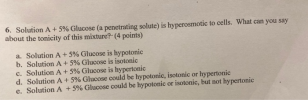 6. Solution A + 5% Glucose (a penetrating solute) is hyperosmotic to cells. What can you say about the tonicity of this mixture?- (4 points) a. Solution A + 5% Glucose is hypotonic b. Solution A + 5% Glucose is isotonic c. Solution A + 5% Glucose is hypertonic d. Solution A + 5% Glucose could be hypotonic, isotonic or hypertonic e. Solution A + 5% Glucose could be hypotonic or isotonic, but not hypertonic
III ) Fe+3(aq) + SCN-(aq) ß→ Fe(SCN)+2(aq) (3) Prepare a stock solution by mixing 2mL each...
III ) Fe+3(aq) + SCN-(aq) ß→ Fe(SCN)+2(aq) (3) Prepare a stock solution by mixing 2mL each of 0.1M FeCl3 and 0.1M KSCN in 100mL graduated cylinder. Add enough water to make 100mL solution. Note the color. If you are the first one to use this station, make this solution and save it for the rest of the class. If you are using someone else's stock solution, make sure to make observations of each reactant. (4) *Add about 1mL of 0.1M...
If you placed a dialysis bag containing NaCl solution, starch solution and glucose solution in a...
 If you placed a dialysis bag containing NaCl solution, starch solution and glucose solution in a beaker of water and left it for 30 minutes before testing the water in the beaker for Cr, glucose and starch what results would you expect? Explain your answer TTTF Paragraph v Arial 3(12pt) ET %DOQ 25" fx Mashups BIMMLESS T' T.
1. You are provided with 1M solution of CuSO4. 2. Calculate how many grams of CuSO4...
 1. You are provided with 1M solution of CuSO4. 2. Calculate how many grams of CuSO4 are dissolved in 100 mL of water to prepare this solution. Show your work in the space provided below. (Molar mass of CuSO4 = 159.6086 g/mol) (1 mark) Scso this . cutissu 159.6 خرداكولات و 3. Using a suitable transfer pipette transfer V. mL of your 1M Cuso. solution into a 100 ml volumetric flask. CV C 2V2 4. Using the equation CiV1=C2V2 calculate...
 what is the answer of the questions?
a. What is the molarity of CuSO4 solution containing 69g of CuSO4 in 324 ml solution? 1. 0.43 moles 2. 1.3 mol 3. 1.3 mol/L 4. 3 M b. What is the concentration percentage (w/v%) for the above CuSO4 solution? 1. 21296.3% 2. 42% 3. 21.3% 4. 0.13%
what is the answer of the questions?
a. What is the molarity of CuSO4 solution containing 69g of CuSO4 in 324 ml solution? 1. 0.43 moles 2. 1.3 mol 3. 1.3 mol/L 4. 3 M b. What is the concentration percentage (w/v%) for the above CuSO4 solution? 1. 21296.3% 2. 42% 3. 21.3% 4. 0.13%
 #11
a b c and #12
11. You have dropper bottles containing solutions of NaCl(aq), KSOs(aq), and Ba(NOs)(ag) a. Which two bottles would you combine if you don't want any precipitate to form? b. If you combine KSOs(aq) and AgNOs(aq) and the solution becomes a very cloudy white, what compound forms the precipitate? Write the balanced molecular equation and the net ionic equation for the reaction of NaCl(aq) and AgNO3(aq) c. 12. You have a piece of metal, a graduated...
#11
a b c and #12
11. You have dropper bottles containing solutions of NaCl(aq), KSOs(aq), and Ba(NOs)(ag) a. Which two bottles would you combine if you don't want any precipitate to form? b. If you combine KSOs(aq) and AgNOs(aq) and the solution becomes a very cloudy white, what compound forms the precipitate? Write the balanced molecular equation and the net ionic equation for the reaction of NaCl(aq) and AgNO3(aq) c. 12. You have a piece of metal, a graduated...
 6. Solution A + 5% Glucose (a penetrating solute) is hyperosmotic to cells. What can you say about the tonicity of this mixture?- (4 points) a. Solution A + 5% Glucose is hypotonic b. Solution A + 5% Glucose is isotonic c. Solution A + 5% Glucose is hypertonic d. Solution A + 5% Glucose could be hypotonic, isotonic or hypertonic e. Solution A + 5% Glucose could be hypotonic or isotonic, but not hypertonic
 If you placed a dialysis bag containing NaCl solution, starch solution and glucose solution in a beaker of water and left it for 30 minutes before testing the water in the beaker for Cr, glucose and starch what results would you expect? Explain your answer TTTF Paragraph v Arial 3(12pt) ET %DOQ 25" fx Mashups BIMMLESS T' T.
 1. You are provided with 1M solution of CuSO4. 2. Calculate how many grams of CuSO4 are dissolved in 100 mL of water to prepare this solution. Show your work in the space provided below. (Molar mass of CuSO4 = 159.6086 g/mol) (1 mark) Scso this . cutissu 159.6 خرداكولات و 3. Using a suitable transfer pipette transfer V. mL of your 1M Cuso. solution into a 100 ml volumetric flask. CV C 2V2 4. Using the equation CiV1=C2V2 calculate...
Most questions answered within 3 hours.
-
Where is the error in this code sequence?
String s1 = "Hello";
String s2 = "ello";...
asked 11 months ago -
Financial data for Joel de Paris, Inc., for last year
follow:
Joel de Paris, Inc.
Balance...
asked 11 months ago -
Consider this reaction:
Al2(SO4)3 (aq)+ BaCl3
(aq) Al2Cl6 (aq)- +
3BaSO4(s) . What is the...
asked 11 months ago -
Suppose that Savneet is considering increasing her
recent random sample from 20 car rentals to 40...
asked 11 months ago -
Trucks arrive at an unloading terminal at an average rate of 120
per hour.
Trucks arrive...
asked 11 months ago -
Why are methanol and ethanol completely soluble in water while
octanol is not very little soluble....
asked 11 months ago -
A facilities manager at a university reads in a research report
that the mean amount of...
asked 11 months ago -
When the CuSO4 is rehydrated by adding water to the anhydrous
compound, is this an endothermic...
asked 11 months ago -
A ray of sunlight is passing from diamond into crown glass; the
angle of incidence is...
asked 11 months ago -
A block of mass 0.249 kg is placed on top of a light, vertical
spring of...
asked 11 months ago -
how do the kidneys compensate in the presences of acidosis
a) trigger hyperventilate
b) reserve acid...
asked 11 months ago -
Question 501 pts
The rental rate of capital to the firm increases. Which of the
following...
asked 11 months ago