
Homework Answers
Add Answer to:
1. A plate is placed in a large vacuum chamber to control its cooling rate. To...
A plate is placed in a large vacuum chamber to control its cooling rate. To prevent...
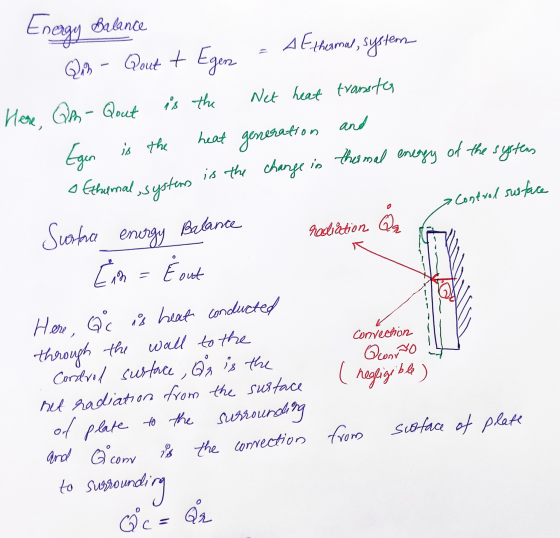
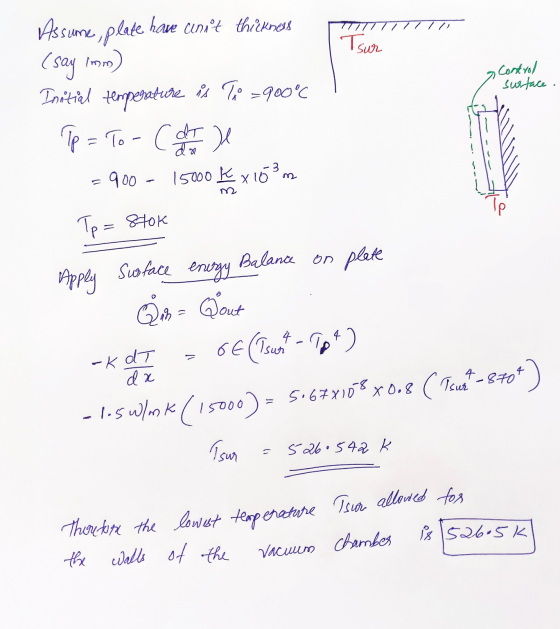
 A plate is placed in a large vacuum chamber to control its cooling rate. To prevent cracking, the temperature gradient in the plate cannot exceed 15 K/mm at any point during cooling. The plate is initially at 900 K with an emissivity of 0.8 and thermal conductivity of 1.5 W/m.K. Assume that one of the surface of the plate is insulated and the other is exposed to the chamber, and the chamber walls are considered as black surface. Apply the...
Clear handwriting plz 1. A plate is placed in a large vacuum chamber to control its...
 Clear handwriting plz
1. A plate is placed in a large vacuum chamber to control its cooling rate. To prevent cracking, the temperature gradient in the plate cannot exceed 15 K/mm at any point during cooling. The plate is initially at 900 K with an emissivity of 0.8 and thermal conductivity of 1.5 W/mK. Assume that one of the surface of the plate is insulated and the other is exposed to the chamber, and the chamber walls are considered as...
Clear handwriting plz
1. A plate is placed in a large vacuum chamber to control its cooling rate. To prevent cracking, the temperature gradient in the plate cannot exceed 15 K/mm at any point during cooling. The plate is initially at 900 K with an emissivity of 0.8 and thermal conductivity of 1.5 W/mK. Assume that one of the surface of the plate is insulated and the other is exposed to the chamber, and the chamber walls are considered as...
During its manufacture, plate glass at 600°C is cooled by passing air over its surface such...
 During its manufacture, plate glass at 600°C is cooled by passing air over its surface such that the convection heat transfer coefficient is h. To prevent cracking, it is known that the temperature gradient must not exceed 15 °C/mm at any point in the glass during the cooling process. The thermal conductivity of the glass is 1.4 W/mK and its surface emissivity is 0.75. The temperature of the air that is used for the cooling is 315 °C. Assume that...
A 50 mm thick steel plate (AISI347) has a uniform heat flux applied to its bottom...
 A 50 mm thick steel plate (AISI347) has a uniform heat flux
applied to its bottom surface by a heater. The heater is in contact
with the steel plate, and the interface between the heater and
steel has a contact resistance of 2.0 x 10⁻⁴
m2*K/W. The top surface of the plate is exposed to
surrounding air (T = 20oC, h = 10 W/m2*K) and
exchanges radiation with surroundings at Tsur =
10oC. The emissivity of the plate is 0.85....
A 50 mm thick steel plate (AISI347) has a uniform heat flux
applied to its bottom surface by a heater. The heater is in contact
with the steel plate, and the interface between the heater and
steel has a contact resistance of 2.0 x 10⁻⁴
m2*K/W. The top surface of the plate is exposed to
surrounding air (T = 20oC, h = 10 W/m2*K) and
exchanges radiation with surroundings at Tsur =
10oC. The emissivity of the plate is 0.85....
During a cooling process of a stainless steel plate, water at 30°C flows over this plate...
 During a cooling process of a stainless steel plate, water at 30°C flows over this plate at a velocity of 0.02 m/s. The stainless steel plate (k=19 W/mK) has 1.15 meter long in the flow direction) and the plate width is 0.7 meter. The plate has a uniform surface temperature of 70°C. Determine, 1. The average friction coefficient 2. The total drag force due to friction (N) 3. The average convection heat transfer 2. coefficient (W/m K) 4. The steady...
The heat question and would like to have work solution. The answers are (c) 136.6 (d)...
 The heat question and would like to have work solution. The
answers are (c) 136.6 (d) < 2%. thank you.
An long cylindrical vaccuum chamber shown in Figure 1, is used to anneal single titanium rods by maintaining their temperature at 800 °C for an extended period of time. Heat is introduced into the rods internally by induction. The insulation surrounding the chamber has a thicknesss of 50 mm and thermal conductivity of 0.1 W/m.K. The convective heat transfer coefficient...
The heat question and would like to have work solution. The
answers are (c) 136.6 (d) < 2%. thank you.
An long cylindrical vaccuum chamber shown in Figure 1, is used to anneal single titanium rods by maintaining their temperature at 800 °C for an extended period of time. Heat is introduced into the rods internally by induction. The insulation surrounding the chamber has a thicknesss of 50 mm and thermal conductivity of 0.1 W/m.K. The convective heat transfer coefficient...
heat is generated uniformly in a large plate at a rate of Egen=e0(12x+1). the inside of...
heat is generated uniformly in a large plate at a rate of Egen=e0(12x+1). the inside of the plate is fully insulated while the midpoint of the plate has a temperature of Tm. If the plate has a thickness of L and a thermal conductivity of k, express the temperature profile across the plate.
1. A thin plate walls are exposed to constant temperatures T1 and T2 as shown in...
 1. A thin plate walls are exposed to constant temperatures T1 and T2 as shown in the figure. If the temperature distribution within the plate is given by the equation; d2T dr2 = 0 LLL 1.1 Derive an expression for the temperature distribution within the plate. 1.2 If T1 = 100 °C, T2 = 60 °C, find the mid plane temperature 1.3 If the heat flux crossing each surface is 400 W/m2, determine the thermal conductivity (k) of the plate...
1. one wall is formed by two materials, the first one is 15cm thick and has...
 1. one wall is formed by two materials, the first one is 15cm thick and has a thermal conductivity of 1W/mk and the second one is cork with an unknown thick. If the temperature of the inner wall is 22°C and the temperature of the outer surface is -10°C find: a) the necessary thick of the cork to maintain a heat loss of 8W. Consider an area of 1m2! b) the interface temperature. Note: use a scheme that represents the...
A hot plate consists of a flat electrical resistor, which is adiabatically insulated on one side...
A hot plate consists of a flat electrical resistor, which is adiabatically insulated on one side and on the other side is in contact with a ceramic layer of 1 cm thickness and 30 W/mK thermal conductivity. The hot plate is operated inside a fume hood, where air at 20 C flows over producing convective cooling on the top surface of the heater with a heat transfer coefficient of 15 W/mK The plate generate a total heat transfer rate of...
 A plate is placed in a large vacuum chamber to control its cooling rate. To prevent cracking, the temperature gradient in the plate cannot exceed 15 K/mm at any point during cooling. The plate is initially at 900 K with an emissivity of 0.8 and thermal conductivity of 1.5 W/m.K. Assume that one of the surface of the plate is insulated and the other is exposed to the chamber, and the chamber walls are considered as black surface. Apply the...
 Clear handwriting plz
1. A plate is placed in a large vacuum chamber to control its cooling rate. To prevent cracking, the temperature gradient in the plate cannot exceed 15 K/mm at any point during cooling. The plate is initially at 900 K with an emissivity of 0.8 and thermal conductivity of 1.5 W/mK. Assume that one of the surface of the plate is insulated and the other is exposed to the chamber, and the chamber walls are considered as...
Clear handwriting plz
1. A plate is placed in a large vacuum chamber to control its cooling rate. To prevent cracking, the temperature gradient in the plate cannot exceed 15 K/mm at any point during cooling. The plate is initially at 900 K with an emissivity of 0.8 and thermal conductivity of 1.5 W/mK. Assume that one of the surface of the plate is insulated and the other is exposed to the chamber, and the chamber walls are considered as...
 During its manufacture, plate glass at 600°C is cooled by passing air over its surface such that the convection heat transfer coefficient is h. To prevent cracking, it is known that the temperature gradient must not exceed 15 °C/mm at any point in the glass during the cooling process. The thermal conductivity of the glass is 1.4 W/mK and its surface emissivity is 0.75. The temperature of the air that is used for the cooling is 315 °C. Assume that...
 A 50 mm thick steel plate (AISI347) has a uniform heat flux
applied to its bottom surface by a heater. The heater is in contact
with the steel plate, and the interface between the heater and
steel has a contact resistance of 2.0 x 10⁻⁴
m2*K/W. The top surface of the plate is exposed to
surrounding air (T = 20oC, h = 10 W/m2*K) and
exchanges radiation with surroundings at Tsur =
10oC. The emissivity of the plate is 0.85....
A 50 mm thick steel plate (AISI347) has a uniform heat flux
applied to its bottom surface by a heater. The heater is in contact
with the steel plate, and the interface between the heater and
steel has a contact resistance of 2.0 x 10⁻⁴
m2*K/W. The top surface of the plate is exposed to
surrounding air (T = 20oC, h = 10 W/m2*K) and
exchanges radiation with surroundings at Tsur =
10oC. The emissivity of the plate is 0.85....
 During a cooling process of a stainless steel plate, water at 30°C flows over this plate at a velocity of 0.02 m/s. The stainless steel plate (k=19 W/mK) has 1.15 meter long in the flow direction) and the plate width is 0.7 meter. The plate has a uniform surface temperature of 70°C. Determine, 1. The average friction coefficient 2. The total drag force due to friction (N) 3. The average convection heat transfer 2. coefficient (W/m K) 4. The steady...
 The heat question and would like to have work solution. The
answers are (c) 136.6 (d) < 2%. thank you.
An long cylindrical vaccuum chamber shown in Figure 1, is used to anneal single titanium rods by maintaining their temperature at 800 °C for an extended period of time. Heat is introduced into the rods internally by induction. The insulation surrounding the chamber has a thicknesss of 50 mm and thermal conductivity of 0.1 W/m.K. The convective heat transfer coefficient...
The heat question and would like to have work solution. The
answers are (c) 136.6 (d) < 2%. thank you.
An long cylindrical vaccuum chamber shown in Figure 1, is used to anneal single titanium rods by maintaining their temperature at 800 °C for an extended period of time. Heat is introduced into the rods internally by induction. The insulation surrounding the chamber has a thicknesss of 50 mm and thermal conductivity of 0.1 W/m.K. The convective heat transfer coefficient...
 1. A thin plate walls are exposed to constant temperatures T1 and T2 as shown in the figure. If the temperature distribution within the plate is given by the equation; d2T dr2 = 0 LLL 1.1 Derive an expression for the temperature distribution within the plate. 1.2 If T1 = 100 °C, T2 = 60 °C, find the mid plane temperature 1.3 If the heat flux crossing each surface is 400 W/m2, determine the thermal conductivity (k) of the plate...
 1. one wall is formed by two materials, the first one is 15cm thick and has a thermal conductivity of 1W/mk and the second one is cork with an unknown thick. If the temperature of the inner wall is 22°C and the temperature of the outer surface is -10°C find: a) the necessary thick of the cork to maintain a heat loss of 8W. Consider an area of 1m2! b) the interface temperature. Note: use a scheme that represents the...
Most questions answered within 3 hours.
-
Where is the error in this code sequence?
String s1 = "Hello";
String s2 = "ello";...
asked 11 months ago -
Financial data for Joel de Paris, Inc., for last year
follow:
Joel de Paris, Inc.
Balance...
asked 11 months ago -
Consider this reaction:
Al2(SO4)3 (aq)+ BaCl3
(aq) Al2Cl6 (aq)- +
3BaSO4(s) . What is the...
asked 11 months ago -
Suppose that Savneet is considering increasing her
recent random sample from 20 car rentals to 40...
asked 11 months ago -
Trucks arrive at an unloading terminal at an average rate of 120
per hour.
Trucks arrive...
asked 11 months ago -
Why are methanol and ethanol completely soluble in water while
octanol is not very little soluble....
asked 11 months ago -
A facilities manager at a university reads in a research report
that the mean amount of...
asked 11 months ago -
When the CuSO4 is rehydrated by adding water to the anhydrous
compound, is this an endothermic...
asked 11 months ago -
A ray of sunlight is passing from diamond into crown glass; the
angle of incidence is...
asked 11 months ago -
A block of mass 0.249 kg is placed on top of a light, vertical
spring of...
asked 11 months ago -
how do the kidneys compensate in the presences of acidosis
a) trigger hyperventilate
b) reserve acid...
asked 11 months ago -
Question 501 pts
The rental rate of capital to the firm increases. Which of the
following...
asked 11 months ago