This bacterium produces invasins A)Salmonella B) Neisseria C) Trypanosoma D) S. pyogenes
Homework Answers
Ans:
D) S. pyogenes
A) Salmonella
Example: Invasins are the extracellular protein that facilitates invasion into the host cells. Streptokinase, hyaluronidase, streptolysins, colagenase etc. are the example of Invasins that are produced by the pathogenic bacteria. Streptolysin is the invasins that is produced by the Streptococcus pyogenes which disrupts phagocytes membrane and causes releases of lysosomal granules. Salmonella also produces Invasins. Neisseria and Trypanosoma doesn't produce Invasins.
Add Answer to:
This bacterium produces invasins
A)Salmonella
B) Neisseria
C) Trypanosoma
D) S. pyogenes
b. Salmonella C. Streptococcus d. Neisseria e. Vibrio 12. Which of the following does NOT belong...
 b. Salmonella C. Streptococcus d. Neisseria e. Vibrio 12. Which of the following does NOT belong with the others from a PHYLOGENETIC perspective? a. Bacillus b. Clostridium c. Mycoplasma d. Streptococcus e. Rickettsia 13. According to Bergey's Determinative Manual, Chromatium is most similar to which of the following bacterial species? a. Chloroflexus b. Chlorobium c. Rhodosprillum d. Bacillus e. Methanobacterium helt
Neisseria has acquired resistance to penicillin. How can it achieve this? A) Neisseria bacteria are dormant and...
Neisseria has acquired resistance to penicillin. How can it achieve this? A) Neisseria bacteria are dormant and penicillin works on active cells B) Neisseria bacteria are too small for penicillin to kill C) Neisseria bacteria are constantly changing for penicillin to work D) Neisseria bacteria produces proteins to make penicillin ineffective
1. Toxoplasma gondii , Trypanosoma bruise, Trypanosoma cruzi a. vector b. in host: location / sample...
1. Toxoplasma gondii , Trypanosoma bruise, Trypanosoma cruzi a. vector b. in host: location / sample type c. transmission d. disease cause e. symptoms f. geographic distribution d. disease caused e. symptoms f. geographic distribution
Toxoplasma gondii , Trypanosoma brusei, Trypanosoma cruzi a. diagnostic stage b. in host: location/ sample type...
Toxoplasma gondii , Trypanosoma brusei, Trypanosoma cruzi a. diagnostic stage b. in host: location/ sample type c. transmission d. vector e. disease caused f. symptoms g. geographic distribution
what does MSA plate stand for? A Gram - B. Staphylococcus C. E. coli D. Salmonella...
what does MSA plate stand for? A Gram - B. Staphylococcus C. E. coli D. Salmonella E. Gram +
1. The most resistant of all non-spore-forming pathogens: a. S. pyogenes b. S. aureus c. S....
 1. The most resistant of all non-spore-forming pathogens: a. S. pyogenes b. S. aureus c. S. pneumoniae d. N. gonorrhoeae e. N. meningitides 2. Pyogenic means: a. Fever-causing b. An extreme form of diarrhea c. Severe dehydration d. Pus-filled e. both a and d 3. Fill in the blank: This pathogen causes gas-gangrene: 4. The genus Clostridium is the causative agent of: a. Botulism b. Tetanus c. Colitis d. Gangrene e. all of the above 5. Bacillus is: a, Gram...
Clostridium botulinum (C. bot) is a type of bacterium that produces neurotoxins that when ingested by...
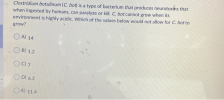 Clostridium botulinum (C. bot) is a type of bacterium that produces neurotoxins that when ingested by humans, can paralyze or kill. c. bot cannot grow when its environment is highly acidic. Which of the values below would not allow for C botto grow? O A) 14 OB) 1.2 OC) 7 OD) 6.2 E) 11.4
D. Neisseria meningitidis 8) An outbreak is considered to be a more contained: A. endemic disease....
 D. Neisseria meningitidis 8) An outbreak is considered to be a more contained: A. endemic disease. B. local disease. C. pandemic disease. D. epidemic disease. 9) True or false. A glass is a biological vector. True -- False 10) Which one is not a reservoir of infections types of reservoirs of infection. a. Human b. Animal c. Soil d. Water e. All of the above are reservoirs
a microorganism that is isolated from the human skin that produces white colonies and is gram...
a microorganism that is isolated from the human skin that produces white colonies and is gram positive coccus is likely to be a. e. coli b. yeast c. s epidermis d. neisseria
J. 13 PUIULUU a. Salmonella b. Shigella Plasmodium d. Entamoeba e. Klebsiella 6. Which of the...
 J. 13 PUIULUU a. Salmonella b. Shigella Plasmodium d. Entamoeba e. Klebsiella 6. Which of the following is an obligate intracellular parasite? a. phage lambda b. Clostridium c. Mycobacterium d. b and c only e. a, b, and c 7. Which of the following is true of bacteriophages that undergo only the lytic cycle? a. They are characterized by a period of dormancy within the host cell b. They include T-even phages. c. They are known as “temperate” phages. d....
 b. Salmonella C. Streptococcus d. Neisseria e. Vibrio 12. Which of the following does NOT belong with the others from a PHYLOGENETIC perspective? a. Bacillus b. Clostridium c. Mycoplasma d. Streptococcus e. Rickettsia 13. According to Bergey's Determinative Manual, Chromatium is most similar to which of the following bacterial species? a. Chloroflexus b. Chlorobium c. Rhodosprillum d. Bacillus e. Methanobacterium helt
 1. The most resistant of all non-spore-forming pathogens: a. S. pyogenes b. S. aureus c. S. pneumoniae d. N. gonorrhoeae e. N. meningitides 2. Pyogenic means: a. Fever-causing b. An extreme form of diarrhea c. Severe dehydration d. Pus-filled e. both a and d 3. Fill in the blank: This pathogen causes gas-gangrene: 4. The genus Clostridium is the causative agent of: a. Botulism b. Tetanus c. Colitis d. Gangrene e. all of the above 5. Bacillus is: a, Gram...
 Clostridium botulinum (C. bot) is a type of bacterium that produces neurotoxins that when ingested by humans, can paralyze or kill. c. bot cannot grow when its environment is highly acidic. Which of the values below would not allow for C botto grow? O A) 14 OB) 1.2 OC) 7 OD) 6.2 E) 11.4
 D. Neisseria meningitidis 8) An outbreak is considered to be a more contained: A. endemic disease. B. local disease. C. pandemic disease. D. epidemic disease. 9) True or false. A glass is a biological vector. True -- False 10) Which one is not a reservoir of infections types of reservoirs of infection. a. Human b. Animal c. Soil d. Water e. All of the above are reservoirs
 J. 13 PUIULUU a. Salmonella b. Shigella Plasmodium d. Entamoeba e. Klebsiella 6. Which of the following is an obligate intracellular parasite? a. phage lambda b. Clostridium c. Mycobacterium d. b and c only e. a, b, and c 7. Which of the following is true of bacteriophages that undergo only the lytic cycle? a. They are characterized by a period of dormancy within the host cell b. They include T-even phages. c. They are known as “temperate” phages. d....
Most questions answered within 3 hours.
-
Where is the error in this code sequence?
String s1 = "Hello";
String s2 = "ello";...
asked 10 months ago -
Financial data for Joel de Paris, Inc., for last year
follow:
Joel de Paris, Inc.
Balance...
asked 10 months ago -
Consider this reaction:
Al2(SO4)3 (aq)+ BaCl3
(aq) Al2Cl6 (aq)- +
3BaSO4(s) . What is the...
asked 10 months ago -
Suppose that Savneet is considering increasing her
recent random sample from 20 car rentals to 40...
asked 10 months ago -
Trucks arrive at an unloading terminal at an average rate of 120
per hour.
Trucks arrive...
asked 10 months ago -
Why are methanol and ethanol completely soluble in water while
octanol is not very little soluble....
asked 10 months ago -
A facilities manager at a university reads in a research report
that the mean amount of...
asked 10 months ago -
When the CuSO4 is rehydrated by adding water to the anhydrous
compound, is this an endothermic...
asked 10 months ago -
A ray of sunlight is passing from diamond into crown glass; the
angle of incidence is...
asked 10 months ago -
A block of mass 0.249 kg is placed on top of a light, vertical
spring of...
asked 10 months ago -
how do the kidneys compensate in the presences of acidosis
a) trigger hyperventilate
b) reserve acid...
asked 10 months ago -
Question 501 pts
The rental rate of capital to the firm increases. Which of the
following...
asked 10 months ago