
Homework Answers
The concentration of phage should be 1.5 X 10⁸.
The multiplication of infection can be calculated as
MOI = Concentration of plaques forming phage ÷ Total number of host cells
Putting the values, we have
3 = Concentration of phage ÷ 5 X 10⁷
Or, concentration of phage = 3 X 5 X 107 = 15 X 107.
Add Answer to:
If you have a culture of E. coli at a concentration of 5x10bacteria/mL and you infect...
You have a liquid culture of E. coli at 7.5 x 10^9 org/mL concentration. Draw a...
You have a liquid culture of E. coli at 7.5 x 10^9 org/mL concentration. Draw a serial dilution scheme to give a final concentration of 1.5 x 10^3 org/mL and indicate the volume of sample, volume of diluent, DF, TDF, and the concentration of each tube. Please explain steps. I am not too sure how to even start problems like these. Thank you!
5 points. Can a wild-type lambda phage infect and kill an E. coli host that harbors...
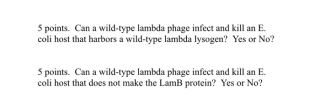 5 points. Can a wild-type lambda phage infect and kill an E. coli host that harbors a wild-type lambda lysogen? Yes or No? 5 points. Can a wild-type lambda phage infect and kill an E. coli host that does not make the LamB protein? Yes or No?
You want to dilute and plate an E. coli culture that has 3 *10 8 cells/ml....
You want to dilute and plate an E. coli culture that has 3 *10 8 cells/ml. If you needed to dilute the above culture, starting from the undiluted stock, to a concentration of 500 cells/ml, how could you perform a serial dilution to achieve the desired final concentration?
you are given three stock cultures- E coli at a concentration of 1.5 x 10^3 cfu/ml,...
you are given three stock cultures- E coli at a concentration of 1.5 x 10^3 cfu/ml, Bacillus at a concentration of 4.2 x10^3 cfu/ml, and staphylococcus at a concentratino of 2.4 x10^4 cful/ml. you ahve been asked to make a 30 ml of a single mixed culture with a final concentration of 500 cfu/ml of E coli, 150 cfu/ml of bacillus, and 80 cfu/ml of Staph. How would you make this mixture?
1. You have a bacterial cell culture with a concentration of 1x10⁹ cells/ml. You need to...
1. You have a bacterial cell culture with a concentration of 1x10⁹ cells/ml. You need to dilute the cells to a concentration of 1x10³. What is the correct ratio for this dilution? 2. You add 0.1 ml of a yeast culture to a test tube that contains 9.9 ml of buffer solution. What is the dilution factor of this mixture? 3. In a 1000 µl total dilution volume, the volume of cell culture used is 800 µl. What is the...
You have a stock of an E. coli cell culture of an unknown concentration. You want...
You have a stock of an E. coli cell culture of an unknown concentration. You want to set up a serial dilution experiment so that you can count the viable colonies and determine the concentration of the stock in cells/ml. In tube A, you add 1 ml of the stock to 999 ml of media. In tube B, you add 1 ml of the material from tube A to 24 ml of media. In tube C, you add 50 microliters...
3. (4) Suppose that you use a phage P1 grown on a strain of E. coli...
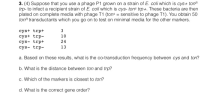 3. (4) Suppose that you use a phage P1 grown on a strain of E. coli which is cys+ ton trp- to infect a recipient strain of E. coli which is cys- tons trp+. These bacteria are then plated on complete media with phage T1 (tons sensitive to phage T1). You obtain 50 ton? transductants which you go on to test on minimal media for the other markers. cyst trp+ cyst trp- cys- trpt cys- trp- 10 24 13 a....
A culture of E. coli is diluted 1:1000. 1 ml of the 1:1000 dilution is spread...
A culture of E. coli is diluted 1:1000. 1 ml of the 1:1000 dilution is spread onto an agar plate. After incubation, 50 colonies are observed. What is the concentration of the original culture? Show your work and include proper units for full credit.
3. You inoculate 1 liter of medium with an E. coli culture to an initial cell...
3. You inoculate 1 liter of medium with an E. coli culture to an initial cell density of 104 cells/ml. The culture grows exponentially with a generation time of 20 minutes. What is the culture density after 24 hours?
Suppose your professor handed you a test tube with 2.0 ml of an E. Coli broth culture in it and...
Suppose your professor handed you a test tube with 2.0 ml of an E. Coli broth culture in it and told you to make a 10 -1 dilution of the entire culture. Explain howyou would do this. Show your calculations.
 5 points. Can a wild-type lambda phage infect and kill an E. coli host that harbors a wild-type lambda lysogen? Yes or No? 5 points. Can a wild-type lambda phage infect and kill an E. coli host that does not make the LamB protein? Yes or No?
 3. (4) Suppose that you use a phage P1 grown on a strain of E. coli which is cys+ ton trp- to infect a recipient strain of E. coli which is cys- tons trp+. These bacteria are then plated on complete media with phage T1 (tons sensitive to phage T1). You obtain 50 ton? transductants which you go on to test on minimal media for the other markers. cyst trp+ cyst trp- cys- trpt cys- trp- 10 24 13 a....
Most questions answered within 3 hours.
-
Where is the error in this code sequence?
String s1 = "Hello";
String s2 = "ello";...
asked 11 months ago -
Financial data for Joel de Paris, Inc., for last year
follow:
Joel de Paris, Inc.
Balance...
asked 11 months ago -
Consider this reaction:
Al2(SO4)3 (aq)+ BaCl3
(aq) Al2Cl6 (aq)- +
3BaSO4(s) . What is the...
asked 11 months ago -
Suppose that Savneet is considering increasing her
recent random sample from 20 car rentals to 40...
asked 11 months ago -
Trucks arrive at an unloading terminal at an average rate of 120
per hour.
Trucks arrive...
asked 11 months ago -
Why are methanol and ethanol completely soluble in water while
octanol is not very little soluble....
asked 11 months ago -
A facilities manager at a university reads in a research report
that the mean amount of...
asked 11 months ago -
When the CuSO4 is rehydrated by adding water to the anhydrous
compound, is this an endothermic...
asked 11 months ago -
A ray of sunlight is passing from diamond into crown glass; the
angle of incidence is...
asked 11 months ago -
A block of mass 0.249 kg is placed on top of a light, vertical
spring of...
asked 11 months ago -
how do the kidneys compensate in the presences of acidosis
a) trigger hyperventilate
b) reserve acid...
asked 11 months ago -
Question 501 pts
The rental rate of capital to the firm increases. Which of the
following...
asked 11 months ago