Please answer all..... Thank you!
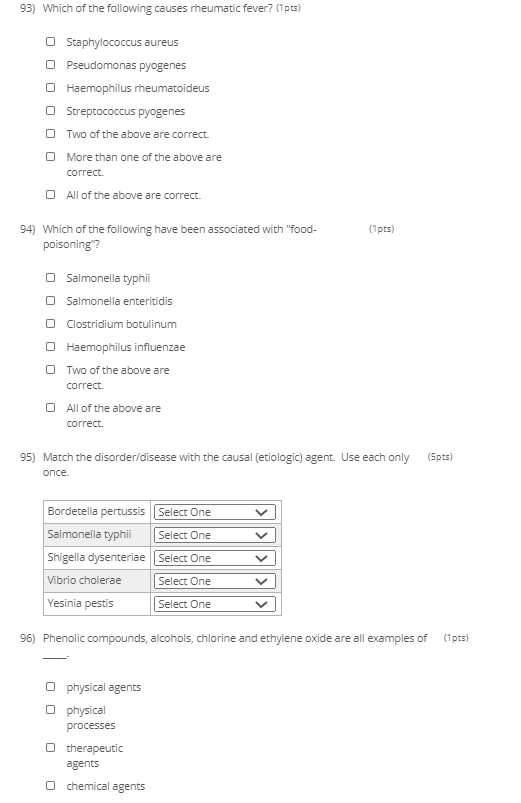
95.) bacillary dysentery, human cholera, plague, typhoid fever, whooping cough
Homework Answers
Ans.93. Streptococcus pyogenes
this disease is caused by a bacteria like a streptococcus pyogenes.This disease affected to connective tissue around arterioles, and it can occur after untreated strep throat infection.Rheumatic fever causes inflammation,of the heart, blood vessels and joints.
Ans.94. two of above are correct
salmonella thyphi and clostridium botulinum are associated with food poisoning.
Salmonella thyphi cause Typhoid fever and it is an infection that spreads through contaminated food and water.
Clostridium botulinum causes Botulism disease. This disease known as Botulism food poisoning that occurs when a toxin that are potent neurotoxin, produced by the bacteria is consumed in improperly preserved foods.
Ans.95
brodetella pertussis--whooping cough
salmonella thyphi--typhoid fever
shigella dysenteriae--bacillary dysentery,
Vibrio cholere--human cholera,
yesinia pestis--plague
Ans.96. chemical agents.
these all are chemical agents that's physical properties are used to kill. Because this agents has a toxic property.Chemical agents classified into four major classes: nerve, blister, choking, and blood agents.
Add Answer to:
Please answer all..... Thank you!
95.) bacillary dysentery, human cholera, plague, typhoid fever,
whooping cough
93)...
Please answer all..... Thank you 89) The DPT vaccination is used for immunization against which of...
 Please answer all..... Thank you
89) The DPT vaccination is used for immunization against which of the following (1 pts bacteria i. Corynebacterium diptheriae ii. Clostridium tetani ii. Bordetella pertussis iv. Salmonella typhii v. Mycobacterium tuberculosis iv. Yersinia pestis O., il. and iii. O i. iii., and V. Oiii. and vi. O., iv. and vi. Oi, v. and vi. (1 pts) 90) Which of the following bacteria exert their pathogenicity via toxins? i. Clostridium botulinum ii. Clostridium tetani iii. Yersinia...
Please answer all..... Thank you
89) The DPT vaccination is used for immunization against which of the following (1 pts bacteria i. Corynebacterium diptheriae ii. Clostridium tetani ii. Bordetella pertussis iv. Salmonella typhii v. Mycobacterium tuberculosis iv. Yersinia pestis O., il. and iii. O i. iii., and V. Oiii. and vi. O., iv. and vi. Oi, v. and vi. (1 pts) 90) Which of the following bacteria exert their pathogenicity via toxins? i. Clostridium botulinum ii. Clostridium tetani iii. Yersinia...
please answer all...… Thank you! 97) The process of destroying all forms of life is called...
 please answer all...… Thank you!
97) The process of destroying all forms of life is called (1 pts) O antisepsis O sterilization disinfection bacteriostasis sanitation 98) Which of the following substances is capable of killing the vegetative cells but not necessarily the spores of infectious agents? O sporicide O disinfectant sterilizer OTwo of the above are correct. All of the above are correct. (1 pts) 99) Which of the following conditions influences the action of antimicrobial agents? con Atration or...
please answer all...… Thank you!
97) The process of destroying all forms of life is called (1 pts) O antisepsis O sterilization disinfection bacteriostasis sanitation 98) Which of the following substances is capable of killing the vegetative cells but not necessarily the spores of infectious agents? O sporicide O disinfectant sterilizer OTwo of the above are correct. All of the above are correct. (1 pts) 99) Which of the following conditions influences the action of antimicrobial agents? con Atration or...
Please answer all...… Thank you Tipts 77) (A) Factor(s) affecting biochemical reaction rates within the cell...
 Please answer all...… Thank you
Tipts 77) (A) Factor(s) affecting biochemical reaction rates within the cell is/are: temperatures enzyme concentration substrate concentration coenzyme concentration O cofactor concentration OTwo of the above are correct. All of the above are correct. 78) RNA nucleosides contains all of the following nitrogenous bases except (1 pts) O adenine thymine Ouracil cytosine guanine 79) The ratio of adenine to thymine or guanine to cytosine in the genome of bacterium is always (1pts) 2:1 1:1 n...
Please answer all...… Thank you
Tipts 77) (A) Factor(s) affecting biochemical reaction rates within the cell is/are: temperatures enzyme concentration substrate concentration coenzyme concentration O cofactor concentration OTwo of the above are correct. All of the above are correct. 78) RNA nucleosides contains all of the following nitrogenous bases except (1 pts) O adenine thymine Ouracil cytosine guanine 79) The ratio of adenine to thymine or guanine to cytosine in the genome of bacterium is always (1pts) 2:1 1:1 n...
1. Which of the following is nottrue of necrotizing fasciitis? All of the above are true....
1. Which of the following is nottrue of necrotizing fasciitis? All of the above are true. Sudden onset, rapid spread. Easily treatable with appropriate antibiotic determined after isolation of agent. So called “Flesh Eating Disease” with necrosis (death) of soft tissue. Severe pain, inflammation, fever, tissue becomes progressively swollen, discolored, with blisters (bullae 2. Which is false concerning the following food-borne pathogens? Yersinia enterocoliticais a food-borne pathogen producing symptoms of appendicitis. Most Salmonella entericaserovars produce enterocolitis (gastroenteritis). Listeria monocytogenescan kill a...
Please answer all.... Thank you! 20.)The term spheroplast applies to a gram-negative bacterial cell which _____....
 Please answer all.... Thank you!
20.)The term
spheroplast applies to a gram-negative bacterial cell which
_____.
Select is likely to lyse due to the
osmotic shock as your answer
is likely to lyse due to the osmotic shock
Select is just about to ready to
produce a spore as your answer
is just about to ready to produce a spore
Select is fighting off an infection
by becteriophages as your answer
is fighting off an infection by becteriophages
Select has...
Please answer all.... Thank you!
20.)The term
spheroplast applies to a gram-negative bacterial cell which
_____.
Select is likely to lyse due to the
osmotic shock as your answer
is likely to lyse due to the osmotic shock
Select is just about to ready to
produce a spore as your answer
is just about to ready to produce a spore
Select is fighting off an infection
by becteriophages as your answer
is fighting off an infection by becteriophages
Select has...
please do all ! thank you INSTRUCTIONS: Answer the subsequent set of questions to solve the...
 please do all ! thank you
INSTRUCTIONS: Answer the subsequent set of questions to solve the "Goal of this problem. We recommend you write out your answer to compare to the particular questions as you go along, as if you were going to submit it fully SETUP: As shown in the figure, a painter climbs along a uniform ladder leaned up against a smooth wall. There is static friction between the feet of the ladder and the ground. The painter...
please do all ! thank you
INSTRUCTIONS: Answer the subsequent set of questions to solve the "Goal of this problem. We recommend you write out your answer to compare to the particular questions as you go along, as if you were going to submit it fully SETUP: As shown in the figure, a painter climbs along a uniform ladder leaned up against a smooth wall. There is static friction between the feet of the ladder and the ground. The painter...
 Please answer all..... Thank you
89) The DPT vaccination is used for immunization against which of the following (1 pts bacteria i. Corynebacterium diptheriae ii. Clostridium tetani ii. Bordetella pertussis iv. Salmonella typhii v. Mycobacterium tuberculosis iv. Yersinia pestis O., il. and iii. O i. iii., and V. Oiii. and vi. O., iv. and vi. Oi, v. and vi. (1 pts) 90) Which of the following bacteria exert their pathogenicity via toxins? i. Clostridium botulinum ii. Clostridium tetani iii. Yersinia...
Please answer all..... Thank you
89) The DPT vaccination is used for immunization against which of the following (1 pts bacteria i. Corynebacterium diptheriae ii. Clostridium tetani ii. Bordetella pertussis iv. Salmonella typhii v. Mycobacterium tuberculosis iv. Yersinia pestis O., il. and iii. O i. iii., and V. Oiii. and vi. O., iv. and vi. Oi, v. and vi. (1 pts) 90) Which of the following bacteria exert their pathogenicity via toxins? i. Clostridium botulinum ii. Clostridium tetani iii. Yersinia...
 please answer all...… Thank you!
97) The process of destroying all forms of life is called (1 pts) O antisepsis O sterilization disinfection bacteriostasis sanitation 98) Which of the following substances is capable of killing the vegetative cells but not necessarily the spores of infectious agents? O sporicide O disinfectant sterilizer OTwo of the above are correct. All of the above are correct. (1 pts) 99) Which of the following conditions influences the action of antimicrobial agents? con Atration or...
please answer all...… Thank you!
97) The process of destroying all forms of life is called (1 pts) O antisepsis O sterilization disinfection bacteriostasis sanitation 98) Which of the following substances is capable of killing the vegetative cells but not necessarily the spores of infectious agents? O sporicide O disinfectant sterilizer OTwo of the above are correct. All of the above are correct. (1 pts) 99) Which of the following conditions influences the action of antimicrobial agents? con Atration or...
 Please answer all...… Thank you
Tipts 77) (A) Factor(s) affecting biochemical reaction rates within the cell is/are: temperatures enzyme concentration substrate concentration coenzyme concentration O cofactor concentration OTwo of the above are correct. All of the above are correct. 78) RNA nucleosides contains all of the following nitrogenous bases except (1 pts) O adenine thymine Ouracil cytosine guanine 79) The ratio of adenine to thymine or guanine to cytosine in the genome of bacterium is always (1pts) 2:1 1:1 n...
Please answer all...… Thank you
Tipts 77) (A) Factor(s) affecting biochemical reaction rates within the cell is/are: temperatures enzyme concentration substrate concentration coenzyme concentration O cofactor concentration OTwo of the above are correct. All of the above are correct. 78) RNA nucleosides contains all of the following nitrogenous bases except (1 pts) O adenine thymine Ouracil cytosine guanine 79) The ratio of adenine to thymine or guanine to cytosine in the genome of bacterium is always (1pts) 2:1 1:1 n...
 Please answer all.... Thank you!
20.)The term
spheroplast applies to a gram-negative bacterial cell which
_____.
Select is likely to lyse due to the
osmotic shock as your answer
is likely to lyse due to the osmotic shock
Select is just about to ready to
produce a spore as your answer
is just about to ready to produce a spore
Select is fighting off an infection
by becteriophages as your answer
is fighting off an infection by becteriophages
Select has...
Please answer all.... Thank you!
20.)The term
spheroplast applies to a gram-negative bacterial cell which
_____.
Select is likely to lyse due to the
osmotic shock as your answer
is likely to lyse due to the osmotic shock
Select is just about to ready to
produce a spore as your answer
is just about to ready to produce a spore
Select is fighting off an infection
by becteriophages as your answer
is fighting off an infection by becteriophages
Select has...
 please do all ! thank you
INSTRUCTIONS: Answer the subsequent set of questions to solve the "Goal of this problem. We recommend you write out your answer to compare to the particular questions as you go along, as if you were going to submit it fully SETUP: As shown in the figure, a painter climbs along a uniform ladder leaned up against a smooth wall. There is static friction between the feet of the ladder and the ground. The painter...
please do all ! thank you
INSTRUCTIONS: Answer the subsequent set of questions to solve the "Goal of this problem. We recommend you write out your answer to compare to the particular questions as you go along, as if you were going to submit it fully SETUP: As shown in the figure, a painter climbs along a uniform ladder leaned up against a smooth wall. There is static friction between the feet of the ladder and the ground. The painter...
Most questions answered within 3 hours.
-
Where is the error in this code sequence?
String s1 = "Hello";
String s2 = "ello";...
asked 10 months ago -
Financial data for Joel de Paris, Inc., for last year
follow:
Joel de Paris, Inc.
Balance...
asked 10 months ago -
Consider this reaction:
Al2(SO4)3 (aq)+ BaCl3
(aq) Al2Cl6 (aq)- +
3BaSO4(s) . What is the...
asked 10 months ago -
Suppose that Savneet is considering increasing her
recent random sample from 20 car rentals to 40...
asked 10 months ago -
Trucks arrive at an unloading terminal at an average rate of 120
per hour.
Trucks arrive...
asked 10 months ago -
Why are methanol and ethanol completely soluble in water while
octanol is not very little soluble....
asked 10 months ago -
A facilities manager at a university reads in a research report
that the mean amount of...
asked 10 months ago -
When the CuSO4 is rehydrated by adding water to the anhydrous
compound, is this an endothermic...
asked 10 months ago -
A ray of sunlight is passing from diamond into crown glass; the
angle of incidence is...
asked 10 months ago -
A block of mass 0.249 kg is placed on top of a light, vertical
spring of...
asked 10 months ago -
how do the kidneys compensate in the presences of acidosis
a) trigger hyperventilate
b) reserve acid...
asked 10 months ago -
Question 501 pts
The rental rate of capital to the firm increases. Which of the
following...
asked 10 months ago