3. If a proton is moving along the x-axis at 8/10 times the speed of light...
3.
If a proton is moving along the x-axis at 8/10 times the speed of
light in vacuum, through a region of space where the Electric field
is 2i and the Magnetic field 3i+4j, find the magnitude of the force
on the proton.
Homework Answers
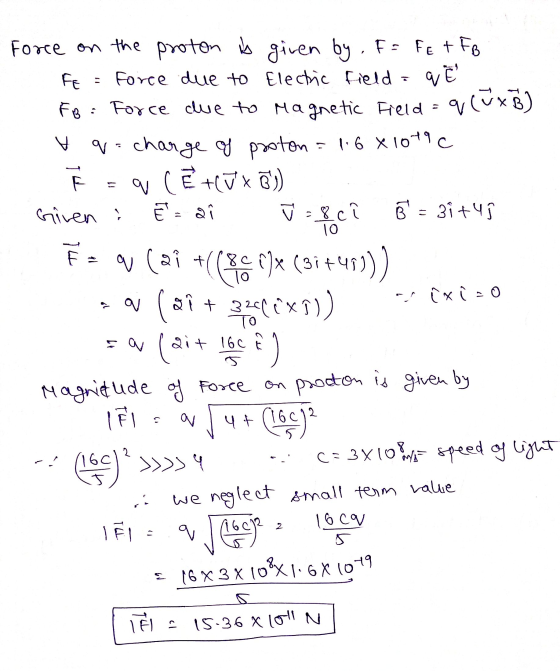
Since proton is moving with such high velocity. Hence on solving for magnitude of force we have to neglect smaller value i.e due to electric field.
Add Answer to:
3.
If a proton is moving along the x-axis at 8/10 times the speed of
light...
A proton traveling to the right along the x-axis enters a region where there is a...
A proton traveling to the right along the x-axis enters a region where there is a mag- netic field of magnitude 2.5 T directed upward along the y-axis. The charge on a proton is 1.60×10⁻¹⁹. If the proton experiences a force of 3.7 × 10⁻¹² N, find its speed. Answer in units of m/s.
A proton is moving in the -x direction with a speed of 337 km/s through a...
A proton is moving in the -x direction with a speed of 337 km/s through a region containing a uniform 2.18 T magnetic field that points in the -y direction. What is the magnitude of the magnetic force on the proton? What is the direction of the magnetic force on the proton? +z +y -z +x -x -y
Score: E-peild Imagine a proton moving initially at 2.1x 10 m/s in the positive direction of...
 Score: E-peild Imagine a proton moving initially at 2.1x 10 m/s in the positive direction of the x-axis. It moves in a field-free space until it passes by the origin, x-0, where it encounters an electric field directed along the x-axis. (The y and z components of the field are zero everywhere.) The electric potential, vto), associated with this field is shown i the left graph for 0x70 cm. 250 200 E 150 100 8 50 0 10 20 30...
In a vacuum, a proton (charge = +e, mass = 1.67 times 10^-27 kg) is moving...
 In a vacuum, a proton (charge = +e, mass = 1.67 times 10^-27 kg) is moving parallel to a uniform electric field that is directed along the +x axis (see figure below). The proton starts with a velocity of +4.30 times 10^4 m/s and accelerates in the same direction as the electric field, which has a value of +5.70 times 10^3 N/C. Find the velocity of the proton when its displacement is +2.0 mm from the starting point. Number Units...
1. An electron moving along the +X-axis with a speed of 3x10⁵ m/s when it enters...
 1. An electron moving along the +X-axis with a speed of 3x10⁵ m/s when it enters a region of uniform magnetic field with strength of 10 T in the +y- direction. What is the Electric field in the region if the electron maintains its initial velocity? Give your answer in component form.
A proton moving along the +x-axis enters a magnetic field. Because of this field the proton...
 A proton moving along the +x-axis enters a magnetic field. Because of this field the proton curves downward (in the -z direction). What is the direction of the magnetic field.
Imagine a proton moving at 2.1 x 10m/s in the positive direction of the x-axis. It...
 Imagine a proton moving at 2.1 x 10m/s in the positive direction of the x-axis. It moves in a field-free space until it passes by the origin, x = 0, where it encounters an electric field directed along the x-axis. (The y and z components of the field are zero everywhere). The electric potential, V(x), associated with this field is shown in the graph below. 200 Hlectrical (V) 100 50 0 0 10 20 30 40 50 60 70 Position...
. An electron is moving (along x-axis) through a 50 T magnetic field (along y-axis) at...
. An electron is moving (along x-axis) through a 50 T magnetic field (along y-axis) at a perpendicular velocity of 20000 m/s. Find the magnitude and direction of the magnetic force experienced by the electron. having hard time pleases go step by step
An electron is moving (along x-axis) through a 77 T magnetic field (along y-axis) at a...
 An electron is moving (along x-axis) through a 77 T magnetic
field (along y-axis) at a perpendicular velocity of 20000 m/s. Find
the magnitude and direction of the magnetic force experienced by
the electron. (Here is a picture not sure if you need it. if not
disregard.)
I P В.
An electron is moving (along x-axis) through a 77 T magnetic
field (along y-axis) at a perpendicular velocity of 20000 m/s. Find
the magnitude and direction of the magnetic force experienced by
the electron. (Here is a picture not sure if you need it. if not
disregard.)
I P В.
An electron is moving (along x-axis) through a 50 T magnetic field (along y-axis) at a...
An electron is moving (along x-axis) through a 50 T magnetic field (along y-axis) at a perpendicular velocity of 20000 m/s. Find the magnitude and direction of the magnetic force experienced by the electron. which law is this using and can you break it down step by step im still not understanding
 Score: E-peild Imagine a proton moving initially at 2.1x 10 m/s in the positive direction of the x-axis. It moves in a field-free space until it passes by the origin, x-0, where it encounters an electric field directed along the x-axis. (The y and z components of the field are zero everywhere.) The electric potential, vto), associated with this field is shown i the left graph for 0x70 cm. 250 200 E 150 100 8 50 0 10 20 30...
 In a vacuum, a proton (charge = +e, mass = 1.67 times 10^-27 kg) is moving parallel to a uniform electric field that is directed along the +x axis (see figure below). The proton starts with a velocity of +4.30 times 10^4 m/s and accelerates in the same direction as the electric field, which has a value of +5.70 times 10^3 N/C. Find the velocity of the proton when its displacement is +2.0 mm from the starting point. Number Units...
 1. An electron moving along the +X-axis with a speed of 3x10⁵ m/s when it enters a region of uniform magnetic field with strength of 10 T in the +y- direction. What is the Electric field in the region if the electron maintains its initial velocity? Give your answer in component form.
 A proton moving along the +x-axis enters a magnetic field. Because of this field the proton curves downward (in the -z direction). What is the direction of the magnetic field.
 Imagine a proton moving at 2.1 x 10m/s in the positive direction of the x-axis. It moves in a field-free space until it passes by the origin, x = 0, where it encounters an electric field directed along the x-axis. (The y and z components of the field are zero everywhere). The electric potential, V(x), associated with this field is shown in the graph below. 200 Hlectrical (V) 100 50 0 0 10 20 30 40 50 60 70 Position...
 An electron is moving (along x-axis) through a 77 T magnetic
field (along y-axis) at a perpendicular velocity of 20000 m/s. Find
the magnitude and direction of the magnetic force experienced by
the electron. (Here is a picture not sure if you need it. if not
disregard.)
I P В.
An electron is moving (along x-axis) through a 77 T magnetic
field (along y-axis) at a perpendicular velocity of 20000 m/s. Find
the magnitude and direction of the magnetic force experienced by
the electron. (Here is a picture not sure if you need it. if not
disregard.)
I P В.
Most questions answered within 3 hours.
-
Where is the error in this code sequence?
String s1 = "Hello";
String s2 = "ello";...
asked 11 months ago -
Financial data for Joel de Paris, Inc., for last year
follow:
Joel de Paris, Inc.
Balance...
asked 11 months ago -
Consider this reaction:
Al2(SO4)3 (aq)+ BaCl3
(aq) Al2Cl6 (aq)- +
3BaSO4(s) . What is the...
asked 11 months ago -
Suppose that Savneet is considering increasing her
recent random sample from 20 car rentals to 40...
asked 11 months ago -
Trucks arrive at an unloading terminal at an average rate of 120
per hour.
Trucks arrive...
asked 11 months ago -
Why are methanol and ethanol completely soluble in water while
octanol is not very little soluble....
asked 11 months ago -
A facilities manager at a university reads in a research report
that the mean amount of...
asked 11 months ago -
When the CuSO4 is rehydrated by adding water to the anhydrous
compound, is this an endothermic...
asked 11 months ago -
A ray of sunlight is passing from diamond into crown glass; the
angle of incidence is...
asked 11 months ago -
A block of mass 0.249 kg is placed on top of a light, vertical
spring of...
asked 11 months ago -
how do the kidneys compensate in the presences of acidosis
a) trigger hyperventilate
b) reserve acid...
asked 11 months ago -
Question 501 pts
The rental rate of capital to the firm increases. Which of the
following...
asked 11 months ago