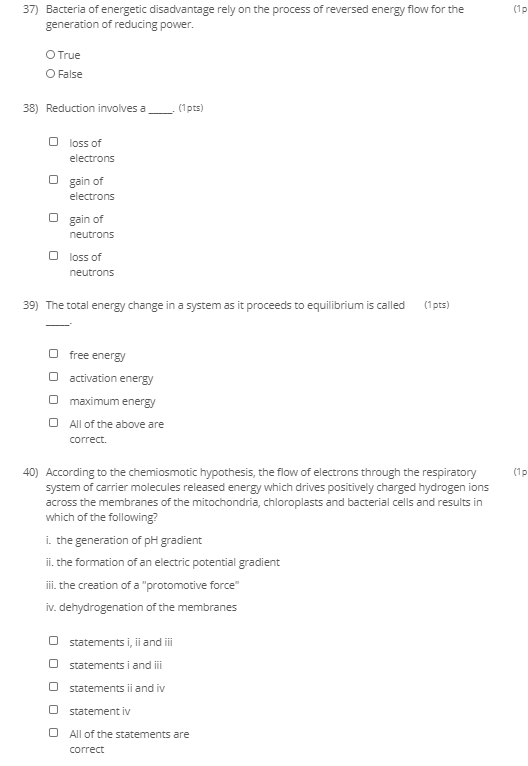
Please answer all.... Thank you!
Homework Answers
37. True
Reverse electron flow occurs in some chemolithotrophic bacteria. They use compounds like nitrite or sulfur to drive the formation of NADH or NADPH from NAD+ or NADP+.
38. Gain of electron
Loss of an electron is oxidation while gain of an electron is reduction. Neutrons are bound within the nucleus and are not exchangable and so are not lost or gained.
39. Free energy
Free energy is the amount of useful energy available to do work. Activation energy is the energy required to achieve the formation of the transient state complex.
40. Statements I, II and III.
Accumulation of H+ in the matrix results in an acidic pH and development of a positively charged region. This results in the setup of a pH and an electrochemical gradient across the membrane.
Add Answer to:
Please answer all.... Thank you!
(1p 37) Bacteria of energetic disadvantage rely on the process of...
Please answer all.. Thank you 73.) Coenzymes serve as carrier molecule, the coenzyme may be? a.)...
 Please answer all.. Thank you
73.) Coenzymes serve as carrier molecule, the coenzyme may
be?
a.) derived from vitamins
b) integral proteinsof all membrane
c.) both correct
d.) none is correct
(1 pts) 74) Which of the following cellular activities does (do) not require metabolic energy? heat production O motility facilitated diffusion active trasnport All of the above require metabolic energy 75) Which of the following statements regarding the peptide chain of peptidoglycan is true? i. Several of the amino...
Please answer all.. Thank you
73.) Coenzymes serve as carrier molecule, the coenzyme may
be?
a.) derived from vitamins
b) integral proteinsof all membrane
c.) both correct
d.) none is correct
(1 pts) 74) Which of the following cellular activities does (do) not require metabolic energy? heat production O motility facilitated diffusion active trasnport All of the above require metabolic energy 75) Which of the following statements regarding the peptide chain of peptidoglycan is true? i. Several of the amino...
PLease answer all... Thank you! 53) An enzyme is (1 pts) an organic catalyst able to...
 PLease answer all... Thank you!
53) An enzyme is (1 pts) an organic catalyst able to change the rate of reaction a protein All of the above are correct. 54) Cyanide is a strong inhibitor of iron-containing enzymes because it binds with iron and deprives the enzyme of its cofactor. This is called O noncompetitive ihibition denaturation O competitive inhibition O constitutive enzymes 55) Enzymes which are produced by the cell only in response to a particular substrate are called...
PLease answer all... Thank you!
53) An enzyme is (1 pts) an organic catalyst able to change the rate of reaction a protein All of the above are correct. 54) Cyanide is a strong inhibitor of iron-containing enzymes because it binds with iron and deprives the enzyme of its cofactor. This is called O noncompetitive ihibition denaturation O competitive inhibition O constitutive enzymes 55) Enzymes which are produced by the cell only in response to a particular substrate are called...
Please answer all..... Thank you 89) The DPT vaccination is used for immunization against which of...
 Please answer all..... Thank you
89) The DPT vaccination is used for immunization against which of the following (1 pts bacteria i. Corynebacterium diptheriae ii. Clostridium tetani ii. Bordetella pertussis iv. Salmonella typhii v. Mycobacterium tuberculosis iv. Yersinia pestis O., il. and iii. O i. iii., and V. Oiii. and vi. O., iv. and vi. Oi, v. and vi. (1 pts) 90) Which of the following bacteria exert their pathogenicity via toxins? i. Clostridium botulinum ii. Clostridium tetani iii. Yersinia...
Please answer all..... Thank you
89) The DPT vaccination is used for immunization against which of the following (1 pts bacteria i. Corynebacterium diptheriae ii. Clostridium tetani ii. Bordetella pertussis iv. Salmonella typhii v. Mycobacterium tuberculosis iv. Yersinia pestis O., il. and iii. O i. iii., and V. Oiii. and vi. O., iv. and vi. Oi, v. and vi. (1 pts) 90) Which of the following bacteria exert their pathogenicity via toxins? i. Clostridium botulinum ii. Clostridium tetani iii. Yersinia...
Please answer all.... Thank you! 20.)The term spheroplast applies to a gram-negative bacterial cell which _____....
 Please answer all.... Thank you!
20.)The term
spheroplast applies to a gram-negative bacterial cell which
_____.
Select is likely to lyse due to the
osmotic shock as your answer
is likely to lyse due to the osmotic shock
Select is just about to ready to
produce a spore as your answer
is just about to ready to produce a spore
Select is fighting off an infection
by becteriophages as your answer
is fighting off an infection by becteriophages
Select has...
Please answer all.... Thank you!
20.)The term
spheroplast applies to a gram-negative bacterial cell which
_____.
Select is likely to lyse due to the
osmotic shock as your answer
is likely to lyse due to the osmotic shock
Select is just about to ready to
produce a spore as your answer
is just about to ready to produce a spore
Select is fighting off an infection
by becteriophages as your answer
is fighting off an infection by becteriophages
Select has...
Please answer all.... Thank you a.) a pentose sugar linked to a phosphate group b.) a...
 Please answer all.... Thank you
a.) a pentose sugar linked to a phosphate group
b.) a pentose sugar linked to a nitrogenous base
c.) a hexose sugar linked to a nitrogenous base
d.) a nucleoside liked to a phosphate group
e.) none of the above are correct
85) The process by which donor bacterial genes are "absorbed" by the recipient cell from DNA fragments in the environment has been called transformation O conjugation transduction transversion O bacteriocinogenesis (1...
Please answer all.... Thank you
a.) a pentose sugar linked to a phosphate group
b.) a pentose sugar linked to a nitrogenous base
c.) a hexose sugar linked to a nitrogenous base
d.) a nucleoside liked to a phosphate group
e.) none of the above are correct
85) The process by which donor bacterial genes are "absorbed" by the recipient cell from DNA fragments in the environment has been called transformation O conjugation transduction transversion O bacteriocinogenesis (1...
Please answer all.... Thank you (1 pts) 69) Aerobic respiration in characterized by the following electron...
 Please answer all.... Thank you
(1 pts) 69) Aerobic respiration in characterized by the following electron acceptor: pyruvate oxygen O NAD+ O NADP- O nitrite ion 70) Chemoheterotrophs rely on the process of reversed energy flow for the generation of reducing (pt power. O True O False (1 pt 71) The reduction of NADP in non-cycling photophosphorylation recylces the coenzyme for use elswhere in the cell. True O False (1pc 72) In the conversion of one amino acid to another...
Please answer all.... Thank you
(1 pts) 69) Aerobic respiration in characterized by the following electron acceptor: pyruvate oxygen O NAD+ O NADP- O nitrite ion 70) Chemoheterotrophs rely on the process of reversed energy flow for the generation of reducing (pt power. O True O False (1 pt 71) The reduction of NADP in non-cycling photophosphorylation recylces the coenzyme for use elswhere in the cell. True O False (1pc 72) In the conversion of one amino acid to another...
Please answer all.... Thank you! 81)If a polypeptide chain contains 600 amino acids, then the gene...
 Please answer all.... Thank you!
81)If a polypeptide chain contains 600 amino acids, then the
gene coding for this polypeptide must contain _____.
600 nucleotides
1200 nucleotides
1800 nucleotides
1800 codons
1800 anticodons
More than one of the above are correct.
82) When we altered gene triplet in the DNA produces a chain-terminating codon in the mRNA, the (1pts) result is called a reverse mutation nonsense mutation missense mutation spontaneous mutation frameshift mutation 83) A single base substitution changes the...
Please answer all.... Thank you!
81)If a polypeptide chain contains 600 amino acids, then the
gene coding for this polypeptide must contain _____.
600 nucleotides
1200 nucleotides
1800 nucleotides
1800 codons
1800 anticodons
More than one of the above are correct.
82) When we altered gene triplet in the DNA produces a chain-terminating codon in the mRNA, the (1pts) result is called a reverse mutation nonsense mutation missense mutation spontaneous mutation frameshift mutation 83) A single base substitution changes the...
YOU MUST ANSWER THE FOLLOWING QUESTIONS ON YOUR OWN PRIOR TO CLASS REVIEW! 1. Label the...
 YOU MUST ANSWER THE FOLLOWING QUESTIONS ON YOUR OWN PRIOR TO CLASS REVIEW! 1. Label the path of electrons through the light reactions of photosynthesis using the illustration below. A. Include PSII and PSI and label all the complexes involved i. Which complex pushes H* across the membrane? ii. Where do these electrons end up? iii. What is the purpose of splitting H2O? iv. Where do the light reactions take place? 2H2D Ot ENR NAOD ADP photolyetemi photosyetemi wlochtone be-...
mestion Completion Status: Why did I suggest that the secret to life is electrons and protons?...
 mestion Completion Status: Why did I suggest that the secret to life is electrons and protons? A. Because redox reactions are necessary for all of the reactions in live cells and these redox reactions require both H+ and electrons B. Because electrons carry a negative charge and protons have a positive charge C. Because most (not all) cells need electron transport and H+ gradients to make ATP D. Because electrons are necessary for the electrical responses of the cell (like...
8. The movement of protons out of the mitochondrial matrix establishes an electrochemical H gradient across...
 8. The movement of protons out of the mitochondrial matrix establishes an electrochemical H gradient across the inner mitochondrial membrane. The electrochemical potential of this gradient is harnessed to synthesize ATP. This is known as the (A) Hydrophobic effect IqChemiosmotic theory (B) Acid catalysis (0) Michaelis-Menten mechanism _9. Which of the following statements about mitochondria and their lon and metabolite transporters is FALSE? (A) Controlled impermeability of the inner mitochondrial membrane to most ions and metabolites allows for the generation...
 Please answer all.. Thank you
73.) Coenzymes serve as carrier molecule, the coenzyme may
be?
a.) derived from vitamins
b) integral proteinsof all membrane
c.) both correct
d.) none is correct
(1 pts) 74) Which of the following cellular activities does (do) not require metabolic energy? heat production O motility facilitated diffusion active trasnport All of the above require metabolic energy 75) Which of the following statements regarding the peptide chain of peptidoglycan is true? i. Several of the amino...
Please answer all.. Thank you
73.) Coenzymes serve as carrier molecule, the coenzyme may
be?
a.) derived from vitamins
b) integral proteinsof all membrane
c.) both correct
d.) none is correct
(1 pts) 74) Which of the following cellular activities does (do) not require metabolic energy? heat production O motility facilitated diffusion active trasnport All of the above require metabolic energy 75) Which of the following statements regarding the peptide chain of peptidoglycan is true? i. Several of the amino...
 PLease answer all... Thank you!
53) An enzyme is (1 pts) an organic catalyst able to change the rate of reaction a protein All of the above are correct. 54) Cyanide is a strong inhibitor of iron-containing enzymes because it binds with iron and deprives the enzyme of its cofactor. This is called O noncompetitive ihibition denaturation O competitive inhibition O constitutive enzymes 55) Enzymes which are produced by the cell only in response to a particular substrate are called...
PLease answer all... Thank you!
53) An enzyme is (1 pts) an organic catalyst able to change the rate of reaction a protein All of the above are correct. 54) Cyanide is a strong inhibitor of iron-containing enzymes because it binds with iron and deprives the enzyme of its cofactor. This is called O noncompetitive ihibition denaturation O competitive inhibition O constitutive enzymes 55) Enzymes which are produced by the cell only in response to a particular substrate are called...
 Please answer all..... Thank you
89) The DPT vaccination is used for immunization against which of the following (1 pts bacteria i. Corynebacterium diptheriae ii. Clostridium tetani ii. Bordetella pertussis iv. Salmonella typhii v. Mycobacterium tuberculosis iv. Yersinia pestis O., il. and iii. O i. iii., and V. Oiii. and vi. O., iv. and vi. Oi, v. and vi. (1 pts) 90) Which of the following bacteria exert their pathogenicity via toxins? i. Clostridium botulinum ii. Clostridium tetani iii. Yersinia...
Please answer all..... Thank you
89) The DPT vaccination is used for immunization against which of the following (1 pts bacteria i. Corynebacterium diptheriae ii. Clostridium tetani ii. Bordetella pertussis iv. Salmonella typhii v. Mycobacterium tuberculosis iv. Yersinia pestis O., il. and iii. O i. iii., and V. Oiii. and vi. O., iv. and vi. Oi, v. and vi. (1 pts) 90) Which of the following bacteria exert their pathogenicity via toxins? i. Clostridium botulinum ii. Clostridium tetani iii. Yersinia...
 Please answer all.... Thank you!
20.)The term
spheroplast applies to a gram-negative bacterial cell which
_____.
Select is likely to lyse due to the
osmotic shock as your answer
is likely to lyse due to the osmotic shock
Select is just about to ready to
produce a spore as your answer
is just about to ready to produce a spore
Select is fighting off an infection
by becteriophages as your answer
is fighting off an infection by becteriophages
Select has...
Please answer all.... Thank you!
20.)The term
spheroplast applies to a gram-negative bacterial cell which
_____.
Select is likely to lyse due to the
osmotic shock as your answer
is likely to lyse due to the osmotic shock
Select is just about to ready to
produce a spore as your answer
is just about to ready to produce a spore
Select is fighting off an infection
by becteriophages as your answer
is fighting off an infection by becteriophages
Select has...
 Please answer all.... Thank you
a.) a pentose sugar linked to a phosphate group
b.) a pentose sugar linked to a nitrogenous base
c.) a hexose sugar linked to a nitrogenous base
d.) a nucleoside liked to a phosphate group
e.) none of the above are correct
85) The process by which donor bacterial genes are "absorbed" by the recipient cell from DNA fragments in the environment has been called transformation O conjugation transduction transversion O bacteriocinogenesis (1...
Please answer all.... Thank you
a.) a pentose sugar linked to a phosphate group
b.) a pentose sugar linked to a nitrogenous base
c.) a hexose sugar linked to a nitrogenous base
d.) a nucleoside liked to a phosphate group
e.) none of the above are correct
85) The process by which donor bacterial genes are "absorbed" by the recipient cell from DNA fragments in the environment has been called transformation O conjugation transduction transversion O bacteriocinogenesis (1...
 Please answer all.... Thank you
(1 pts) 69) Aerobic respiration in characterized by the following electron acceptor: pyruvate oxygen O NAD+ O NADP- O nitrite ion 70) Chemoheterotrophs rely on the process of reversed energy flow for the generation of reducing (pt power. O True O False (1 pt 71) The reduction of NADP in non-cycling photophosphorylation recylces the coenzyme for use elswhere in the cell. True O False (1pc 72) In the conversion of one amino acid to another...
Please answer all.... Thank you
(1 pts) 69) Aerobic respiration in characterized by the following electron acceptor: pyruvate oxygen O NAD+ O NADP- O nitrite ion 70) Chemoheterotrophs rely on the process of reversed energy flow for the generation of reducing (pt power. O True O False (1 pt 71) The reduction of NADP in non-cycling photophosphorylation recylces the coenzyme for use elswhere in the cell. True O False (1pc 72) In the conversion of one amino acid to another...
 Please answer all.... Thank you!
81)If a polypeptide chain contains 600 amino acids, then the
gene coding for this polypeptide must contain _____.
600 nucleotides
1200 nucleotides
1800 nucleotides
1800 codons
1800 anticodons
More than one of the above are correct.
82) When we altered gene triplet in the DNA produces a chain-terminating codon in the mRNA, the (1pts) result is called a reverse mutation nonsense mutation missense mutation spontaneous mutation frameshift mutation 83) A single base substitution changes the...
Please answer all.... Thank you!
81)If a polypeptide chain contains 600 amino acids, then the
gene coding for this polypeptide must contain _____.
600 nucleotides
1200 nucleotides
1800 nucleotides
1800 codons
1800 anticodons
More than one of the above are correct.
82) When we altered gene triplet in the DNA produces a chain-terminating codon in the mRNA, the (1pts) result is called a reverse mutation nonsense mutation missense mutation spontaneous mutation frameshift mutation 83) A single base substitution changes the...
 YOU MUST ANSWER THE FOLLOWING QUESTIONS ON YOUR OWN PRIOR TO CLASS REVIEW! 1. Label the path of electrons through the light reactions of photosynthesis using the illustration below. A. Include PSII and PSI and label all the complexes involved i. Which complex pushes H* across the membrane? ii. Where do these electrons end up? iii. What is the purpose of splitting H2O? iv. Where do the light reactions take place? 2H2D Ot ENR NAOD ADP photolyetemi photosyetemi wlochtone be-...
 mestion Completion Status: Why did I suggest that the secret to life is electrons and protons? A. Because redox reactions are necessary for all of the reactions in live cells and these redox reactions require both H+ and electrons B. Because electrons carry a negative charge and protons have a positive charge C. Because most (not all) cells need electron transport and H+ gradients to make ATP D. Because electrons are necessary for the electrical responses of the cell (like...
 8. The movement of protons out of the mitochondrial matrix establishes an electrochemical H gradient across the inner mitochondrial membrane. The electrochemical potential of this gradient is harnessed to synthesize ATP. This is known as the (A) Hydrophobic effect IqChemiosmotic theory (B) Acid catalysis (0) Michaelis-Menten mechanism _9. Which of the following statements about mitochondria and their lon and metabolite transporters is FALSE? (A) Controlled impermeability of the inner mitochondrial membrane to most ions and metabolites allows for the generation...
Most questions answered within 3 hours.
-
Where is the error in this code sequence?
String s1 = "Hello";
String s2 = "ello";...
asked 10 months ago -
Financial data for Joel de Paris, Inc., for last year
follow:
Joel de Paris, Inc.
Balance...
asked 10 months ago -
Consider this reaction:
Al2(SO4)3 (aq)+ BaCl3
(aq) Al2Cl6 (aq)- +
3BaSO4(s) . What is the...
asked 10 months ago -
Suppose that Savneet is considering increasing her
recent random sample from 20 car rentals to 40...
asked 10 months ago -
Trucks arrive at an unloading terminal at an average rate of 120
per hour.
Trucks arrive...
asked 10 months ago -
Why are methanol and ethanol completely soluble in water while
octanol is not very little soluble....
asked 10 months ago -
A facilities manager at a university reads in a research report
that the mean amount of...
asked 10 months ago -
When the CuSO4 is rehydrated by adding water to the anhydrous
compound, is this an endothermic...
asked 10 months ago -
A ray of sunlight is passing from diamond into crown glass; the
angle of incidence is...
asked 10 months ago -
A block of mass 0.249 kg is placed on top of a light, vertical
spring of...
asked 10 months ago -
how do the kidneys compensate in the presences of acidosis
a) trigger hyperventilate
b) reserve acid...
asked 10 months ago -
Question 501 pts
The rental rate of capital to the firm increases. Which of the
following...
asked 10 months ago