What is a synthetic strategy for the synthesis of
trans-1,2-cyclohexanediol from the reactant. Please explain how you
got the stereochemistry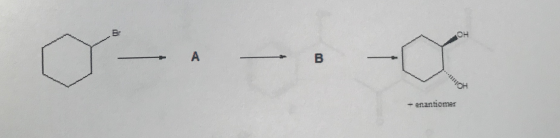
Homework Answers
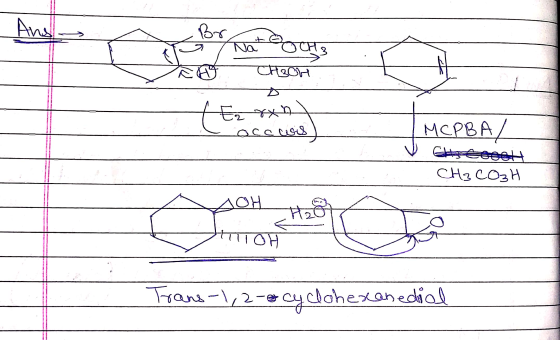
Add Answer to:
What is a synthetic strategy for the synthesis of
trans-1,2-cyclohexanediol from the reactant. Please explain how...
Can someone explain why the answer is not cis-1,2-cyclohexanediol and ethanol? Question 7 What are the...
 Can someone explain why the answer is not
cis-1,2-cyclohexanediol and ethanol?
Question 7 What are the products of the reaction shown below? O CH heat O IH OA. cyclohexanone and ethanol O B. cis-1,2-cyclohexanediol and ethanol O C. trans-1,2-cyclohexanediol and ethanol O D. cyclohexanone and ethanal 0 E. cis-1,2-cyclohexanediol and ethanal
Can someone explain why the answer is not
cis-1,2-cyclohexanediol and ethanol?
Question 7 What are the products of the reaction shown below? O CH heat O IH OA. cyclohexanone and ethanol O B. cis-1,2-cyclohexanediol and ethanol O C. trans-1,2-cyclohexanediol and ethanol O D. cyclohexanone and ethanal 0 E. cis-1,2-cyclohexanediol and ethanal
Propose a reasonable synthetic strategy for the synthesis of trans-6-methyl-3-heptene from 4-methyl-1-pentyne.
Propose a reasonable synthetic strategy for the synthesis of trans-6-methyl-3-heptene from 4-methyl-1-pentyne.
5) Please provide a synthetic strategy (Reagents, conditions, and order of reaction) to affect the following...
 5) Please provide a synthetic strategy (Reagents, conditions, and order of reaction) to affect the following synthetic transformation. Please draw any intermediate compounds involved in the synthesis. (6 points) OH ?? Br
5) Please provide a synthetic strategy (Reagents, conditions, and order of reaction) to affect the following...
 5) Please provide a synthetic strategy (Reagents, conditions, and order of reaction) to affect the following synthetic transformation. Please draw any intermediate compounds involved in the synthesis. (6 points) OH ?? Br
5) Please provide a synthetic strategy (Reagents, conditions, and order of reaction) to affect the following...
 5) Please provide a synthetic strategy (Reagents, conditions, and order of reaction) to affect the following synthetic transformation. Please draw any intermediate compounds nvolved in the synthesis. (6 points) etic transformation. Please draw any inte (6 points) OH ?? Br
1-methyl-1,2-cyclohexanediol + HIO4/water/heat --> possible answers: OH B 1-methyl-1,2cyclohexanediol + HIO4 / water / heat O...
 1-methyl-1,2-cyclohexanediol + HIO4/water/heat --> possible answers: OH B 1-methyl-1,2cyclohexanediol + HIO4 / water / heat O sto This is a multi-step synthesis question. You must choose which set of steps would give the most correct, highest yield path. The 4 arrows do NOT imply 4 steps....it just means many steps needed. ? ? ? ? Br ter 1. Li/hexanes, then Cul/THF/-78, 2. bromoethane 3. dilute HCI, 4. SOBr2/pyr/zero deg 5. Li/hexanes, then Cul/THF -78 6. 2-bromopropane 7. Br2 / light...
synthesis: how to get this molecule? thesis+B 20 AM 1. Outline a synthetic strategy that could...
 synthesis: how to get this molecule?
thesis+B 20 AM 1. Outline a synthetic strategy that could be used to efficiently synthesize the following, products. You may use oxacyclopropane, benzene, cyclohexane and any, alkene, alkyne, alcohol, or alkyl halide that is four carbon atoms or less. You may also use any organic solvents necessary and standard reagents as needed.
synthesis: how to get this molecule?
thesis+B 20 AM 1. Outline a synthetic strategy that could be used to efficiently synthesize the following, products. You may use oxacyclopropane, benzene, cyclohexane and any, alkene, alkyne, alcohol, or alkyl halide that is four carbon atoms or less. You may also use any organic solvents necessary and standard reagents as needed.
Draw the structure of each compound 1. Draw the structure of each compound: (a) cis-1,2-Cyclohexanediol (b)...
 Draw the structure of each compound
1. Draw the structure of each compound: (a) cis-1,2-Cyclohexanediol (b) Isobutanol (c) 2,4,6-Trinitrophenol (d) (R)-2,2-Dimethyl-3-heptanol (e) Ethylene glycol (0) (s)-2-Methyl-1-butanol 2. Acid-catalyzed hydration of 3,3-dimethyl-1-butene produces 2,3-dimethyl-2-butanol. Show a mechanism for this reaction 3. Acid-catalyzed hydration of 1-methylcyclohexene yields two alcohols. The major product does not undergo oxidation, while the minor product will undergo oxidation. Explain. 4. Using 2-propanol as your only source of carbon, show how you would prepare 2-methyl- 2-pentanol. 5. Identify...
Draw the structure of each compound
1. Draw the structure of each compound: (a) cis-1,2-Cyclohexanediol (b) Isobutanol (c) 2,4,6-Trinitrophenol (d) (R)-2,2-Dimethyl-3-heptanol (e) Ethylene glycol (0) (s)-2-Methyl-1-butanol 2. Acid-catalyzed hydration of 3,3-dimethyl-1-butene produces 2,3-dimethyl-2-butanol. Show a mechanism for this reaction 3. Acid-catalyzed hydration of 1-methylcyclohexene yields two alcohols. The major product does not undergo oxidation, while the minor product will undergo oxidation. Explain. 4. Using 2-propanol as your only source of carbon, show how you would prepare 2-methyl- 2-pentanol. 5. Identify...
Provide the missing compounds for each step in the following synthesis. Please use Br as your...
 Provide the missing compounds for each step in the following
synthesis. Please use Br as your leaving group, should you require
one. Be sure to show stereochemistry explicitly where necessary,
using wedges and dashes.
Please draw all four bonds at the sp2 carbons and at chiral carbons, including those to hydrogen. Provide the structure for compound B in the given synthesis. Be sure to consider the stereochemistry of the product as well as the mechanism for the reaction of Br2...
Provide the missing compounds for each step in the following
synthesis. Please use Br as your leaving group, should you require
one. Be sure to show stereochemistry explicitly where necessary,
using wedges and dashes.
Please draw all four bonds at the sp2 carbons and at chiral carbons, including those to hydrogen. Provide the structure for compound B in the given synthesis. Be sure to consider the stereochemistry of the product as well as the mechanism for the reaction of Br2...
Protecting Groups in Organic Synthesis 15) Propose how you could carry out the following synthetic sequence....
 Protecting Groups in Organic Synthesis 15) Propose how you could carry out the following synthetic sequence. Hint: PBrs converts alcohols to bromides Br OH он 16) A student tried to carry out the reaction sequence below, but none of the diol (A) was formed. Explain what went wrong with the plan and design a successful synthesis of A. OH он 2. H3O+
 Can someone explain why the answer is not
cis-1,2-cyclohexanediol and ethanol?
Question 7 What are the products of the reaction shown below? O CH heat O IH OA. cyclohexanone and ethanol O B. cis-1,2-cyclohexanediol and ethanol O C. trans-1,2-cyclohexanediol and ethanol O D. cyclohexanone and ethanal 0 E. cis-1,2-cyclohexanediol and ethanal
Can someone explain why the answer is not
cis-1,2-cyclohexanediol and ethanol?
Question 7 What are the products of the reaction shown below? O CH heat O IH OA. cyclohexanone and ethanol O B. cis-1,2-cyclohexanediol and ethanol O C. trans-1,2-cyclohexanediol and ethanol O D. cyclohexanone and ethanal 0 E. cis-1,2-cyclohexanediol and ethanal
 5) Please provide a synthetic strategy (Reagents, conditions, and order of reaction) to affect the following synthetic transformation. Please draw any intermediate compounds involved in the synthesis. (6 points) OH ?? Br
 5) Please provide a synthetic strategy (Reagents, conditions, and order of reaction) to affect the following synthetic transformation. Please draw any intermediate compounds involved in the synthesis. (6 points) OH ?? Br
 5) Please provide a synthetic strategy (Reagents, conditions, and order of reaction) to affect the following synthetic transformation. Please draw any intermediate compounds nvolved in the synthesis. (6 points) etic transformation. Please draw any inte (6 points) OH ?? Br
 1-methyl-1,2-cyclohexanediol + HIO4/water/heat --> possible answers: OH B 1-methyl-1,2cyclohexanediol + HIO4 / water / heat O sto This is a multi-step synthesis question. You must choose which set of steps would give the most correct, highest yield path. The 4 arrows do NOT imply 4 steps....it just means many steps needed. ? ? ? ? Br ter 1. Li/hexanes, then Cul/THF/-78, 2. bromoethane 3. dilute HCI, 4. SOBr2/pyr/zero deg 5. Li/hexanes, then Cul/THF -78 6. 2-bromopropane 7. Br2 / light...
 synthesis: how to get this molecule?
thesis+B 20 AM 1. Outline a synthetic strategy that could be used to efficiently synthesize the following, products. You may use oxacyclopropane, benzene, cyclohexane and any, alkene, alkyne, alcohol, or alkyl halide that is four carbon atoms or less. You may also use any organic solvents necessary and standard reagents as needed.
synthesis: how to get this molecule?
thesis+B 20 AM 1. Outline a synthetic strategy that could be used to efficiently synthesize the following, products. You may use oxacyclopropane, benzene, cyclohexane and any, alkene, alkyne, alcohol, or alkyl halide that is four carbon atoms or less. You may also use any organic solvents necessary and standard reagents as needed.
 Draw the structure of each compound
1. Draw the structure of each compound: (a) cis-1,2-Cyclohexanediol (b) Isobutanol (c) 2,4,6-Trinitrophenol (d) (R)-2,2-Dimethyl-3-heptanol (e) Ethylene glycol (0) (s)-2-Methyl-1-butanol 2. Acid-catalyzed hydration of 3,3-dimethyl-1-butene produces 2,3-dimethyl-2-butanol. Show a mechanism for this reaction 3. Acid-catalyzed hydration of 1-methylcyclohexene yields two alcohols. The major product does not undergo oxidation, while the minor product will undergo oxidation. Explain. 4. Using 2-propanol as your only source of carbon, show how you would prepare 2-methyl- 2-pentanol. 5. Identify...
Draw the structure of each compound
1. Draw the structure of each compound: (a) cis-1,2-Cyclohexanediol (b) Isobutanol (c) 2,4,6-Trinitrophenol (d) (R)-2,2-Dimethyl-3-heptanol (e) Ethylene glycol (0) (s)-2-Methyl-1-butanol 2. Acid-catalyzed hydration of 3,3-dimethyl-1-butene produces 2,3-dimethyl-2-butanol. Show a mechanism for this reaction 3. Acid-catalyzed hydration of 1-methylcyclohexene yields two alcohols. The major product does not undergo oxidation, while the minor product will undergo oxidation. Explain. 4. Using 2-propanol as your only source of carbon, show how you would prepare 2-methyl- 2-pentanol. 5. Identify...
 Provide the missing compounds for each step in the following
synthesis. Please use Br as your leaving group, should you require
one. Be sure to show stereochemistry explicitly where necessary,
using wedges and dashes.
Please draw all four bonds at the sp2 carbons and at chiral carbons, including those to hydrogen. Provide the structure for compound B in the given synthesis. Be sure to consider the stereochemistry of the product as well as the mechanism for the reaction of Br2...
Provide the missing compounds for each step in the following
synthesis. Please use Br as your leaving group, should you require
one. Be sure to show stereochemistry explicitly where necessary,
using wedges and dashes.
Please draw all four bonds at the sp2 carbons and at chiral carbons, including those to hydrogen. Provide the structure for compound B in the given synthesis. Be sure to consider the stereochemistry of the product as well as the mechanism for the reaction of Br2...
 Protecting Groups in Organic Synthesis 15) Propose how you could carry out the following synthetic sequence. Hint: PBrs converts alcohols to bromides Br OH он 16) A student tried to carry out the reaction sequence below, but none of the diol (A) was formed. Explain what went wrong with the plan and design a successful synthesis of A. OH он 2. H3O+
Most questions answered within 3 hours.
-
Where is the error in this code sequence?
String s1 = "Hello";
String s2 = "ello";...
asked 11 months ago -
Financial data for Joel de Paris, Inc., for last year
follow:
Joel de Paris, Inc.
Balance...
asked 11 months ago -
Consider this reaction:
Al2(SO4)3 (aq)+ BaCl3
(aq) Al2Cl6 (aq)- +
3BaSO4(s) . What is the...
asked 11 months ago -
Suppose that Savneet is considering increasing her
recent random sample from 20 car rentals to 40...
asked 11 months ago -
Trucks arrive at an unloading terminal at an average rate of 120
per hour.
Trucks arrive...
asked 11 months ago -
Why are methanol and ethanol completely soluble in water while
octanol is not very little soluble....
asked 11 months ago -
A facilities manager at a university reads in a research report
that the mean amount of...
asked 11 months ago -
When the CuSO4 is rehydrated by adding water to the anhydrous
compound, is this an endothermic...
asked 11 months ago -
A ray of sunlight is passing from diamond into crown glass; the
angle of incidence is...
asked 11 months ago -
A block of mass 0.249 kg is placed on top of a light, vertical
spring of...
asked 11 months ago -
how do the kidneys compensate in the presences of acidosis
a) trigger hyperventilate
b) reserve acid...
asked 11 months ago -
Question 501 pts
The rental rate of capital to the firm increases. Which of the
following...
asked 11 months ago