
Homework Answers
Answer) -2.1
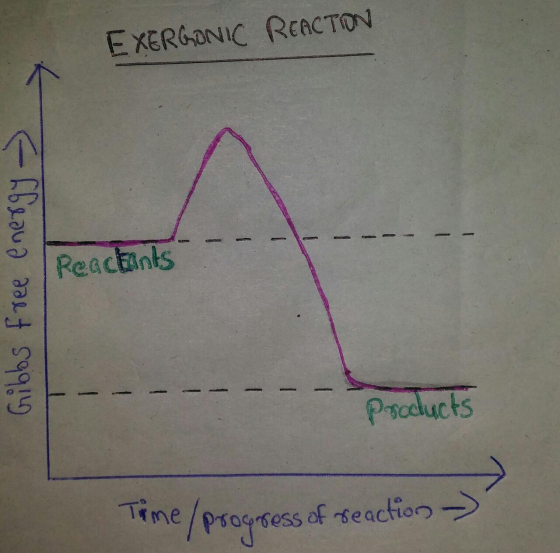
The correct answer will be -2.1 because exergonic reactions are spontaneous reactions, so that the change in free energy in these chemical reactions will be always negative. These reactions will release their free energy into the surrounding easily, so it is termed as spontaneous reactions. They will not consume the energy. Because of this process the free energy of the system will be decreased and as a result of this the Gibbs free energy(G) will also be termed as negative.
That is,  G =
H-TS
G =
H-TS
G
= Gibbs free energy
H
= Enthalpy
T= Temperature
S
= Entropy of the system
For an exergonic reaction, the free
energy is released therefore the
G value becomes negative and such that the reaction will be
spontaneous. The entropy of an exergonic system will always
increases. Free energy of the system is the total amount of energy
that is available on the system. The examples for exergonic
reactions are cellular
respiration,glycolysis,combustion,chemiluminescence. In all these
reactions the energy is released out of the system, for example in
chemiluminescence light energy is released out of the
system.
The other options zero,+2.1, it
varies from +2.1 to -2.1 is incorrect for the reason that
G< 0 ,so that zero cannot be the answer. Considering +2.1, it is
a positive value so that it cannot indicate an exergonic reaction.
The next varies from a positive value to a negative value, so that
it is not the correct option.
Add Answer to:
From the choices below, the change in free energy for the reaction that is exergonic will...
Below is a free energy change graph for a reaction in which reactants A+B produce the...
 Below is a free energy change graph for a reaction in which reactants A+B produce the product D. Use the data given to answer the following questions: What does the hump in the middle represent? What is the name of the general class of proteins that are needed to help the reactions go through that hump in a cell? How do they help the reaction go through? In this reaction is the free energy of the reactants or the free...
To calculate the free energy (delta G^0,) of a reaction, you can subtract the free energies...
 To calculate the free energy (delta G^0,) of a reaction, you can subtract the free energies of formation (G_f^0) of the reactants from those of the products. Given the following data, what will be true of this reaction? C_6H_12O_6 + O_2 rightarrow CO_2 + H_2O G_f^0: -917.30 -394.4 -237.2 The reaction will not require a catalyst to proceed. The reaction is not balanced, so you cannot calculate the change in free energy. The reaction will be endergonic. The reaction will...
Given an endergonic or exergonic process/reaction, predict what will happen to entropy and free energy levels
Given an endergonic or exergonic process/reaction, predict what will happen to entropy and free energy levels
4. Draw a free energy reaction coordinate diagram for both a generic endergonic and a generic exergonic...
4. Draw a free energy reaction coordinate diagram for both a generic endergonic and a generic exergonic reaction (label each). Make sure to label the x- and y-axes. Now label where reactants and products should go on the figure. Draw something that illustrates the free energy change for each reaction. Now write something like the following next to your figures: “reactants <—> products”. a. What do the reaction coordinate diagrams have to do with the text you just wrote? b. What...
please help Label all parts of reaction, describe energy changes in exergonic reaction, when catalyzed and...
 please help
Label all parts of reaction, describe energy changes in exergonic reaction, when catalyzed and when not catalyzed by an enzyme. Mark activation energy and changes in free energy.
please help
Label all parts of reaction, describe energy changes in exergonic reaction, when catalyzed and when not catalyzed by an enzyme. Mark activation energy and changes in free energy.
For the reaction given below, the standard change in free energy has a positive value. A+B<-->C+D...
For the reaction given below, the standard change in free energy has a positive value. A+B<-->C+D Changing the conditions of the reaction can alter the value of the change in free energy (?G). Sort the following conditions as to whether each would decrease the free energy value, increase the free energy value, or not change the free energy value for the reaction. For each change, assume that the other variables are kept constant. a. Adding a catalyst decrease the free...
Suppose the Gibbs free energy change of a reaction has a large positive value. What does...
 Suppose the Gibbs free energy change of a reaction has a large positive value. What does this say about the spontaneity of the chemical reaction? Select the correct answer below: O The chemical reaction is spontaneous. O The chemical reaction is not spontaneous. O The Gibbs free energy change, in itself, says nothing about whether a reaction is spontaneous O There is not enough information provided for a definitive answer
Calculate the value of the free energy change, ΔG, for the reaction below at 227.0ºC when...
Calculate the value of the free energy change, ΔG, for the reaction below at 227.0ºC when the pressures of NO (g) = 2.00 atm, O₂ (g) = 10.00 atm, and NO₂ (g) = 0.0250 atm. 2 NO (g) + O₂ (g) → 2 NO₂ (g) ΔGº = -70.54 kJ ΔHº = -114.14 kJ ΔSº = -146.43 J/K ΔG = ? kJ
Calculate the change in Gibbs Free Energy (AG) for the following system. Is this reaction endergonic...
 Calculate the change in Gibbs Free Energy (AG) for the following system. Is this reaction endergonic or exergonic? For the following reaction (synthesis of aspirin. C_5H_3O_4), it was experimentally determined that Ea = 50 kJ under standard conditions. After the addition of an enzyme, it was experimentally determined that E_aa = 20 kJ: Complete the following graph showing the reaction before (solid line) and after (dashed line) the addition of the enzyme. Label the horizontal lines for the products and...
Free Energy Changes for the Nonstandard States: The Relationship between dg rxn and dg rxn. Below...
Free Energy Changes for the Nonstandard States: The Relationship between dg rxn and dg rxn. Below are key questions . 1 .Calculate the free energy change for a reaction or process under nonstandard conditions. 2 .Understand that the free energy change for a reaction or process at equilibrium is exactly zero, indicating nonspontaneity for the reaction or process in either direction. also, Free Energy and Equilibrium: Relating dg rxn to the Equilibrium Constant (K) 3. Calculate and interconvert between the...
 Below is a free energy change graph for a reaction in which reactants A+B produce the product D. Use the data given to answer the following questions: What does the hump in the middle represent? What is the name of the general class of proteins that are needed to help the reactions go through that hump in a cell? How do they help the reaction go through? In this reaction is the free energy of the reactants or the free...
 To calculate the free energy (delta G^0,) of a reaction, you can subtract the free energies of formation (G_f^0) of the reactants from those of the products. Given the following data, what will be true of this reaction? C_6H_12O_6 + O_2 rightarrow CO_2 + H_2O G_f^0: -917.30 -394.4 -237.2 The reaction will not require a catalyst to proceed. The reaction is not balanced, so you cannot calculate the change in free energy. The reaction will be endergonic. The reaction will...
 please help
Label all parts of reaction, describe energy changes in exergonic reaction, when catalyzed and when not catalyzed by an enzyme. Mark activation energy and changes in free energy.
please help
Label all parts of reaction, describe energy changes in exergonic reaction, when catalyzed and when not catalyzed by an enzyme. Mark activation energy and changes in free energy.
 Suppose the Gibbs free energy change of a reaction has a large positive value. What does this say about the spontaneity of the chemical reaction? Select the correct answer below: O The chemical reaction is spontaneous. O The chemical reaction is not spontaneous. O The Gibbs free energy change, in itself, says nothing about whether a reaction is spontaneous O There is not enough information provided for a definitive answer
 Calculate the change in Gibbs Free Energy (AG) for the following system. Is this reaction endergonic or exergonic? For the following reaction (synthesis of aspirin. C_5H_3O_4), it was experimentally determined that Ea = 50 kJ under standard conditions. After the addition of an enzyme, it was experimentally determined that E_aa = 20 kJ: Complete the following graph showing the reaction before (solid line) and after (dashed line) the addition of the enzyme. Label the horizontal lines for the products and...
Most questions answered within 3 hours.
-
Where is the error in this code sequence?
String s1 = "Hello";
String s2 = "ello";...
asked 11 months ago -
Financial data for Joel de Paris, Inc., for last year
follow:
Joel de Paris, Inc.
Balance...
asked 11 months ago -
Consider this reaction:
Al2(SO4)3 (aq)+ BaCl3
(aq) Al2Cl6 (aq)- +
3BaSO4(s) . What is the...
asked 11 months ago -
Suppose that Savneet is considering increasing her
recent random sample from 20 car rentals to 40...
asked 11 months ago -
Trucks arrive at an unloading terminal at an average rate of 120
per hour.
Trucks arrive...
asked 11 months ago -
Why are methanol and ethanol completely soluble in water while
octanol is not very little soluble....
asked 11 months ago -
A facilities manager at a university reads in a research report
that the mean amount of...
asked 11 months ago -
When the CuSO4 is rehydrated by adding water to the anhydrous
compound, is this an endothermic...
asked 11 months ago -
A ray of sunlight is passing from diamond into crown glass; the
angle of incidence is...
asked 11 months ago -
A block of mass 0.249 kg is placed on top of a light, vertical
spring of...
asked 11 months ago -
how do the kidneys compensate in the presences of acidosis
a) trigger hyperventilate
b) reserve acid...
asked 11 months ago -
Question 501 pts
The rental rate of capital to the firm increases. Which of the
following...
asked 11 months ago