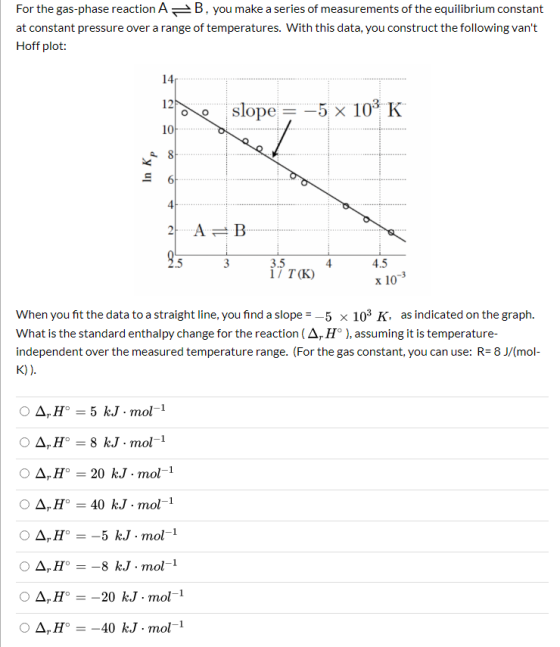
please show how you got the answer
Homework Answers
Using Van't Hoff equation,
ln(Kp) = -∆H°/RT + ∆S°/T
So, slope of Graph is
Slope = -∆H°/R = 5×10³
∆H° = -40 kJ/mol
Add Answer to:
please show how you got the answer
For the gas-phase reaction A=B, you make a series...
please show me how you got the answer For a newly discovered chemical compound, it was...
 please show me how you got the answer
For a newly discovered chemical compound, it was determined that the vapor pressure can be estimated with the following equation over a range of temperatures that includes the compound's boiling point: = exp(-4 + B), where A = 4,000 K and B = 20 Р Calculate the molar enthalpy of vaporization for this compound. You can assume ideal gas behavior of the vapor. (As an approximation for the gas constant, you can...
please show me how you got the answer
For a newly discovered chemical compound, it was determined that the vapor pressure can be estimated with the following equation over a range of temperatures that includes the compound's boiling point: = exp(-4 + B), where A = 4,000 K and B = 20 Р Calculate the molar enthalpy of vaporization for this compound. You can assume ideal gas behavior of the vapor. (As an approximation for the gas constant, you can...
1. Ethylene can be formed by cracking of propane: CH CHA+CH. This reaction is carried out...
 1. Ethylene can be formed by cracking of propane: CH CHA+CH. This reaction is carried out in the gas phase. You may assume ideal gas for parts b and c. AH (kJ/mol) AG (kJ/mol) CH 52.4 68.4 -103.8 CHA -74.6 --50.5 a. (10%) Use the provided data (for 1 bar, 298.15 K) to calculate the equilibrium constant of this reaction at 298.15 K. b. (10%) Calculate the equilibrium constant of this reaction at 800 K using the shortent van't Hoff...
Problem 4 The value of Δ110 is-12.93 kJ mol-1 for the following reaction: 2HI(g)H2(g) +12(9) Assuming...
 Problem 4 The value of Δ110 is-12.93 kJ mol-1 for the following reaction: 2HI(g)H2(g) +12(9) Assuming that Δ/P is independent of temperature, calculate K at 700 K given that K = 29.1 at 1000K. HINT: You can integrate the Van't Hoff Equation in a VERY similar way as we approached the integration of the Gibbs-Helmholtz equation)
Review Intelligent Tutoring Problem 03-02 Consider the following reaction, with all reagents in the gas phase:...
 Review Intelligent Tutoring Problem 03-02 Consider the following reaction, with all reagents in the gas phase: Η Η C=( + 3 0=0 HH 2 0=c=0 +2 -O-H Avarage bond energy for C=0 = 800 kJ/mol. x Incorrect. Make sure you used AE = sum of energies of bonds broken - sum of energies of bonds made. Calculate the energy change of this reaction (in kJ mol-?) using average bond energies found in Table 3-2 of the textbook. Use 800 kJ/mol...
1. Ethylene can he farmed hy cracking of propane: CHACHA+CH. This reaction is carried out in...
 1. Ethylene can he farmed hy cracking of propane: CHACHA+CH. This reaction is carried out in the gas phase. You may assume ideal gas for parts b and c. 68.4 AH (kJ/Llol AG (LJ/mol 52.4 CIL - 103 -23.1 -74.6 -30.5 a. (10%) Use the provided data for 1 bar, 298.15 K) to calculate the exquilibrium constant of this reaction at 298.15 K. b. (10%) Calculate the equilibrium constant of this reaction at 800 K using the shortcut van't Holl...
(3 Points) Calculate the standard Gibbs energy of reaction for the reaction below at 298 K...
 (3 Points) Calculate the standard Gibbs energy of reaction for the reaction below at 298 K and 596 K. 4 HCl(g) + O2(g) 2Cl2(g) + 2H2O(l) Assume that the heat capacities are constant over the temperature range involved. 02(g) Cl2(g) HCl(g) 4,Hº (kJ mol-4) -92.11 S JK- mol-) 186.91 Comº (K-mol-4) 29.12 AG° (k mol-1) | -95.30 223.07 205.14 9.36 H2O(1) -285.83 69.91 75.29 -237.133 2 33.91
The irreversible gas phase rxn, A=> B+C is performed in an adiabatic, 800‐liter PFR with a rate...
 The irreversible gas phase rxn, A=> B+C is performed in
an adiabatic, 800‐liter PFR with a rate constant, k, as
below: k=60*exp(‐5000/T) s‐1 The feed is pure A at 15 bar and 450 K
with a volumetric flow rate of 1.956 L/s. The heat of
rxnis ‐12 kJ/mol(independent of temperature), heat
capacities are CPA= 40 J/mol/K, CPB= 15 J/mol/K, and CPC
= 25 J/mol/K. The reaction is operated at constant
pressure Plot (a) FAand FBversus reactor volume (b) Temperature
versus reactor volume (c) volumetric flow...
The irreversible gas phase rxn, A=> B+C is performed in
an adiabatic, 800‐liter PFR with a rate constant, k, as
below: k=60*exp(‐5000/T) s‐1 The feed is pure A at 15 bar and 450 K
with a volumetric flow rate of 1.956 L/s. The heat of
rxnis ‐12 kJ/mol(independent of temperature), heat
capacities are CPA= 40 J/mol/K, CPB= 15 J/mol/K, and CPC
= 25 J/mol/K. The reaction is operated at constant
pressure Plot (a) FAand FBversus reactor volume (b) Temperature
versus reactor volume (c) volumetric flow...
The gas phase reaction 2 N2O5(g) → 4 NO2(g) + O2(g) has an activation energy of...
The gas phase reaction 2 N2O5(g) → 4 NO2(g) + O2(g) has an activation energy of 103 kJ/mol, and the first order rate constant is 1.01×10⁻⁴ min-1 at 278 K. What is the rate constant at 308 K? ________min-1
T(N)=352 please I need the answer urgent Question 1 The following gas phase reaction produces ethanol...
 T(N)=352 please I need the answer urgent
Question 1 The following gas phase reaction produces ethanol (C2H5OH) by catalytic hydrogenation of acetaldehyde (CH3CHO). The reaction reaches equilibrium at a temperature of T= T(N) and a pressure of 3 bar: CH,CHO(g) + H, (g) C,H,OH (8) The reactive system initially contains 1.5 moles of Hydrogen (Ha) for each mole of acetaldehyde (CH3CHO). The mixture is assumed to be an ideal gas. T(N) is the temperature corresponding to the student number as...
T(N)=352 please I need the answer urgent
Question 1 The following gas phase reaction produces ethanol (C2H5OH) by catalytic hydrogenation of acetaldehyde (CH3CHO). The reaction reaches equilibrium at a temperature of T= T(N) and a pressure of 3 bar: CH,CHO(g) + H, (g) C,H,OH (8) The reactive system initially contains 1.5 moles of Hydrogen (Ha) for each mole of acetaldehyde (CH3CHO). The mixture is assumed to be an ideal gas. T(N) is the temperature corresponding to the student number as...
Please show all your work and write neatly please! Thank you guys! ?? Solve the following...
 Please show all your work and write neatly please! Thank you guys!
??
Solve the following problems. The activation energy for the reaction below equals 1.0 x 10⁵ J/mol. Given k 2.5 x 10³ sec1 at 332 K, find k at 375 K. 1. N20s (g)-2NO (g) + 0a(g) Based on information in problem 1, find the temperature at which k is twice as large as it is at 332K. 2.
Please show all your work and write neatly please! Thank you guys!
??
Solve the following problems. The activation energy for the reaction below equals 1.0 x 10⁵ J/mol. Given k 2.5 x 10³ sec1 at 332 K, find k at 375 K. 1. N20s (g)-2NO (g) + 0a(g) Based on information in problem 1, find the temperature at which k is twice as large as it is at 332K. 2.
 please show me how you got the answer
For a newly discovered chemical compound, it was determined that the vapor pressure can be estimated with the following equation over a range of temperatures that includes the compound's boiling point: = exp(-4 + B), where A = 4,000 K and B = 20 Р Calculate the molar enthalpy of vaporization for this compound. You can assume ideal gas behavior of the vapor. (As an approximation for the gas constant, you can...
please show me how you got the answer
For a newly discovered chemical compound, it was determined that the vapor pressure can be estimated with the following equation over a range of temperatures that includes the compound's boiling point: = exp(-4 + B), where A = 4,000 K and B = 20 Р Calculate the molar enthalpy of vaporization for this compound. You can assume ideal gas behavior of the vapor. (As an approximation for the gas constant, you can...
 1. Ethylene can be formed by cracking of propane: CH CHA+CH. This reaction is carried out in the gas phase. You may assume ideal gas for parts b and c. AH (kJ/mol) AG (kJ/mol) CH 52.4 68.4 -103.8 CHA -74.6 --50.5 a. (10%) Use the provided data (for 1 bar, 298.15 K) to calculate the equilibrium constant of this reaction at 298.15 K. b. (10%) Calculate the equilibrium constant of this reaction at 800 K using the shortent van't Hoff...
 Problem 4 The value of Δ110 is-12.93 kJ mol-1 for the following reaction: 2HI(g)H2(g) +12(9) Assuming that Δ/P is independent of temperature, calculate K at 700 K given that K = 29.1 at 1000K. HINT: You can integrate the Van't Hoff Equation in a VERY similar way as we approached the integration of the Gibbs-Helmholtz equation)
 Review Intelligent Tutoring Problem 03-02 Consider the following reaction, with all reagents in the gas phase: Η Η C=( + 3 0=0 HH 2 0=c=0 +2 -O-H Avarage bond energy for C=0 = 800 kJ/mol. x Incorrect. Make sure you used AE = sum of energies of bonds broken - sum of energies of bonds made. Calculate the energy change of this reaction (in kJ mol-?) using average bond energies found in Table 3-2 of the textbook. Use 800 kJ/mol...
 1. Ethylene can he farmed hy cracking of propane: CHACHA+CH. This reaction is carried out in the gas phase. You may assume ideal gas for parts b and c. 68.4 AH (kJ/Llol AG (LJ/mol 52.4 CIL - 103 -23.1 -74.6 -30.5 a. (10%) Use the provided data for 1 bar, 298.15 K) to calculate the exquilibrium constant of this reaction at 298.15 K. b. (10%) Calculate the equilibrium constant of this reaction at 800 K using the shortcut van't Holl...
 (3 Points) Calculate the standard Gibbs energy of reaction for the reaction below at 298 K and 596 K. 4 HCl(g) + O2(g) 2Cl2(g) + 2H2O(l) Assume that the heat capacities are constant over the temperature range involved. 02(g) Cl2(g) HCl(g) 4,Hº (kJ mol-4) -92.11 S JK- mol-) 186.91 Comº (K-mol-4) 29.12 AG° (k mol-1) | -95.30 223.07 205.14 9.36 H2O(1) -285.83 69.91 75.29 -237.133 2 33.91
 The irreversible gas phase rxn, A=> B+C is performed in
an adiabatic, 800‐liter PFR with a rate constant, k, as
below: k=60*exp(‐5000/T) s‐1 The feed is pure A at 15 bar and 450 K
with a volumetric flow rate of 1.956 L/s. The heat of
rxnis ‐12 kJ/mol(independent of temperature), heat
capacities are CPA= 40 J/mol/K, CPB= 15 J/mol/K, and CPC
= 25 J/mol/K. The reaction is operated at constant
pressure Plot (a) FAand FBversus reactor volume (b) Temperature
versus reactor volume (c) volumetric flow...
The irreversible gas phase rxn, A=> B+C is performed in
an adiabatic, 800‐liter PFR with a rate constant, k, as
below: k=60*exp(‐5000/T) s‐1 The feed is pure A at 15 bar and 450 K
with a volumetric flow rate of 1.956 L/s. The heat of
rxnis ‐12 kJ/mol(independent of temperature), heat
capacities are CPA= 40 J/mol/K, CPB= 15 J/mol/K, and CPC
= 25 J/mol/K. The reaction is operated at constant
pressure Plot (a) FAand FBversus reactor volume (b) Temperature
versus reactor volume (c) volumetric flow...
 T(N)=352 please I need the answer urgent
Question 1 The following gas phase reaction produces ethanol (C2H5OH) by catalytic hydrogenation of acetaldehyde (CH3CHO). The reaction reaches equilibrium at a temperature of T= T(N) and a pressure of 3 bar: CH,CHO(g) + H, (g) C,H,OH (8) The reactive system initially contains 1.5 moles of Hydrogen (Ha) for each mole of acetaldehyde (CH3CHO). The mixture is assumed to be an ideal gas. T(N) is the temperature corresponding to the student number as...
T(N)=352 please I need the answer urgent
Question 1 The following gas phase reaction produces ethanol (C2H5OH) by catalytic hydrogenation of acetaldehyde (CH3CHO). The reaction reaches equilibrium at a temperature of T= T(N) and a pressure of 3 bar: CH,CHO(g) + H, (g) C,H,OH (8) The reactive system initially contains 1.5 moles of Hydrogen (Ha) for each mole of acetaldehyde (CH3CHO). The mixture is assumed to be an ideal gas. T(N) is the temperature corresponding to the student number as...
 Please show all your work and write neatly please! Thank you guys!
??
Solve the following problems. The activation energy for the reaction below equals 1.0 x 10⁵ J/mol. Given k 2.5 x 10³ sec1 at 332 K, find k at 375 K. 1. N20s (g)-2NO (g) + 0a(g) Based on information in problem 1, find the temperature at which k is twice as large as it is at 332K. 2.
Please show all your work and write neatly please! Thank you guys!
??
Solve the following problems. The activation energy for the reaction below equals 1.0 x 10⁵ J/mol. Given k 2.5 x 10³ sec1 at 332 K, find k at 375 K. 1. N20s (g)-2NO (g) + 0a(g) Based on information in problem 1, find the temperature at which k is twice as large as it is at 332K. 2.
Most questions answered within 3 hours.
-
Where is the error in this code sequence?
String s1 = "Hello";
String s2 = "ello";...
asked 10 months ago -
Financial data for Joel de Paris, Inc., for last year
follow:
Joel de Paris, Inc.
Balance...
asked 10 months ago -
Consider this reaction:
Al2(SO4)3 (aq)+ BaCl3
(aq) Al2Cl6 (aq)- +
3BaSO4(s) . What is the...
asked 10 months ago -
Suppose that Savneet is considering increasing her
recent random sample from 20 car rentals to 40...
asked 10 months ago -
Trucks arrive at an unloading terminal at an average rate of 120
per hour.
Trucks arrive...
asked 10 months ago -
Why are methanol and ethanol completely soluble in water while
octanol is not very little soluble....
asked 10 months ago -
A facilities manager at a university reads in a research report
that the mean amount of...
asked 10 months ago -
When the CuSO4 is rehydrated by adding water to the anhydrous
compound, is this an endothermic...
asked 10 months ago -
A ray of sunlight is passing from diamond into crown glass; the
angle of incidence is...
asked 10 months ago -
A block of mass 0.249 kg is placed on top of a light, vertical
spring of...
asked 10 months ago -
how do the kidneys compensate in the presences of acidosis
a) trigger hyperventilate
b) reserve acid...
asked 10 months ago -
Question 501 pts
The rental rate of capital to the firm increases. Which of the
following...
asked 10 months ago