

Homework Answers
According to HOMEWORKLIB RULES we can solve only one question max.
Q1
Structure of a amino acid is NH2-CHR-COOH where R can be any group.
Let two amino acid be NH2-CHR1-COOH and NH2-CHR2-COOH
For the above two amino acids to bond:--
NH2-CHR1-COOH + NH2-CHR2-COOH ====> NH2-CHR1-CO-NH-CHR2-COOH + H2O
The bond formed is -CO-NH- which is a amide.
Ketone is -CO-
Ester is R-CO-O-R
Disulphide is R-S-S-R
Aldehyde R-CO-H
Add Answer to:
A peptide bond between two amino acids is what type of functional group? Ketone O Ester...
What type of covalent bond between amino acid side chains functions in maintaining a polypeptide's specific...
What type of covalent bond between amino acid side chains functions in maintaining a polypeptide's specific tertiary structure? disulfide bond ionic bond hydrogen bond peptide bond hydrophobic interaction
THIS IS BIOCHEMISTRY A peptide has a low pI value. Which of the following amino acids...
THIS IS BIOCHEMISTRY A peptide has a low pI value. Which of the following amino acids are likely to be present? Glycine Serine Valine Aspartic aci Arginine The R-groups of which of the following pairs of amino acids could participate in the formation of salt bridge electrostatic interaction? Alanine and valine Valine and lysine Lysine and glutamate Serine and isoleucine Asparagine and glutamine Which of the following interactions does NOT contribute to stabilizing tertiary structure? Hydrophobic interactions Electrostatic interations...
Part A H3C o HẠN- o=0 - What type of tertiary interaction will be present with...
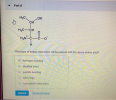 Part A H3C o HẠN- o=0 - What type of tertiary interaction will be present with the above amino acid? hydrogen bonding disulfide bond O peptide bonding salt bridge hydrophobic interaction Submit Request Answer
25) What maintains the secondary structure of a protein? a) hydrophobic interactions b) hydrogen bonds between...
25) What maintains the secondary structure of a protein? a) hydrophobic interactions b) hydrogen bonds between the R groups c) peptide bonds d) disulfide bonds e) hydrogen bonds between the amino group of one peptide bond and the carboxyl group of another peptide bond
. The covalent (ester / amide /hydrocarbon /hydrogen) bond between peptides is responsible for the (primary...
 . The covalent (ester / amide /hydrocarbon /hydrogen) bond between peptides is responsible for the (primary /secondary /tertiary /quaternary) structure of a protein. (Delete incorrect answers) (2 pts) 2. (a) Of the twenty amino acids, onlyof them are termed essential amino acids. (1pt (b) What does it mean when an amino acid is termed "essential"? (2 pts) 3. Draw an example of hydrogen bonding between the carbonyl group and the secondary NH group of two different amino acids in the...
Question 2 (10 points) Saved What type of stabilizing interaction could there be between the side...
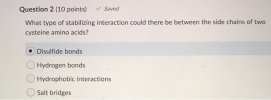 Question 2 (10 points) Saved What type of stabilizing interaction could there be between the side chains of two cysteine amino acids? Disulfide bonds Hydrogen bonds Hydrophobic interactions Salt bridges
What type of bonds/interactions can be formed between two amino acids in a protein? [Select all...
What type of bonds/interactions can be formed between two amino acids in a protein? [Select all that apply] A. peptide bond B. hydrogen bond C. metallic bonds D. sulfur bridges E. salt bridges
26. Which of the following classification does not match the amino acid side chain A) Contains an basic group/ lysi...
 26. Which of the following classification does not match the amino acid side chain A) Contains an basic group/ lysine B) It is polar C) Forms disulfide bond/ cysteine D) Forms hydrogen bonds with neighbors/ alanine serine 27. All amino acids found in proteins are L-amino acids EXCEPT the achiral. A) glutamate B) Lysine C) glyeine D) Alamine 28. The plH at which the positive and negative charges of an amino acid balance each ofher is called the A) isotonic...
What type of interaction would you expect between the following groups in a tertiary structure? Part...
 What type of interaction would you expect between the following
groups in a tertiary structure?
Part A cysteine and cysteine O hydrophobic interaction O hydrogen bond O disulfide bond O salt bridge O hydrophilic interaction Submit Request Answer Part B Submit Request Answer Part B glutamate and lysine O hydrophobic interaction O hydrophilic interaction O hydrogen bond O salt bridge O disulfide bond Submit Request Answer Part C Part C serine and aspartate O hydrophobic interaction O hydrophilic interaction O...
What type of interaction would you expect between the following
groups in a tertiary structure?
Part A cysteine and cysteine O hydrophobic interaction O hydrogen bond O disulfide bond O salt bridge O hydrophilic interaction Submit Request Answer Part B Submit Request Answer Part B glutamate and lysine O hydrophobic interaction O hydrophilic interaction O hydrogen bond O salt bridge O disulfide bond Submit Request Answer Part C Part C serine and aspartate O hydrophobic interaction O hydrophilic interaction O...
17. Which type of interactions (forces) found in proteins is MOST APPROPRIATELY matched with the feature...
 17. Which type of interactions (forces) found in proteins is MOST APPROPRIATELY matched with the feature that follows? a. Ionic bonds: a-helical secondary structure b. Peptide bonds: association of subunits to form quaternary structure c. Hydrophobic interaction: tertiary structure d. Hydrogen bonds: covalent cross-links between olypeptides e. Cation-anion interactions: B-pleated sheet
 Part A H3C o HẠN- o=0 - What type of tertiary interaction will be present with the above amino acid? hydrogen bonding disulfide bond O peptide bonding salt bridge hydrophobic interaction Submit Request Answer
 . The covalent (ester / amide /hydrocarbon /hydrogen) bond between peptides is responsible for the (primary /secondary /tertiary /quaternary) structure of a protein. (Delete incorrect answers) (2 pts) 2. (a) Of the twenty amino acids, onlyof them are termed essential amino acids. (1pt (b) What does it mean when an amino acid is termed "essential"? (2 pts) 3. Draw an example of hydrogen bonding between the carbonyl group and the secondary NH group of two different amino acids in the...
 Question 2 (10 points) Saved What type of stabilizing interaction could there be between the side chains of two cysteine amino acids? Disulfide bonds Hydrogen bonds Hydrophobic interactions Salt bridges
 26. Which of the following classification does not match the amino acid side chain A) Contains an basic group/ lysine B) It is polar C) Forms disulfide bond/ cysteine D) Forms hydrogen bonds with neighbors/ alanine serine 27. All amino acids found in proteins are L-amino acids EXCEPT the achiral. A) glutamate B) Lysine C) glyeine D) Alamine 28. The plH at which the positive and negative charges of an amino acid balance each ofher is called the A) isotonic...
 What type of interaction would you expect between the following
groups in a tertiary structure?
Part A cysteine and cysteine O hydrophobic interaction O hydrogen bond O disulfide bond O salt bridge O hydrophilic interaction Submit Request Answer Part B Submit Request Answer Part B glutamate and lysine O hydrophobic interaction O hydrophilic interaction O hydrogen bond O salt bridge O disulfide bond Submit Request Answer Part C Part C serine and aspartate O hydrophobic interaction O hydrophilic interaction O...
What type of interaction would you expect between the following
groups in a tertiary structure?
Part A cysteine and cysteine O hydrophobic interaction O hydrogen bond O disulfide bond O salt bridge O hydrophilic interaction Submit Request Answer Part B Submit Request Answer Part B glutamate and lysine O hydrophobic interaction O hydrophilic interaction O hydrogen bond O salt bridge O disulfide bond Submit Request Answer Part C Part C serine and aspartate O hydrophobic interaction O hydrophilic interaction O...
 17. Which type of interactions (forces) found in proteins is MOST APPROPRIATELY matched with the feature that follows? a. Ionic bonds: a-helical secondary structure b. Peptide bonds: association of subunits to form quaternary structure c. Hydrophobic interaction: tertiary structure d. Hydrogen bonds: covalent cross-links between olypeptides e. Cation-anion interactions: B-pleated sheet
Most questions answered within 3 hours.
-
Where is the error in this code sequence?
String s1 = "Hello";
String s2 = "ello";...
asked 10 months ago -
Financial data for Joel de Paris, Inc., for last year
follow:
Joel de Paris, Inc.
Balance...
asked 10 months ago -
Consider this reaction:
Al2(SO4)3 (aq)+ BaCl3
(aq) Al2Cl6 (aq)- +
3BaSO4(s) . What is the...
asked 10 months ago -
Suppose that Savneet is considering increasing her
recent random sample from 20 car rentals to 40...
asked 10 months ago -
Trucks arrive at an unloading terminal at an average rate of 120
per hour.
Trucks arrive...
asked 10 months ago -
Why are methanol and ethanol completely soluble in water while
octanol is not very little soluble....
asked 10 months ago -
A facilities manager at a university reads in a research report
that the mean amount of...
asked 10 months ago -
When the CuSO4 is rehydrated by adding water to the anhydrous
compound, is this an endothermic...
asked 10 months ago -
A ray of sunlight is passing from diamond into crown glass; the
angle of incidence is...
asked 10 months ago -
A block of mass 0.249 kg is placed on top of a light, vertical
spring of...
asked 10 months ago -
how do the kidneys compensate in the presences of acidosis
a) trigger hyperventilate
b) reserve acid...
asked 10 months ago -
Question 501 pts
The rental rate of capital to the firm increases. Which of the
following...
asked 10 months ago