What type of bonds/interactions can be formed between two amino acids in a protein? [Select all...
What type of bonds/interactions can be formed between two amino acids in a protein?
[Select all that apply]
A. peptide bond
B. hydrogen bond
C. metallic bonds
D. sulfur bridges
E. salt bridges
Homework Answers
Two Amino acids in protein are linked through Amide bond known as peptide bond. These Amino acids have acidic and basic groups which can interact through H-BONDING, sulfur bridges and salt bridges.
Answer is A) peptide bond, B) Hydrogen bond, D) Sulfur bridges and E) Salt bridges.
Metallic bonds are not present between them because they don't have any metal ions.
Add Answer to:
What type of bonds/interactions can be formed between two amino
acids in a protein?
[Select all...
25) What maintains the secondary structure of a protein? a) hydrophobic interactions b) hydrogen bonds between...
25) What maintains the secondary structure of a protein? a) hydrophobic interactions b) hydrogen bonds between the R groups c) peptide bonds d) disulfide bonds e) hydrogen bonds between the amino group of one peptide bond and the carboxyl group of another peptide bond
29. All of the following are non-covalent interactions important in maintaining the secondary. tertiary, and quaternary aspects of amino acids except
29. All of the following are non-covalent interactions important in maintaining the secondary. tertiary, and quaternary aspects of amino acids except A) salt bridges between R groups. B) hydrogen bonding between R groups. C) hydrogen bonding along the backbone. D) sulfur-sulfur bonds. E) hydrophobic interactions between R groups. 30. A hemiacetal consists of a A) carbon atom bonded to both an -OH and an-OR group B) carbonyl group that is also bonded to a hydroxyl group. C) carbon atom bonded to two-OH groups....
A peptide bond between two amino acids is what type of functional group? Ketone O Ester...
 A peptide bond between two amino acids is what type of functional group? Ketone O Ester Amide O Disulfide Aldehyde The tertiary structure of a proteins is NOT held together by which type of bond/interaction? Hydrogen bond Electrostatic interactions Hydrophobic interactions Peptide bond Disulfide bonds
1. What type of bond is formed between the amino acids of a protein? a. Peptide...
1. What type of bond is formed between the amino acids of a protein? a. Peptide b. Nucleopeptide c. Condensation d. Catalyst 2. A dipeptide has how many amino acids? 3. Which of the following is true about the functions of protein? A. proteins are required to metabolize fat B. proteins help buffer acids in the body C. proteins are the primary energy source for the body? D. all of the above 4. What is the recommended range of daily...
The _______ of amino acids in a protein is referred to as its primary structure
24. The _______ of amino acids in a protein is referred to as its primary structure. A) twisting B) sequencing C) folding D) none of these 25. The structure of a protein is most important because the _______ of the amino acids determines its overall shape, function and properties. A) primary, twisting B) primary, sequencing C) secondary, twisting D) secondary, folding E) none of these 26. The secondary structure of a protein is due to_______ between amino acid residues. A) hydrophobic interactions B) hydrogen bonding...
Since the secondary structure of a protein results from hydrogen bonding between components shared by all amino acids
Distinguish between the different levels of protein structure, including primary, secondary, tertiary, and quaternary Question Is the following statement true? If not, explain why not: Since the secondary structure of a protein results from hydrogen bonding between components shared by all amino acids (a hydrogen on an amide N on one amino acid interacts with an oxygen on the carbonyl of another amino acid), the secondary structure does not depend on the specific amino acid groups (the R-groups) in the amino acid chain. Select...
The primary structure of a protein is formed by the condensation of amino acids in a...
 The primary structure of a protein is formed by the condensation of amino acids in a certain sequence. Consider the dipeptide formed by the condensation of glycine and tyrosine in Figure 8.31B. a. Draw the structure of the dipeptide that would be formed if the two amino acids condensed in the opposite sequence. b. How are the structures of the dipeptides in Figure 8.31B and your drawing related to each other? B 0 HN-C-0--OH HO H-N-C-C-OH H CHE H OH...
Question 2 (10 points) Saved What type of stabilizing interaction could there be between the side...
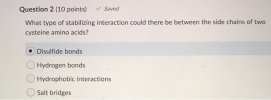 Question 2 (10 points) Saved What type of stabilizing interaction could there be between the side chains of two cysteine amino acids? Disulfide bonds Hydrogen bonds Hydrophobic interactions Salt bridges
The type of bonding that maintains the secondary structure in a protein is the
The type of bonding that maintains the secondary structure in a protein is theA) Hydrogen bonds between the carbonyl and amino groups of the backboneB) Covalent bond between the carbonyl and amino groups of the amino acidsC) Hydrogen bonds between two amino acidsD) Disulfide bonds that hold two polypeptide chains togetherE) Hydrogen bonds between two amino groups
O points 1 attempts left Check my work What interactions are responsible for maintaining quaternary protein...
 O points 1 attempts left Check my work What interactions are responsible for maintaining quaternary protein structure? Select all that apply O ionic bridges van der Waals forces hydrogen bonding O disulfide bonds peptide bonds
 A peptide bond between two amino acids is what type of functional group? Ketone O Ester Amide O Disulfide Aldehyde The tertiary structure of a proteins is NOT held together by which type of bond/interaction? Hydrogen bond Electrostatic interactions Hydrophobic interactions Peptide bond Disulfide bonds
 The primary structure of a protein is formed by the condensation of amino acids in a certain sequence. Consider the dipeptide formed by the condensation of glycine and tyrosine in Figure 8.31B. a. Draw the structure of the dipeptide that would be formed if the two amino acids condensed in the opposite sequence. b. How are the structures of the dipeptides in Figure 8.31B and your drawing related to each other? B 0 HN-C-0--OH HO H-N-C-C-OH H CHE H OH...
 Question 2 (10 points) Saved What type of stabilizing interaction could there be between the side chains of two cysteine amino acids? Disulfide bonds Hydrogen bonds Hydrophobic interactions Salt bridges
 O points 1 attempts left Check my work What interactions are responsible for maintaining quaternary protein structure? Select all that apply O ionic bridges van der Waals forces hydrogen bonding O disulfide bonds peptide bonds
Most questions answered within 3 hours.
-
Where is the error in this code sequence?
String s1 = "Hello";
String s2 = "ello";...
asked 10 months ago -
Financial data for Joel de Paris, Inc., for last year
follow:
Joel de Paris, Inc.
Balance...
asked 10 months ago -
Consider this reaction:
Al2(SO4)3 (aq)+ BaCl3
(aq) Al2Cl6 (aq)- +
3BaSO4(s) . What is the...
asked 10 months ago -
Suppose that Savneet is considering increasing her
recent random sample from 20 car rentals to 40...
asked 10 months ago -
Trucks arrive at an unloading terminal at an average rate of 120
per hour.
Trucks arrive...
asked 10 months ago -
Why are methanol and ethanol completely soluble in water while
octanol is not very little soluble....
asked 10 months ago -
A facilities manager at a university reads in a research report
that the mean amount of...
asked 10 months ago -
When the CuSO4 is rehydrated by adding water to the anhydrous
compound, is this an endothermic...
asked 10 months ago -
A ray of sunlight is passing from diamond into crown glass; the
angle of incidence is...
asked 10 months ago -
A block of mass 0.249 kg is placed on top of a light, vertical
spring of...
asked 10 months ago -
how do the kidneys compensate in the presences of acidosis
a) trigger hyperventilate
b) reserve acid...
asked 10 months ago -
Question 501 pts
The rental rate of capital to the firm increases. Which of the
following...
asked 10 months ago