Apply the appropriate La Place transform properties to get the solution to the problem. (It can only be solved by this method). Can someone please solve it STEP BY STEP without skipping any step please? It would be really helpful. I´m lost ):

Homework Answers
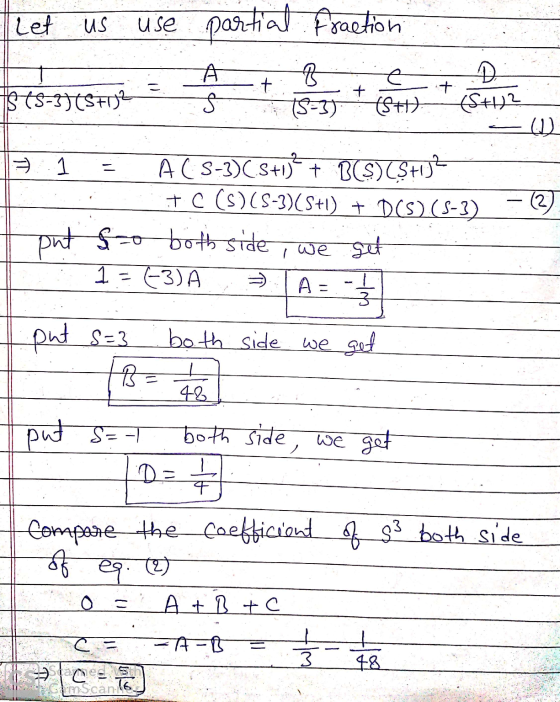
![Fact: 1 2[fm (4) s L[fc] - $hf(0) = 5-250)... 42-22 16-1) -Sf 0) f(o) Fact! 2 (First ( First shifting shifting the onem):](http://img.homeworklib.com/questions/7b109450-12a0-11eb-9e89-878aaf62923e.png?x-oss-process=image/resize,w_560)
![1 x tet 3X taplace we get apply LE both side L[tet 11 38 IT 2[x) - 32[x] Lłtet 6: Faet (31) CS Scanned with CamScanner](http://img.homeworklib.com/questions/7c733190-12a0-11eb-a8e3-0fd0aec9b783.png?x-oss-process=image/resize,w_560)
![- 3 SLExt] X00?) → (5? LEXO) - S X(0) – x(0) L[tet fact 1 (put n=2 and n=1 n=1 + -> (52-39.) Lo [x4] = (st? Fact 2 and L[6]](http://img.homeworklib.com/questions/7d58d620-12a0-11eb-b600-31bdb86c2067.png?x-oss-process=image/resize,w_560)

Add Answer to:
Apply the appropriate La Place transform properties to get the
solution to the problem. (It can...
Apply the indeterminate coefficients method to determine the general solution of the differential equation STEP BY...
 Apply the indeterminate coefficients method to determine the general solution of the differential equation
STEP BY STEP without skipping any step please? It would be
really helpful. I´m lost ):
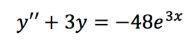
у” + Зу = — 48e3x
Apply the indeterminate coefficients method to determine the general solution of the differential equation
STEP BY STEP without skipping any step please? It would be
really helpful. I´m lost ):
у” + Зу = — 48e3x
Inglés El isòtopo del plomo Pb-209 decae a un ritmo proporcional a la cantidad presente en...
Inglés El isòtopo del plomo Pb-209 decae a un ritmo proporcional a la cantidad presente en el instante t y tiene una vida media de 3.3 horas. Si un gramo de este isòtopo està presente incialmente ¿Cuanto tiempo tardarà en descomponerse al 90% del plomo? The Pb-209 isotope of lead decays at a rate proportional to the amount present at time t and has a half-life of 3.3 hours. If one gram of this isotope is present initially, how long...
Consider an LC circuit with L = 1H, C = 1F. Suppose the circuit devices are...
 Consider an LC circuit with L = 1H, C = 1F. Suppose the circuit
devices are connected to a voltage source f given by:
If the capacitor is initially discharged and no current is
flowing through the circuit, determine the charge on the capacitor
at any time in t. Can someone please solve it STEP BY
STEP without skipping any step please? It would be really helpful.
I´m lost ):
t si 0 <t < 6 f(t) = 6 si t...
Consider an LC circuit with L = 1H, C = 1F. Suppose the circuit
devices are connected to a voltage source f given by:
If the capacitor is initially discharged and no current is
flowing through the circuit, determine the charge on the capacitor
at any time in t. Can someone please solve it STEP BY
STEP without skipping any step please? It would be really helpful.
I´m lost ):
t si 0 <t < 6 f(t) = 6 si t...
Can Someone please hep me solve this is problem Please. It is really important and it...
Can Someone please hep me solve this is problem Please. It is really important and it has 2 parts. both need to be solved. Thank you in advance A) A DT signal x[n] has the following z-transform X(z)= z+1/2z^2+10z+4 Determine the inverse z-transform, i.e. x[n] for all n Sketch the poles and zeros of X(z), including the unit circle. Determine whether the system is stable or unstable, why? B)Determine the z-transform of x[n-2], using the properties table, write it as...
can some one solve it step by step please 16. Let M be the Möbius transform...
 can some one solve it step by step please
16. Let M be the Möbius transform with M(0) = 1 M(1) = 2 and M(0) = 0. Find M(i). Solution: For M(z) = azt to have these properties, we must have a = 0 and b = d = 1, without loss of generality. Then the second equations gives -1 2 M(1) = = 2 hence M(2) 2 - 2 + 2 CE 9 C+1 in particular M(i) 2 2...
can some one solve it step by step please
16. Let M be the Möbius transform with M(0) = 1 M(1) = 2 and M(0) = 0. Find M(i). Solution: For M(z) = azt to have these properties, we must have a = 0 and b = d = 1, without loss of generality. Then the second equations gives -1 2 M(1) = = 2 hence M(2) 2 - 2 + 2 CE 9 C+1 in particular M(i) 2 2...
can you solve this problem please? 8. Determine the appropriate form of the particular solution for...
 can you solve this problem please?
8. Determine the appropriate form of the particular solution for the following non-homogeneous linear differential equation with constant coefficients. * (8 Points) +9y" = 5 + e* (x – 3) + 4sin (3x). y (4) A + B sin(3x) + Cxsin (3x) + Det + Exer none of these A + Bxe-3x + Cxe3x + Det + Exet Ax2 + Bxe-3x + Cxe3x + Det + Exer Ax + B + C sin(3x) +...
can you solve this problem please?
8. Determine the appropriate form of the particular solution for the following non-homogeneous linear differential equation with constant coefficients. * (8 Points) +9y" = 5 + e* (x – 3) + 4sin (3x). y (4) A + B sin(3x) + Cxsin (3x) + Det + Exer none of these A + Bxe-3x + Cxe3x + Det + Exet Ax2 + Bxe-3x + Cxe3x + Det + Exer Ax + B + C sin(3x) +...
What are the basic ingredients needed in a recursive solution (choose all that apply)? A case...
 What are the basic ingredients needed in a recursive solution (choose all that apply)? A case that requires iteration to solve a problem through smaller versions of the problem A case within a recursive solution that is so simple that it can be solved directly without a recursive call known as the Base Case. A case within a recursive solution that that solves a portion of the problem (smaller version) through the use of iteration known as the Smaller Case....
can someone explain to me how #1 is solved. please dont just solve the problem, explain...
 can someone explain to me how #1 is solved. please
dont just solve the problem, explain the steps to get the answer. I
have trouble understanding the concept
GENERAL CHEMISTRY STUDY CHEMISTRY STUDY SHEET NO. 16 How many mL of a 0.121 M Ba(OH), solution is required to completely new tralize 22.4 mL of a 0.210 M H.PO, solution? 2. Tt requires 27.5 mL of a NaOH solution to titrate 0.214 g of H.C.O. (MM = 90.01 molarity of the...
can someone explain to me how #1 is solved. please
dont just solve the problem, explain the steps to get the answer. I
have trouble understanding the concept
GENERAL CHEMISTRY STUDY CHEMISTRY STUDY SHEET NO. 16 How many mL of a 0.121 M Ba(OH), solution is required to completely new tralize 22.4 mL of a 0.210 M H.PO, solution? 2. Tt requires 27.5 mL of a NaOH solution to titrate 0.214 g of H.C.O. (MM = 90.01 molarity of the...
+ Solve an equilibrium problem (using an ICE table) to calculate the pH of each solution:...
+ Solve an equilibrium problem (using an ICE table) to calculate the pH of each solution: Can someone please breakdown the algebra part STEP BY STEP on how to get X! Part A a solution that is 0.165 M in HC2H3O2 and 0.110 M in KC2H3O2 Express your answer using two decimal places. Part B a solution that is 0.255 M in CH3NH2 and 0.110 M in CH3NH3Br Express your answer using two decimal places.
We can apply the Method of Separation of Variables to obtain a representation for the solution u ...
 Please show all work and provide and an original solution.
We can apply the Method of Separation of Variables to obtain a representation for the solution u u(, t) for the following partial differential equation (PDE) on a bounded domain with homogeneous boundary conditions. The PDE model is given by: u(r, 0) 0, (2,0) = 4. u(0,t)0, t 0 t 0 (a) (20 points) Assume that the solution to this PDE model has the form u(x,t) -X (r) T(t). State...
Please show all work and provide and an original solution.
We can apply the Method of Separation of Variables to obtain a representation for the solution u u(, t) for the following partial differential equation (PDE) on a bounded domain with homogeneous boundary conditions. The PDE model is given by: u(r, 0) 0, (2,0) = 4. u(0,t)0, t 0 t 0 (a) (20 points) Assume that the solution to this PDE model has the form u(x,t) -X (r) T(t). State...
 Apply the indeterminate coefficients method to determine the general solution of the differential equation
STEP BY STEP without skipping any step please? It would be
really helpful. I´m lost ):
у” + Зу = — 48e3x
Apply the indeterminate coefficients method to determine the general solution of the differential equation
STEP BY STEP without skipping any step please? It would be
really helpful. I´m lost ):
у” + Зу = — 48e3x
 Consider an LC circuit with L = 1H, C = 1F. Suppose the circuit
devices are connected to a voltage source f given by:
If the capacitor is initially discharged and no current is
flowing through the circuit, determine the charge on the capacitor
at any time in t. Can someone please solve it STEP BY
STEP without skipping any step please? It would be really helpful.
I´m lost ):
t si 0 <t < 6 f(t) = 6 si t...
Consider an LC circuit with L = 1H, C = 1F. Suppose the circuit
devices are connected to a voltage source f given by:
If the capacitor is initially discharged and no current is
flowing through the circuit, determine the charge on the capacitor
at any time in t. Can someone please solve it STEP BY
STEP without skipping any step please? It would be really helpful.
I´m lost ):
t si 0 <t < 6 f(t) = 6 si t...
 can some one solve it step by step please
16. Let M be the Möbius transform with M(0) = 1 M(1) = 2 and M(0) = 0. Find M(i). Solution: For M(z) = azt to have these properties, we must have a = 0 and b = d = 1, without loss of generality. Then the second equations gives -1 2 M(1) = = 2 hence M(2) 2 - 2 + 2 CE 9 C+1 in particular M(i) 2 2...
can some one solve it step by step please
16. Let M be the Möbius transform with M(0) = 1 M(1) = 2 and M(0) = 0. Find M(i). Solution: For M(z) = azt to have these properties, we must have a = 0 and b = d = 1, without loss of generality. Then the second equations gives -1 2 M(1) = = 2 hence M(2) 2 - 2 + 2 CE 9 C+1 in particular M(i) 2 2...
 can you solve this problem please?
8. Determine the appropriate form of the particular solution for the following non-homogeneous linear differential equation with constant coefficients. * (8 Points) +9y" = 5 + e* (x – 3) + 4sin (3x). y (4) A + B sin(3x) + Cxsin (3x) + Det + Exer none of these A + Bxe-3x + Cxe3x + Det + Exet Ax2 + Bxe-3x + Cxe3x + Det + Exer Ax + B + C sin(3x) +...
can you solve this problem please?
8. Determine the appropriate form of the particular solution for the following non-homogeneous linear differential equation with constant coefficients. * (8 Points) +9y" = 5 + e* (x – 3) + 4sin (3x). y (4) A + B sin(3x) + Cxsin (3x) + Det + Exer none of these A + Bxe-3x + Cxe3x + Det + Exet Ax2 + Bxe-3x + Cxe3x + Det + Exer Ax + B + C sin(3x) +...
 What are the basic ingredients needed in a recursive solution (choose all that apply)? A case that requires iteration to solve a problem through smaller versions of the problem A case within a recursive solution that is so simple that it can be solved directly without a recursive call known as the Base Case. A case within a recursive solution that that solves a portion of the problem (smaller version) through the use of iteration known as the Smaller Case....
 can someone explain to me how #1 is solved. please
dont just solve the problem, explain the steps to get the answer. I
have trouble understanding the concept
GENERAL CHEMISTRY STUDY CHEMISTRY STUDY SHEET NO. 16 How many mL of a 0.121 M Ba(OH), solution is required to completely new tralize 22.4 mL of a 0.210 M H.PO, solution? 2. Tt requires 27.5 mL of a NaOH solution to titrate 0.214 g of H.C.O. (MM = 90.01 molarity of the...
can someone explain to me how #1 is solved. please
dont just solve the problem, explain the steps to get the answer. I
have trouble understanding the concept
GENERAL CHEMISTRY STUDY CHEMISTRY STUDY SHEET NO. 16 How many mL of a 0.121 M Ba(OH), solution is required to completely new tralize 22.4 mL of a 0.210 M H.PO, solution? 2. Tt requires 27.5 mL of a NaOH solution to titrate 0.214 g of H.C.O. (MM = 90.01 molarity of the...
 Please show all work and provide and an original solution.
We can apply the Method of Separation of Variables to obtain a representation for the solution u u(, t) for the following partial differential equation (PDE) on a bounded domain with homogeneous boundary conditions. The PDE model is given by: u(r, 0) 0, (2,0) = 4. u(0,t)0, t 0 t 0 (a) (20 points) Assume that the solution to this PDE model has the form u(x,t) -X (r) T(t). State...
Please show all work and provide and an original solution.
We can apply the Method of Separation of Variables to obtain a representation for the solution u u(, t) for the following partial differential equation (PDE) on a bounded domain with homogeneous boundary conditions. The PDE model is given by: u(r, 0) 0, (2,0) = 4. u(0,t)0, t 0 t 0 (a) (20 points) Assume that the solution to this PDE model has the form u(x,t) -X (r) T(t). State...
Most questions answered within 3 hours.
-
Where is the error in this code sequence?
String s1 = "Hello";
String s2 = "ello";...
asked 11 months ago -
Financial data for Joel de Paris, Inc., for last year
follow:
Joel de Paris, Inc.
Balance...
asked 11 months ago -
Consider this reaction:
Al2(SO4)3 (aq)+ BaCl3
(aq) Al2Cl6 (aq)- +
3BaSO4(s) . What is the...
asked 11 months ago -
Suppose that Savneet is considering increasing her
recent random sample from 20 car rentals to 40...
asked 11 months ago -
Trucks arrive at an unloading terminal at an average rate of 120
per hour.
Trucks arrive...
asked 11 months ago -
Why are methanol and ethanol completely soluble in water while
octanol is not very little soluble....
asked 11 months ago -
A facilities manager at a university reads in a research report
that the mean amount of...
asked 11 months ago -
When the CuSO4 is rehydrated by adding water to the anhydrous
compound, is this an endothermic...
asked 11 months ago -
A ray of sunlight is passing from diamond into crown glass; the
angle of incidence is...
asked 11 months ago -
A block of mass 0.249 kg is placed on top of a light, vertical
spring of...
asked 11 months ago -
how do the kidneys compensate in the presences of acidosis
a) trigger hyperventilate
b) reserve acid...
asked 11 months ago -
Question 501 pts
The rental rate of capital to the firm increases. Which of the
following...
asked 11 months ago