Consider an LC circuit with L = 1H, C = 1F. Suppose the circuit devices are connected to a voltage source f given by:
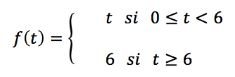
If the capacitor is initially discharged and no current is
flowing through the circuit, determine the charge on the capacitor
at any time in t. Can someone please solve it STEP BY
STEP without skipping any step please? It would be really helpful.
I´m lost ):
Homework Answers
The diffrential equation for the LC circuit is
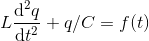
Since initially capacitor is discharged and no current is flowing, the initial conditions are, q(0)=0 and dq/dt(0) =0
For L=1 and C=1, we get
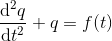
For 
and 
The solution (complementary) of homogeneous differential
equation  is
is
qc(t) = A sin[t]+B cos[t]
The particular solution (it is the solution which satisfy the nonhomogeneous differential equation) is

Now q(t) = qc(t) +qp(t)
Using initial conditions (for qp=t)
q(0)=0 => Asin[0]+B cos[0]+0 = 0 => B=0
and dq/dt(0)=0 => A cos[0]-Bsin[0]+1=0 => A=-1
So q= t-sin[t]
Now using initial conditions (for qp=6)
q(0)=0 => Asin[0]+B cos[0]+6 = 0 => B=-6
and dq/dt(0)=0 => A cos[0]-Bsin[0]=0 => A=0
So q= 6-6cos[t]
We can solve it using Mathematica as well. The results are same.
![In[8]= DSolve[{[t] +9[t] =t, q[0] == 0, [0] == 0), q[t], t] DSolve[{q[t] + [t] = 6, 9[0] == 0, [0] == 0), q[t], t] Out[8]](http://img.homeworklib.com/questions/faf8b1d0-11df-11eb-b25e-6d697cfeb162.png?x-oss-process=image/resize,w_560)
So at any time the charge is given by
![q(t)= \left\{\begin{matrix} t-sin[t] & ~for~ 0 \leqslant t < 6\\ 6(1-cos[t])~for~ t \geq 6 & \end{matrix}\right, \\](http://img.homeworklib.com/questions/fba46b90-11df-11eb-a0ee-59391a717db9.png?x-oss-process=image/resize,w_560)
Add Answer to:
Consider an LC circuit with L = 1H, C = 1F. Suppose the circuit
devices are...
subject: signals and systems 2. Consider the electric circuit shown in Fig. ??, L = 1H,...
 subject: signals and systems
2. Consider the electric circuit shown in Fig. ??, L = 1H, C = 1F. • Determine the differential equation that relates the input (t) to output y(t). Recall that ic(t) = C2C and vy(t) = • Find the characteristic equation for this circuit. • Determine the zero-input response given an initial capacitor voltage of one volt and an initial inductor current of zero ampere. That is, find yo(t) given uc(0) = 2V and iL(0) =...
subject: signals and systems
2. Consider the electric circuit shown in Fig. ??, L = 1H, C = 1F. • Determine the differential equation that relates the input (t) to output y(t). Recall that ic(t) = C2C and vy(t) = • Find the characteristic equation for this circuit. • Determine the zero-input response given an initial capacitor voltage of one volt and an initial inductor current of zero ampere. That is, find yo(t) given uc(0) = 2V and iL(0) =...
An LC circuit is built with an inductor L = 9.40 mH and a capacitor C...
An LC circuit is built with an inductor L = 9.40 mH and a capacitor C = 17.9 pF. If the capacitor voltage has its maximum value of V = 4.49 V at t = 0 s, what is the inductor current if the capacitor is fully discharged?
An LC circuit is built with an inductor L = 5.40 mH and a capacitor C...
An LC circuit is built with an inductor L = 5.40 mH and a capacitor C = 73.0 pF. If the capacitor voltage has its maximum value of V = 4.46 V at t = 0 s, what is the inductor current if the capacitor is fully discharged?
An LC circuit is built with an inductor L = 7.40 mH and a capacitor C...
An LC circuit is built with an inductor L = 7.40 mH and a capacitor C = 51.3 pF. If the capacitor voltage has its maximum value of V = 2.40 V at t = 0 s, what is the inductor current if the capacitor is fully discharged?
Apply the appropriate La Place transform properties to get the solution to the problem. (It can...
 Apply the appropriate La Place transform properties to get the
solution to the problem. (It can only be solved by this
method). Can someone please solve it STEP BY STEP
without skipping any step please? It would be really helpful. I´m
lost ):
x" - 3x' = te-t x(0) = 0 x'(0) = 0
Apply the appropriate La Place transform properties to get the
solution to the problem. (It can only be solved by this
method). Can someone please solve it STEP BY STEP
without skipping any step please? It would be really helpful. I´m
lost ):
x" - 3x' = te-t x(0) = 0 x'(0) = 0
f, and E(t) = 3. (30 pts) Consider an LRC-series circuit with L = 1h, R...
 f, and E(t) = 3. (30 pts) Consider an LRC-series circuit with L = 1h, R = 42, C = 8sint V, where q0) = 0 C, and iO) = 0 A. a. Find the charge on the capacitor at time t.
10.02 m a 0.2 H s 000 5) Consider the circuit in the figure. For a...
 10.02 m a 0.2 H s 000 5) Consider the circuit in the figure. For a long time prior to time t=0, the switch is in position a, allowing the capacitor to fully charge. a) Find the characteristic time, t, over which the capacitor charged up. b) Find the charge on the capacitor at t= 0. ind the energy stored in the capacitor at 1 = 0. 12.0V 2.0 uF At time t=0, the switch is flipped to position b....
Inglés El isòtopo del plomo Pb-209 decae a un ritmo proporcional a la cantidad presente en...
Inglés El isòtopo del plomo Pb-209 decae a un ritmo proporcional a la cantidad presente en el instante t y tiene una vida media de 3.3 horas. Si un gramo de este isòtopo està presente incialmente ¿Cuanto tiempo tardarà en descomponerse al 90% del plomo? The Pb-209 isotope of lead decays at a rate proportional to the amount present at time t and has a half-life of 3.3 hours. If one gram of this isotope is present initially, how long...
For part (c) of the Check Your Understanding 14.10 I got 1800 rad/s for the angular...
 For part (c) of the Check Your Understanding 14.10 I got 1800
rad/s for the angular frequency, am I right? The book gives the
answer as 1.4 * 10^3 rad/s. Also for part (b) I got -pi/2 rad, but
the answer is pi/2 rad and -pi/2 rad. I'm not sure where the pi/2
came from. I've attached the problem below. Please don't solve the
example but the questions after it.
Example 14.6 An LC Circuit In an LC circuit,...
For part (c) of the Check Your Understanding 14.10 I got 1800
rad/s for the angular frequency, am I right? The book gives the
answer as 1.4 * 10^3 rad/s. Also for part (b) I got -pi/2 rad, but
the answer is pi/2 rad and -pi/2 rad. I'm not sure where the pi/2
came from. I've attached the problem below. Please don't solve the
example but the questions after it.
Example 14.6 An LC Circuit In an LC circuit,...
Please help me with the exercise 2: Consider the circuit shown where L=5 H, C=10 uF,...
 Please help me with the exercise 2:
Consider the circuit shown where L=5 H, C=10 uF, Vo=220. The
switch is closed at t=0, determine the expression for the voltage
across the capacitor. Sketch the voltage across the capacitor,
inductor, and the diode. Sketch the current flowing through the
circuit
Thanks :)
1. For the current waveform, determine the average, rms, and peak current ratings 2. Consider the circuit shown where L-5 H, C=10 uF, Vo=220V. The switch is closed at...
Please help me with the exercise 2:
Consider the circuit shown where L=5 H, C=10 uF, Vo=220. The
switch is closed at t=0, determine the expression for the voltage
across the capacitor. Sketch the voltage across the capacitor,
inductor, and the diode. Sketch the current flowing through the
circuit
Thanks :)
1. For the current waveform, determine the average, rms, and peak current ratings 2. Consider the circuit shown where L-5 H, C=10 uF, Vo=220V. The switch is closed at...
 subject: signals and systems
2. Consider the electric circuit shown in Fig. ??, L = 1H, C = 1F. • Determine the differential equation that relates the input (t) to output y(t). Recall that ic(t) = C2C and vy(t) = • Find the characteristic equation for this circuit. • Determine the zero-input response given an initial capacitor voltage of one volt and an initial inductor current of zero ampere. That is, find yo(t) given uc(0) = 2V and iL(0) =...
subject: signals and systems
2. Consider the electric circuit shown in Fig. ??, L = 1H, C = 1F. • Determine the differential equation that relates the input (t) to output y(t). Recall that ic(t) = C2C and vy(t) = • Find the characteristic equation for this circuit. • Determine the zero-input response given an initial capacitor voltage of one volt and an initial inductor current of zero ampere. That is, find yo(t) given uc(0) = 2V and iL(0) =...
 Apply the appropriate La Place transform properties to get the
solution to the problem. (It can only be solved by this
method). Can someone please solve it STEP BY STEP
without skipping any step please? It would be really helpful. I´m
lost ):
x" - 3x' = te-t x(0) = 0 x'(0) = 0
Apply the appropriate La Place transform properties to get the
solution to the problem. (It can only be solved by this
method). Can someone please solve it STEP BY STEP
without skipping any step please? It would be really helpful. I´m
lost ):
x" - 3x' = te-t x(0) = 0 x'(0) = 0
 f, and E(t) = 3. (30 pts) Consider an LRC-series circuit with L = 1h, R = 42, C = 8sint V, where q0) = 0 C, and iO) = 0 A. a. Find the charge on the capacitor at time t.
 10.02 m a 0.2 H s 000 5) Consider the circuit in the figure. For a long time prior to time t=0, the switch is in position a, allowing the capacitor to fully charge. a) Find the characteristic time, t, over which the capacitor charged up. b) Find the charge on the capacitor at t= 0. ind the energy stored in the capacitor at 1 = 0. 12.0V 2.0 uF At time t=0, the switch is flipped to position b....
 For part (c) of the Check Your Understanding 14.10 I got 1800
rad/s for the angular frequency, am I right? The book gives the
answer as 1.4 * 10^3 rad/s. Also for part (b) I got -pi/2 rad, but
the answer is pi/2 rad and -pi/2 rad. I'm not sure where the pi/2
came from. I've attached the problem below. Please don't solve the
example but the questions after it.
Example 14.6 An LC Circuit In an LC circuit,...
For part (c) of the Check Your Understanding 14.10 I got 1800
rad/s for the angular frequency, am I right? The book gives the
answer as 1.4 * 10^3 rad/s. Also for part (b) I got -pi/2 rad, but
the answer is pi/2 rad and -pi/2 rad. I'm not sure where the pi/2
came from. I've attached the problem below. Please don't solve the
example but the questions after it.
Example 14.6 An LC Circuit In an LC circuit,...
 Please help me with the exercise 2:
Consider the circuit shown where L=5 H, C=10 uF, Vo=220. The
switch is closed at t=0, determine the expression for the voltage
across the capacitor. Sketch the voltage across the capacitor,
inductor, and the diode. Sketch the current flowing through the
circuit
Thanks :)
1. For the current waveform, determine the average, rms, and peak current ratings 2. Consider the circuit shown where L-5 H, C=10 uF, Vo=220V. The switch is closed at...
Please help me with the exercise 2:
Consider the circuit shown where L=5 H, C=10 uF, Vo=220. The
switch is closed at t=0, determine the expression for the voltage
across the capacitor. Sketch the voltage across the capacitor,
inductor, and the diode. Sketch the current flowing through the
circuit
Thanks :)
1. For the current waveform, determine the average, rms, and peak current ratings 2. Consider the circuit shown where L-5 H, C=10 uF, Vo=220V. The switch is closed at...
Most questions answered within 3 hours.
-
Where is the error in this code sequence?
String s1 = "Hello";
String s2 = "ello";...
asked 11 months ago -
Financial data for Joel de Paris, Inc., for last year
follow:
Joel de Paris, Inc.
Balance...
asked 11 months ago -
Consider this reaction:
Al2(SO4)3 (aq)+ BaCl3
(aq) Al2Cl6 (aq)- +
3BaSO4(s) . What is the...
asked 11 months ago -
Suppose that Savneet is considering increasing her
recent random sample from 20 car rentals to 40...
asked 11 months ago -
Trucks arrive at an unloading terminal at an average rate of 120
per hour.
Trucks arrive...
asked 11 months ago -
Why are methanol and ethanol completely soluble in water while
octanol is not very little soluble....
asked 11 months ago -
A facilities manager at a university reads in a research report
that the mean amount of...
asked 11 months ago -
When the CuSO4 is rehydrated by adding water to the anhydrous
compound, is this an endothermic...
asked 11 months ago -
A ray of sunlight is passing from diamond into crown glass; the
angle of incidence is...
asked 11 months ago -
A block of mass 0.249 kg is placed on top of a light, vertical
spring of...
asked 11 months ago -
how do the kidneys compensate in the presences of acidosis
a) trigger hyperventilate
b) reserve acid...
asked 11 months ago -
Question 501 pts
The rental rate of capital to the firm increases. Which of the
following...
asked 11 months ago