
Homework Answers
![1 » Å lm, m) = ( , + f₂) im, m) En,mln,m) Ĥi 19, m m, m) + , 11,4) [tw, (n+1) + ħ Hz (m+ + y)] in, m) {t(nw, + mws) + $(w,+w,](http://img.homeworklib.com/questions/e567d5a0-124e-11eb-aaf8-a3ae5ec07278.png?x-oss-process=image/resize,w_560)
![Enim-En-1,miti ħ(nw, +mW 2) + t (w, +W2) -to [(-1)w, +(m+1) wz] - Ę (w, twe) - ħW, - ħWz En, ne-Enti,mars = -tw, + ħ Wz 2,2 2](http://img.homeworklib.com/questions/e72f9250-124e-11eb-b949-6d07367abad0.png?x-oss-process=image/resize,w_560)
Add Answer to:
H2 Consider two harmonic oscillators described by the Hamiltonians łty = ħws (atât ta+2) and =...
H2 Consider two harmonic oscillators described by the Hamiltonians łty = ħws (atât ta+2) and =...
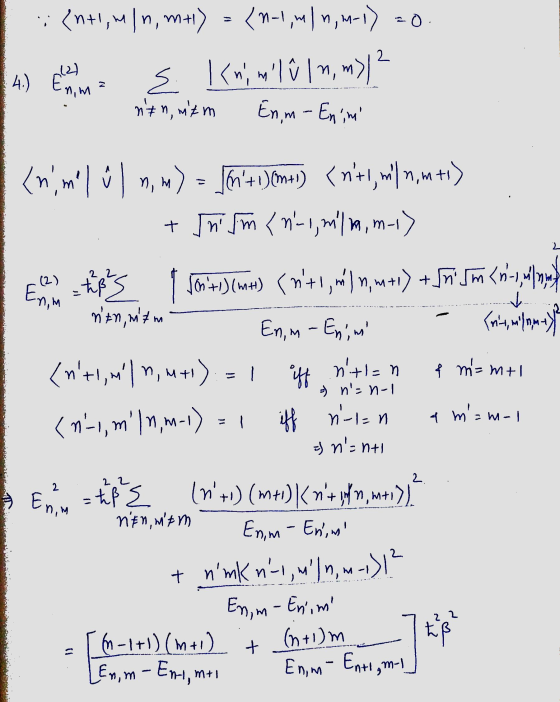
 H2 Consider two harmonic oscillators described by the Hamiltonians łty = ħws (atât ta+2) and = ħwz (6+6 +) with â (h) and at (@t) being the annihilation and creation operators for the first (second) oscillator, respectively. The Hamiltonian of two non-interacting oscillators is given by Ĥg = îl + Ħ2. Its eigenstates are tensor products of the eigenstates of single-oscillator states: Ĥm, n) = En,m|n, m), where İn, m) = \n) |m) and n, m = 0,1,2, ... a)...
4. (30 points) Harmonic oscillator with perturbation Recall the Hamiltonian of an harmonic oscillator in 1D:...
 4. (30 points) Harmonic oscillator with perturbation Recall the Hamiltonian of an harmonic oscillator in 1D: p21 ÃO = + mwf?, where m is the mass of the particle and w is the angular frequency. Now, let us perturb the oscillator with a quadratic potential. The perturbation is given by Î' = zgmw?h?, where g is a dimensionless constant and g <1. (a) Write down the eigen-energies of the unperturbed Hamiltonian. (b) In Lecture 3, we introduced the lowering (or...
Please answer all parts: Consider a particle in a one-dimensional box, where the potential the potential...
 Please answer all parts:
Consider a particle in a one-dimensional box, where the potential the potential V(x) = 0 for 0 < x <a and V(x) = 20 outside the box. On the system acts a perturbation Ĥ' of the form: 2a ad αδα 3 Approximation: Although the Hilbert space for this problem has infinite dimensions, you are allowed (and advised) to limit your calculations to a subspace of the lowest six states (n = 6), for the questions of...
Please answer all parts:
Consider a particle in a one-dimensional box, where the potential the potential V(x) = 0 for 0 < x <a and V(x) = 20 outside the box. On the system acts a perturbation Ĥ' of the form: 2a ad αδα 3 Approximation: Although the Hilbert space for this problem has infinite dimensions, you are allowed (and advised) to limit your calculations to a subspace of the lowest six states (n = 6), for the questions of...
A particle of charge q and mass m is bound in the ground state of a one-dimensional harmonic osci...
 A particle of charge q and mass m is bound in the ground state of a one-dimensional harmonic oscillator potential with frequency oo. At time t-0 a weak spatially uniform electric field (E) is turned on, so that the perturbation to the Hamiltonian can be described as R'(t) =-q Exe-t/t for t> 0. Using first order, time-dependent perturbation theory, calculate the following probabilities: (a) the particle is detected in the first excited state after a very long time (t »...
 H2 Consider two harmonic oscillators described by the Hamiltonians łty = ħws (atât ta+2) and = ħwz (6+6 +) with â (h) and at (@t) being the annihilation and creation operators for the first (second) oscillator, respectively. The Hamiltonian of two non-interacting oscillators is given by Ĥg = îl + Ħ2. Its eigenstates are tensor products of the eigenstates of single-oscillator states: Ĥm, n) = En,m|n, m), where İn, m) = \n) |m) and n, m = 0,1,2, ... a)...
 4. (30 points) Harmonic oscillator with perturbation Recall the Hamiltonian of an harmonic oscillator in 1D: p21 ÃO = + mwf?, where m is the mass of the particle and w is the angular frequency. Now, let us perturb the oscillator with a quadratic potential. The perturbation is given by Î' = zgmw?h?, where g is a dimensionless constant and g <1. (a) Write down the eigen-energies of the unperturbed Hamiltonian. (b) In Lecture 3, we introduced the lowering (or...
 Please answer all parts:
Consider a particle in a one-dimensional box, where the potential the potential V(x) = 0 for 0 < x <a and V(x) = 20 outside the box. On the system acts a perturbation Ĥ' of the form: 2a ad αδα 3 Approximation: Although the Hilbert space for this problem has infinite dimensions, you are allowed (and advised) to limit your calculations to a subspace of the lowest six states (n = 6), for the questions of...
Please answer all parts:
Consider a particle in a one-dimensional box, where the potential the potential V(x) = 0 for 0 < x <a and V(x) = 20 outside the box. On the system acts a perturbation Ĥ' of the form: 2a ad αδα 3 Approximation: Although the Hilbert space for this problem has infinite dimensions, you are allowed (and advised) to limit your calculations to a subspace of the lowest six states (n = 6), for the questions of...
 A particle of charge q and mass m is bound in the ground state of a one-dimensional harmonic oscillator potential with frequency oo. At time t-0 a weak spatially uniform electric field (E) is turned on, so that the perturbation to the Hamiltonian can be described as R'(t) =-q Exe-t/t for t> 0. Using first order, time-dependent perturbation theory, calculate the following probabilities: (a) the particle is detected in the first excited state after a very long time (t »...
Most questions answered within 3 hours.
-
Where is the error in this code sequence?
String s1 = "Hello";
String s2 = "ello";...
asked 10 months ago -
Financial data for Joel de Paris, Inc., for last year
follow:
Joel de Paris, Inc.
Balance...
asked 10 months ago -
Consider this reaction:
Al2(SO4)3 (aq)+ BaCl3
(aq) Al2Cl6 (aq)- +
3BaSO4(s) . What is the...
asked 10 months ago -
Suppose that Savneet is considering increasing her
recent random sample from 20 car rentals to 40...
asked 10 months ago -
Trucks arrive at an unloading terminal at an average rate of 120
per hour.
Trucks arrive...
asked 10 months ago -
Why are methanol and ethanol completely soluble in water while
octanol is not very little soluble....
asked 10 months ago -
A facilities manager at a university reads in a research report
that the mean amount of...
asked 10 months ago -
When the CuSO4 is rehydrated by adding water to the anhydrous
compound, is this an endothermic...
asked 10 months ago -
A ray of sunlight is passing from diamond into crown glass; the
angle of incidence is...
asked 10 months ago -
A block of mass 0.249 kg is placed on top of a light, vertical
spring of...
asked 10 months ago -
how do the kidneys compensate in the presences of acidosis
a) trigger hyperventilate
b) reserve acid...
asked 10 months ago -
Question 501 pts
The rental rate of capital to the firm increases. Which of the
following...
asked 10 months ago