
Homework Answers
Answer : B) Eumetazoa and Mollusca
Explanation :
Clam is a common name for several kinds of bivalve molluscs.
Subkingdom of clam is Eumetazoa.
Snail is a Mollusca , that have single spiral shell into which the whole body can be withdrawn. Snail is classified under phylum Mollusca , kingdom Animalia.
Note point : Both snail and clam present under Phylum
Mollusca, kingdom Animalia and subkingdom Eumetazoa. So according
to it Option B is the right answer.
Hope it clear your doubt. Thank you
Add Answer to:
25. These organisms would be in the groups _?_ A. Mollusca & Ecdysozoa C. Mollusca &...
dass 26. These organisms would be in the groups A. Mollusca & Bilateria B. Syndermata &...
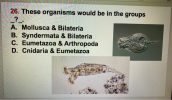 dass 26. These organisms would be in the groups A. Mollusca & Bilateria B. Syndermata & Bilateria C. Eumetazoa & Arthropoda D. Cnidaria & Eumetazoa
Animals: Invertebrates and Vertebrates Annelida Deuterostome Mollusca Arthropoda Ecdysozoa Nematoda Bilateria Echinodermata Platyhelminthes Chordata Eumetazoa Porifera...
 Animals: Invertebrates and Vertebrates Annelida Deuterostome Mollusca Arthropoda Ecdysozoa Nematoda Bilateria Echinodermata Platyhelminthes Chordata Eumetazoa Porifera Cnidaria Lophotrochozoa Protostome 75. 76. 77. 83. 78. 79. 80. 82. 81. flatworms Segmented worms luods dams, Shails, sea stars, sea urchins roundworms Sandopo Crustaceans, insects, spiders lancelets, vertebrates RADIAL jellyfish, coral, anemones 85. 84. NO TISSUES 86. (feeding structure) 87. (shed exoskeleton)
27. These organisms would be in the groups _?_ A. Cnidaria & Eumetazoa B. Bilateria &...
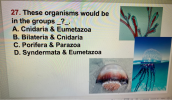 27. These organisms would be in the groups _?_ A. Cnidaria & Eumetazoa B. Bilateria & Cnidaria C. Porifera & Parazoa D. Syndermata & Eumetazoa 110%
clearer picture mals: Invertebrates and Vertebrates Annelida Deuterostome Mollusca Arthropoda Ecdysozoa Nematoda Bilateria Echinodermata Platyhelminthes Chordata...
 clearer picture
mals: Invertebrates and Vertebrates Annelida Deuterostome Mollusca Arthropoda Ecdysozoa Nematoda Bilateria Echinodermata Platyhelminthes Chordata Eumetazoa Porifera Cnidaria Lophotrochozoa Protostome 75. 76. 77. 78. 79. 80. 81. 82. 83. wo Matworms worms dams, was Spunoi sea stars. sea urchins jellyfish, coral, anemones crustaceans, insects, spiders RADIAL landets 85. 84. NO TISSUES 86. (feeding structure) 87. (shed exoskeleton) 88) The most ancient branch point in animal phylogeny (what distinguishes sponges from other animals) is that between having A) radial or...
clearer picture
mals: Invertebrates and Vertebrates Annelida Deuterostome Mollusca Arthropoda Ecdysozoa Nematoda Bilateria Echinodermata Platyhelminthes Chordata Eumetazoa Porifera Cnidaria Lophotrochozoa Protostome 75. 76. 77. 78. 79. 80. 81. 82. 83. wo Matworms worms dams, was Spunoi sea stars. sea urchins jellyfish, coral, anemones crustaceans, insects, spiders RADIAL landets 85. 84. NO TISSUES 86. (feeding structure) 87. (shed exoskeleton) 88) The most ancient branch point in animal phylogeny (what distinguishes sponges from other animals) is that between having A) radial or...
mals: Invertebrates and Vertebrates Annelida Deuterostome Mollusca Arthropoda Ecdysozoa Nematoda Bilateria Echinodermata Platyhelminthes Chordata Eumetazoa Porifera...
 mals: Invertebrates and Vertebrates Annelida Deuterostome Mollusca Arthropoda Ecdysozoa Nematoda Bilateria Echinodermata Platyhelminthes Chordata Eumetazoa Porifera Cnidaria Lophotrochozoa Protostome 75. 76. 77 78. 79. 80. 81. 82 83. Watworms os Semented worms doms, als Foundworms sea stars. sea urchins jellyfish, coral, anemones crustaceans, insects, spiders RADIAL vertebrates 85. 84. NO TISSUES 86. (feeding structure) 87. (shed exoskeleton) 88) The most ancient branch point in animal phylogeny (what distinguishes sponges from other animals) is that between having A) radial or bilateral...
Name: Porifera | Ctenophora Cnidaria Rotifera Platyhelminthes Acoela Mollusca Annelida Nematoda Arthropoda Echinodermata Chordata - coelom...
 Name: Porifera | Ctenophora Cnidaria Rotifera Platyhelminthes Acoela Mollusca Annelida Nematoda Arthropoda Echinodermata Chordata - coelom Add in the following characteristics: A. True tissue B. Incomplete Digestive Tract C. Complete digestive Tract D. Open Circulatory E. Closed Circulatory F. Hydrostatic Skeleton Ancestral protist Add in the following characteristics (cont.): G. Endoskeleton H. Exoskeleton 1. Nerve Net J. Central Nervous System K. Nerve Ring
Assistance with completing the concept map below by matching the lettered terms with those found in...
 Assistance with completing the concept map below by matching the
lettered terms with those found in the circle.
Thank you!
Animal Diversity Second mouth Asymmetrical animals Symmetrical animals Spiny skin Radial symmetry Bilateral symmetry Vertebrae Animal Diversity Acoelomate flatworms Molting animals Spiral cleavage Cuticle Chitin exoskeleton Place the letter in the appropriate blank a. Deuterostomes b. Ecdysozoa c. Eumetazoans d. Annelida e. Mollusca f. Echinodermata g. Nematoda h. Spiralia i. Platyhelminthes j. Porifera k. Bilateralia 1. Chordata m. Cniderians n....
Assistance with completing the concept map below by matching the
lettered terms with those found in the circle.
Thank you!
Animal Diversity Second mouth Asymmetrical animals Symmetrical animals Spiny skin Radial symmetry Bilateral symmetry Vertebrae Animal Diversity Acoelomate flatworms Molting animals Spiral cleavage Cuticle Chitin exoskeleton Place the letter in the appropriate blank a. Deuterostomes b. Ecdysozoa c. Eumetazoans d. Annelida e. Mollusca f. Echinodermata g. Nematoda h. Spiralia i. Platyhelminthes j. Porifera k. Bilateralia 1. Chordata m. Cniderians n....
The phylum Cycliophora are tiny organisms that live in large numbers on the outsides of the...
The phylum Cycliophora are tiny organisms that live in large numbers on the outsides of the mouthparts and appendages of lobsters. The feeding stage permanently attaches to the lobster via an adhesive disk and collects scraps of food from its host's feeding by capturing the scraps in a current created by a ring of cilia. The body is saclike and has a U-shaped intestine that brings it'sanus close to the mouth. Cycliophorans are coelomates, do not molt (though their host...
Lineage Examples Tissue Organization Body Symmetry C oelom Protostome/ Development Deuterostome Locomotion Support Porifera Cnidaria Ctenophore...
 Lineage Examples Tissue Organization Body Symmetry C oelom Protostome/ Development Deuterostome Locomotion Support Porifera Cnidaria Ctenophore Platyhelminthes Annelida Mollusca Nematoda Arthropoda Echinodermata Chordata
You are a biologist on a quest to document a digital collection of living organisms. Using...
You are a biologist on a quest to document a digital collection of living organisms. Using your iPad, smartphone, or digital camera, collect a representative organism for 10 of the taxonomical classifications listed in Table. You may have multiple specimens from one classification as long as they are unique. (For example, you may have photographs of 3 different insects). Compile your 10 photographs in a PowerPoint file. Research the classification of your organisms using the common name. Wikipedia is a...
 dass 26. These organisms would be in the groups A. Mollusca & Bilateria B. Syndermata & Bilateria C. Eumetazoa & Arthropoda D. Cnidaria & Eumetazoa
 Animals: Invertebrates and Vertebrates Annelida Deuterostome Mollusca Arthropoda Ecdysozoa Nematoda Bilateria Echinodermata Platyhelminthes Chordata Eumetazoa Porifera Cnidaria Lophotrochozoa Protostome 75. 76. 77. 83. 78. 79. 80. 82. 81. flatworms Segmented worms luods dams, Shails, sea stars, sea urchins roundworms Sandopo Crustaceans, insects, spiders lancelets, vertebrates RADIAL jellyfish, coral, anemones 85. 84. NO TISSUES 86. (feeding structure) 87. (shed exoskeleton)
 27. These organisms would be in the groups _?_ A. Cnidaria & Eumetazoa B. Bilateria & Cnidaria C. Porifera & Parazoa D. Syndermata & Eumetazoa 110%
 clearer picture
mals: Invertebrates and Vertebrates Annelida Deuterostome Mollusca Arthropoda Ecdysozoa Nematoda Bilateria Echinodermata Platyhelminthes Chordata Eumetazoa Porifera Cnidaria Lophotrochozoa Protostome 75. 76. 77. 78. 79. 80. 81. 82. 83. wo Matworms worms dams, was Spunoi sea stars. sea urchins jellyfish, coral, anemones crustaceans, insects, spiders RADIAL landets 85. 84. NO TISSUES 86. (feeding structure) 87. (shed exoskeleton) 88) The most ancient branch point in animal phylogeny (what distinguishes sponges from other animals) is that between having A) radial or...
clearer picture
mals: Invertebrates and Vertebrates Annelida Deuterostome Mollusca Arthropoda Ecdysozoa Nematoda Bilateria Echinodermata Platyhelminthes Chordata Eumetazoa Porifera Cnidaria Lophotrochozoa Protostome 75. 76. 77. 78. 79. 80. 81. 82. 83. wo Matworms worms dams, was Spunoi sea stars. sea urchins jellyfish, coral, anemones crustaceans, insects, spiders RADIAL landets 85. 84. NO TISSUES 86. (feeding structure) 87. (shed exoskeleton) 88) The most ancient branch point in animal phylogeny (what distinguishes sponges from other animals) is that between having A) radial or...
 mals: Invertebrates and Vertebrates Annelida Deuterostome Mollusca Arthropoda Ecdysozoa Nematoda Bilateria Echinodermata Platyhelminthes Chordata Eumetazoa Porifera Cnidaria Lophotrochozoa Protostome 75. 76. 77 78. 79. 80. 81. 82 83. Watworms os Semented worms doms, als Foundworms sea stars. sea urchins jellyfish, coral, anemones crustaceans, insects, spiders RADIAL vertebrates 85. 84. NO TISSUES 86. (feeding structure) 87. (shed exoskeleton) 88) The most ancient branch point in animal phylogeny (what distinguishes sponges from other animals) is that between having A) radial or bilateral...
 Name: Porifera | Ctenophora Cnidaria Rotifera Platyhelminthes Acoela Mollusca Annelida Nematoda Arthropoda Echinodermata Chordata - coelom Add in the following characteristics: A. True tissue B. Incomplete Digestive Tract C. Complete digestive Tract D. Open Circulatory E. Closed Circulatory F. Hydrostatic Skeleton Ancestral protist Add in the following characteristics (cont.): G. Endoskeleton H. Exoskeleton 1. Nerve Net J. Central Nervous System K. Nerve Ring
 Assistance with completing the concept map below by matching the
lettered terms with those found in the circle.
Thank you!
Animal Diversity Second mouth Asymmetrical animals Symmetrical animals Spiny skin Radial symmetry Bilateral symmetry Vertebrae Animal Diversity Acoelomate flatworms Molting animals Spiral cleavage Cuticle Chitin exoskeleton Place the letter in the appropriate blank a. Deuterostomes b. Ecdysozoa c. Eumetazoans d. Annelida e. Mollusca f. Echinodermata g. Nematoda h. Spiralia i. Platyhelminthes j. Porifera k. Bilateralia 1. Chordata m. Cniderians n....
Assistance with completing the concept map below by matching the
lettered terms with those found in the circle.
Thank you!
Animal Diversity Second mouth Asymmetrical animals Symmetrical animals Spiny skin Radial symmetry Bilateral symmetry Vertebrae Animal Diversity Acoelomate flatworms Molting animals Spiral cleavage Cuticle Chitin exoskeleton Place the letter in the appropriate blank a. Deuterostomes b. Ecdysozoa c. Eumetazoans d. Annelida e. Mollusca f. Echinodermata g. Nematoda h. Spiralia i. Platyhelminthes j. Porifera k. Bilateralia 1. Chordata m. Cniderians n....
 Lineage Examples Tissue Organization Body Symmetry C oelom Protostome/ Development Deuterostome Locomotion Support Porifera Cnidaria Ctenophore Platyhelminthes Annelida Mollusca Nematoda Arthropoda Echinodermata Chordata
Most questions answered within 3 hours.
-
Where is the error in this code sequence?
String s1 = "Hello";
String s2 = "ello";...
asked 10 months ago -
Financial data for Joel de Paris, Inc., for last year
follow:
Joel de Paris, Inc.
Balance...
asked 10 months ago -
Consider this reaction:
Al2(SO4)3 (aq)+ BaCl3
(aq) Al2Cl6 (aq)- +
3BaSO4(s) . What is the...
asked 10 months ago -
Suppose that Savneet is considering increasing her
recent random sample from 20 car rentals to 40...
asked 10 months ago -
Trucks arrive at an unloading terminal at an average rate of 120
per hour.
Trucks arrive...
asked 10 months ago -
Why are methanol and ethanol completely soluble in water while
octanol is not very little soluble....
asked 10 months ago -
A facilities manager at a university reads in a research report
that the mean amount of...
asked 10 months ago -
When the CuSO4 is rehydrated by adding water to the anhydrous
compound, is this an endothermic...
asked 10 months ago -
A ray of sunlight is passing from diamond into crown glass; the
angle of incidence is...
asked 10 months ago -
A block of mass 0.249 kg is placed on top of a light, vertical
spring of...
asked 10 months ago -
how do the kidneys compensate in the presences of acidosis
a) trigger hyperventilate
b) reserve acid...
asked 10 months ago -
Question 501 pts
The rental rate of capital to the firm increases. Which of the
following...
asked 10 months ago