
Homework Answers
Answer)
The picture is of Aurelia (jelly fish), . It is found in the ctenohora or cnidaria phylum. Because they have cnidoblast cells in their body. They are found in the eumetazoa group. It is the sister group for proifera. This group is more advanced as compared to the porifera. The acellular mode of organisation is not found in the eumetazoa. They have either tissue, organ or organ system level of organisation. Cnidaria have tissue level of organisation.
Answer is : A) Cnidaria and eumetazoa.
----
please rate.
Add Answer to:
27. These organisms would be in the groups _?_ A. Cnidaria & Eumetazoa B. Bilateria &...
dass 26. These organisms would be in the groups A. Mollusca & Bilateria B. Syndermata &...
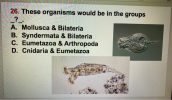 dass 26. These organisms would be in the groups A. Mollusca & Bilateria B. Syndermata & Bilateria C. Eumetazoa & Arthropoda D. Cnidaria & Eumetazoa
25. These organisms would be in the groups _?_ A. Mollusca & Ecdysozoa C. Mollusca &...
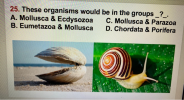 25. These organisms would be in the groups _?_ A. Mollusca & Ecdysozoa C. Mollusca & Parazoa B. Eumetazoa & Mollusca D. Chordata & Porifera
Metazoans Mesozoans Parazoans Phylum Porifera Eumetazoans Radiata - Phyla Cnidaria & Ctenophora Bilateria AcoelomatesPlatyhelmithes - Turbellaria,...
 Metazoans Mesozoans Parazoans Phylum Porifera Eumetazoans Radiata - Phyla Cnidaria & Ctenophora Bilateria AcoelomatesPlatyhelmithes - Turbellaria, Trematoda & Cestoda Nemertea Gnathostomulida Pseudocoelomates _ Nematoda, Rotifera, Nematomorpha, Acanthocephala, Priapulida, Gastrotricha Eucoelomates Protostome - Mollusca, Annelida, Arthropoda -Deuterostome - Echinodermata, Hemichordata & Chordata
Animals: Invertebrates and Vertebrates Annelida Deuterostome Mollusca Arthropoda Ecdysozoa Nematoda Bilateria Echinodermata Platyhelminthes Chordata Eumetazoa Porifera...
 Animals: Invertebrates and Vertebrates Annelida Deuterostome Mollusca Arthropoda Ecdysozoa Nematoda Bilateria Echinodermata Platyhelminthes Chordata Eumetazoa Porifera Cnidaria Lophotrochozoa Protostome 75. 76. 77. 83. 78. 79. 80. 82. 81. flatworms Segmented worms luods dams, Shails, sea stars, sea urchins roundworms Sandopo Crustaceans, insects, spiders lancelets, vertebrates RADIAL jellyfish, coral, anemones 85. 84. NO TISSUES 86. (feeding structure) 87. (shed exoskeleton)
clearer picture mals: Invertebrates and Vertebrates Annelida Deuterostome Mollusca Arthropoda Ecdysozoa Nematoda Bilateria Echinodermata Platyhelminthes Chordata...
 clearer picture
mals: Invertebrates and Vertebrates Annelida Deuterostome Mollusca Arthropoda Ecdysozoa Nematoda Bilateria Echinodermata Platyhelminthes Chordata Eumetazoa Porifera Cnidaria Lophotrochozoa Protostome 75. 76. 77. 78. 79. 80. 81. 82. 83. wo Matworms worms dams, was Spunoi sea stars. sea urchins jellyfish, coral, anemones crustaceans, insects, spiders RADIAL landets 85. 84. NO TISSUES 86. (feeding structure) 87. (shed exoskeleton) 88) The most ancient branch point in animal phylogeny (what distinguishes sponges from other animals) is that between having A) radial or...
clearer picture
mals: Invertebrates and Vertebrates Annelida Deuterostome Mollusca Arthropoda Ecdysozoa Nematoda Bilateria Echinodermata Platyhelminthes Chordata Eumetazoa Porifera Cnidaria Lophotrochozoa Protostome 75. 76. 77. 78. 79. 80. 81. 82. 83. wo Matworms worms dams, was Spunoi sea stars. sea urchins jellyfish, coral, anemones crustaceans, insects, spiders RADIAL landets 85. 84. NO TISSUES 86. (feeding structure) 87. (shed exoskeleton) 88) The most ancient branch point in animal phylogeny (what distinguishes sponges from other animals) is that between having A) radial or...
mals: Invertebrates and Vertebrates Annelida Deuterostome Mollusca Arthropoda Ecdysozoa Nematoda Bilateria Echinodermata Platyhelminthes Chordata Eumetazoa Porifera...
 mals: Invertebrates and Vertebrates Annelida Deuterostome Mollusca Arthropoda Ecdysozoa Nematoda Bilateria Echinodermata Platyhelminthes Chordata Eumetazoa Porifera Cnidaria Lophotrochozoa Protostome 75. 76. 77 78. 79. 80. 81. 82 83. Watworms os Semented worms doms, als Foundworms sea stars. sea urchins jellyfish, coral, anemones crustaceans, insects, spiders RADIAL vertebrates 85. 84. NO TISSUES 86. (feeding structure) 87. (shed exoskeleton) 88) The most ancient branch point in animal phylogeny (what distinguishes sponges from other animals) is that between having A) radial or bilateral...
For questions #65 – 70: If the organisms in the phylum or clade on the list...
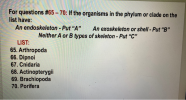 For questions #65 – 70: If the organisms in the phylum or clade on the list have: An endoskeleton - Put "A" An exoskeleton or shell - Put "B" Neither A or B types of skeleton - Put "C" LIST: 65. Arthropoda 66. Dipnoi 67. Cnidaria 68. Actinopterygii 69. Brachiopoda 70. Porifera
The phylum Cycliophora are tiny organisms that live in large numbers on the outsides of the...
The phylum Cycliophora are tiny organisms that live in large numbers on the outsides of the mouthparts and appendages of lobsters. The feeding stage permanently attaches to the lobster via an adhesive disk and collects scraps of food from its host's feeding by capturing the scraps in a current created by a ring of cilia. The body is saclike and has a U-shaped intestine that brings it'sanus close to the mouth. Cycliophorans are coelomates, do not molt (though their host...
Which organisms are NOT responsible for methane production? a) hydrogenotrophs b) methanotrophs c) acetoclastic groups d)...
Which organisms are NOT responsible for methane production? a) hydrogenotrophs b) methanotrophs c) acetoclastic groups d) fermentative groups e) all of these
What organisms are NOT responsible for methane production? a) hydrogenotrophs b) methanotrophs c) acetoclastic groups d)...
What organisms are NOT responsible for methane production? a) hydrogenotrophs b) methanotrophs c) acetoclastic groups d) fermentative groups e) all of these f) none of these
 dass 26. These organisms would be in the groups A. Mollusca & Bilateria B. Syndermata & Bilateria C. Eumetazoa & Arthropoda D. Cnidaria & Eumetazoa
 25. These organisms would be in the groups _?_ A. Mollusca & Ecdysozoa C. Mollusca & Parazoa B. Eumetazoa & Mollusca D. Chordata & Porifera
 Metazoans Mesozoans Parazoans Phylum Porifera Eumetazoans Radiata - Phyla Cnidaria & Ctenophora Bilateria AcoelomatesPlatyhelmithes - Turbellaria, Trematoda & Cestoda Nemertea Gnathostomulida Pseudocoelomates _ Nematoda, Rotifera, Nematomorpha, Acanthocephala, Priapulida, Gastrotricha Eucoelomates Protostome - Mollusca, Annelida, Arthropoda -Deuterostome - Echinodermata, Hemichordata & Chordata
 Animals: Invertebrates and Vertebrates Annelida Deuterostome Mollusca Arthropoda Ecdysozoa Nematoda Bilateria Echinodermata Platyhelminthes Chordata Eumetazoa Porifera Cnidaria Lophotrochozoa Protostome 75. 76. 77. 83. 78. 79. 80. 82. 81. flatworms Segmented worms luods dams, Shails, sea stars, sea urchins roundworms Sandopo Crustaceans, insects, spiders lancelets, vertebrates RADIAL jellyfish, coral, anemones 85. 84. NO TISSUES 86. (feeding structure) 87. (shed exoskeleton)
 clearer picture
mals: Invertebrates and Vertebrates Annelida Deuterostome Mollusca Arthropoda Ecdysozoa Nematoda Bilateria Echinodermata Platyhelminthes Chordata Eumetazoa Porifera Cnidaria Lophotrochozoa Protostome 75. 76. 77. 78. 79. 80. 81. 82. 83. wo Matworms worms dams, was Spunoi sea stars. sea urchins jellyfish, coral, anemones crustaceans, insects, spiders RADIAL landets 85. 84. NO TISSUES 86. (feeding structure) 87. (shed exoskeleton) 88) The most ancient branch point in animal phylogeny (what distinguishes sponges from other animals) is that between having A) radial or...
clearer picture
mals: Invertebrates and Vertebrates Annelida Deuterostome Mollusca Arthropoda Ecdysozoa Nematoda Bilateria Echinodermata Platyhelminthes Chordata Eumetazoa Porifera Cnidaria Lophotrochozoa Protostome 75. 76. 77. 78. 79. 80. 81. 82. 83. wo Matworms worms dams, was Spunoi sea stars. sea urchins jellyfish, coral, anemones crustaceans, insects, spiders RADIAL landets 85. 84. NO TISSUES 86. (feeding structure) 87. (shed exoskeleton) 88) The most ancient branch point in animal phylogeny (what distinguishes sponges from other animals) is that between having A) radial or...
 mals: Invertebrates and Vertebrates Annelida Deuterostome Mollusca Arthropoda Ecdysozoa Nematoda Bilateria Echinodermata Platyhelminthes Chordata Eumetazoa Porifera Cnidaria Lophotrochozoa Protostome 75. 76. 77 78. 79. 80. 81. 82 83. Watworms os Semented worms doms, als Foundworms sea stars. sea urchins jellyfish, coral, anemones crustaceans, insects, spiders RADIAL vertebrates 85. 84. NO TISSUES 86. (feeding structure) 87. (shed exoskeleton) 88) The most ancient branch point in animal phylogeny (what distinguishes sponges from other animals) is that between having A) radial or bilateral...
 For questions #65 – 70: If the organisms in the phylum or clade on the list have: An endoskeleton - Put "A" An exoskeleton or shell - Put "B" Neither A or B types of skeleton - Put "C" LIST: 65. Arthropoda 66. Dipnoi 67. Cnidaria 68. Actinopterygii 69. Brachiopoda 70. Porifera
Most questions answered within 3 hours.
-
Where is the error in this code sequence?
String s1 = "Hello";
String s2 = "ello";...
asked 10 months ago -
Financial data for Joel de Paris, Inc., for last year
follow:
Joel de Paris, Inc.
Balance...
asked 10 months ago -
Consider this reaction:
Al2(SO4)3 (aq)+ BaCl3
(aq) Al2Cl6 (aq)- +
3BaSO4(s) . What is the...
asked 10 months ago -
Suppose that Savneet is considering increasing her
recent random sample from 20 car rentals to 40...
asked 10 months ago -
Trucks arrive at an unloading terminal at an average rate of 120
per hour.
Trucks arrive...
asked 10 months ago -
Why are methanol and ethanol completely soluble in water while
octanol is not very little soluble....
asked 10 months ago -
A facilities manager at a university reads in a research report
that the mean amount of...
asked 10 months ago -
When the CuSO4 is rehydrated by adding water to the anhydrous
compound, is this an endothermic...
asked 10 months ago -
A ray of sunlight is passing from diamond into crown glass; the
angle of incidence is...
asked 10 months ago -
A block of mass 0.249 kg is placed on top of a light, vertical
spring of...
asked 10 months ago -
how do the kidneys compensate in the presences of acidosis
a) trigger hyperventilate
b) reserve acid...
asked 10 months ago -
Question 501 pts
The rental rate of capital to the firm increases. Which of the
following...
asked 10 months ago