 prove
proveHomework Answers
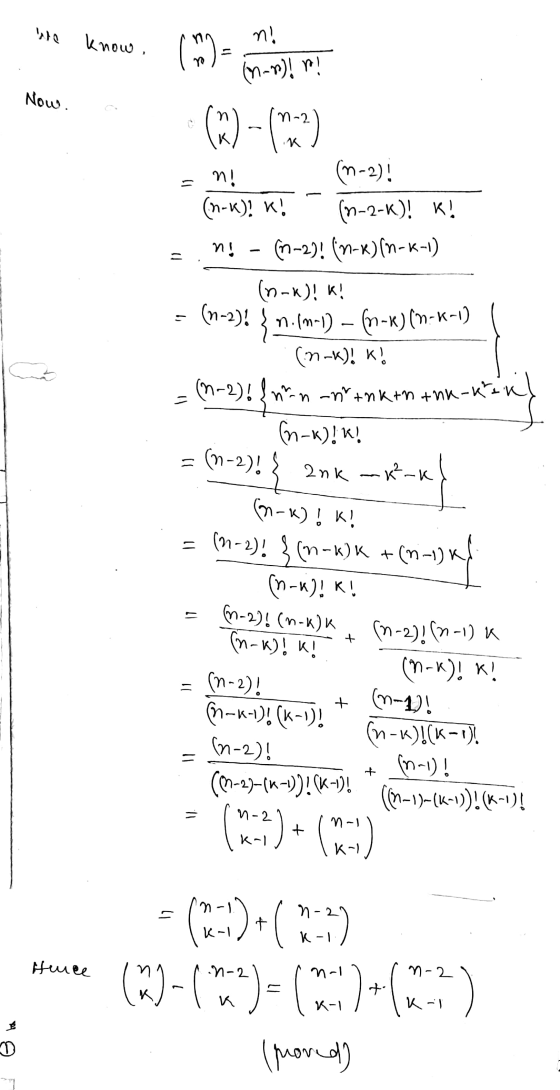
(3) Using the identity: (*) – 16–191 n! k!(n-k! k for n > 2, prove the...
 (3) Using the identity: (*) – 16–191 n! k!(n-k! k for n > 2, prove the following identity: (n-2 + (5+1) 1
(2) Using the identity: n! k!(n - k)! for n > 2, prove that the following...
 (2) Using the identity: n! k!(n - k)! for n > 2, prove that the following identity is even: 1 n
For all n E N prove that 0 <e- > < 2 k!“ (n + 1)!...
 For all n E N prove that 0 <e- > < 2 k!“ (n + 1)! k=0 Hint: Think about Taylor approximations of the function e".
Ulscrete Mathematics a. Prove that k (*)=n (1 - 1) for integers n and k with...
 Ulscrete Mathematics a. Prove that k (*)=n (1 - 1) for integers n and k with 15ks n, using a i. combinatorial proof: (3 marks) ii. algebraic proof. (3 marks)
Prove: If n=2^(k)−1 for k∈N, then every entry in row n of pascal's triangle is odd.
Prove: If n=2^(k)−1 for k∈N, then every entry in row n of pascal's triangle is odd.
(c) contrapositive positiv 2. (a) Prove that for all integers n and k where n >k>0,...
 (c) contrapositive positiv 2. (a) Prove that for all integers n and k where n >k>0, (+1) = 0)+2). (b) Let k be a positive integer. Prove by induction on n that ¿ () = 1) for all integers n > k. 3. An urn contains five white balls numbered from 1 to 5. five red balls numbered from 1 to 5 and fiv
Exercise 1.6.4: Prove the following by induction: (a) “k - n(n+1)(2n +1) k= 1 (b) If...
 Exercise 1.6.4: Prove the following by induction: (a) “k - n(n+1)(2n +1) k= 1 (b) If n > 1, then 13-n is divisible by 3. (c) For n 3, we have n +4 <2". (d) For any positive integer n, one of n, n+2, and 11+ 4 must be divisible by 3. (e) For all n e N, we have 3" > 2n +1. ()/Prove that, for any x > -1 and any n e N, we have (1+x)" 21+1x.
4. Here is a fact about permutations: (*) nPr= n!/(n-k)!, for all k =n. Let's prove...
 4. Here is a fact about permutations: (*) nPr= n!/(n-k)!, for all k =n. Let's prove this via mathematical induction for the fixed case k-3. 2 of 3 (i) Write clearly the statement (**) we wish to prove. Be sure your statement includes the phrase "for all n" (ii) State explicitly the assumption in (*) we will thus automatically make about k-2 (ii) Now recall that to prove by induction means to show that IfmPm!/lm-k)! is true for all km...
(1) Using the identity: n n! (2) want k k!(n - k)! for n > 1,...
 (1) Using the identity: n n! (2) want k k!(n - k)! for n > 1, prove the following identity: ()-20) + n2
Assume it is given that T1(n) = O(g1(n)) and T2(n) = O(g2(n)). Prove or disprove each...
Assume it is given that T1(n) = O(g1(n)) and T2(n) = O(g2(n)). Prove or disprove each one of the following claims T1(n)/T2(n) = O(g1(n)/g2(n))
 (3) Using the identity: (*) – 16–191 n! k!(n-k! k for n > 2, prove the following identity: (n-2 + (5+1) 1
 (2) Using the identity: n! k!(n - k)! for n > 2, prove that the following identity is even: 1 n
 For all n E N prove that 0 <e- > < 2 k!“ (n + 1)! k=0 Hint: Think about Taylor approximations of the function e".
 Ulscrete Mathematics a. Prove that k (*)=n (1 - 1) for integers n and k with 15ks n, using a i. combinatorial proof: (3 marks) ii. algebraic proof. (3 marks)
 (c) contrapositive positiv 2. (a) Prove that for all integers n and k where n >k>0, (+1) = 0)+2). (b) Let k be a positive integer. Prove by induction on n that ¿ () = 1) for all integers n > k. 3. An urn contains five white balls numbered from 1 to 5. five red balls numbered from 1 to 5 and fiv
 Exercise 1.6.4: Prove the following by induction: (a) “k - n(n+1)(2n +1) k= 1 (b) If n > 1, then 13-n is divisible by 3. (c) For n 3, we have n +4 <2". (d) For any positive integer n, one of n, n+2, and 11+ 4 must be divisible by 3. (e) For all n e N, we have 3" > 2n +1. ()/Prove that, for any x > -1 and any n e N, we have (1+x)" 21+1x.
 4. Here is a fact about permutations: (*) nPr= n!/(n-k)!, for all k =n. Let's prove this via mathematical induction for the fixed case k-3. 2 of 3 (i) Write clearly the statement (**) we wish to prove. Be sure your statement includes the phrase "for all n" (ii) State explicitly the assumption in (*) we will thus automatically make about k-2 (ii) Now recall that to prove by induction means to show that IfmPm!/lm-k)! is true for all km...
 (1) Using the identity: n n! (2) want k k!(n - k)! for n > 1, prove the following identity: ()-20) + n2
Most questions answered within 3 hours.
-
Where is the error in this code sequence?
String s1 = "Hello";
String s2 = "ello";...
asked 10 months ago -
Financial data for Joel de Paris, Inc., for last year
follow:
Joel de Paris, Inc.
Balance...
asked 10 months ago -
Consider this reaction:
Al2(SO4)3 (aq)+ BaCl3
(aq) Al2Cl6 (aq)- +
3BaSO4(s) . What is the...
asked 10 months ago -
Suppose that Savneet is considering increasing her
recent random sample from 20 car rentals to 40...
asked 10 months ago -
Trucks arrive at an unloading terminal at an average rate of 120
per hour.
Trucks arrive...
asked 10 months ago -
Why are methanol and ethanol completely soluble in water while
octanol is not very little soluble....
asked 10 months ago -
A facilities manager at a university reads in a research report
that the mean amount of...
asked 10 months ago -
When the CuSO4 is rehydrated by adding water to the anhydrous
compound, is this an endothermic...
asked 10 months ago -
A ray of sunlight is passing from diamond into crown glass; the
angle of incidence is...
asked 10 months ago -
A block of mass 0.249 kg is placed on top of a light, vertical
spring of...
asked 10 months ago -
how do the kidneys compensate in the presences of acidosis
a) trigger hyperventilate
b) reserve acid...
asked 10 months ago -
Question 501 pts
The rental rate of capital to the firm increases. Which of the
following...
asked 10 months ago