

Homework Answers
Add Answer to:
5. Induction motor The nameplate of an induction motor that is delta connected is shown below:...
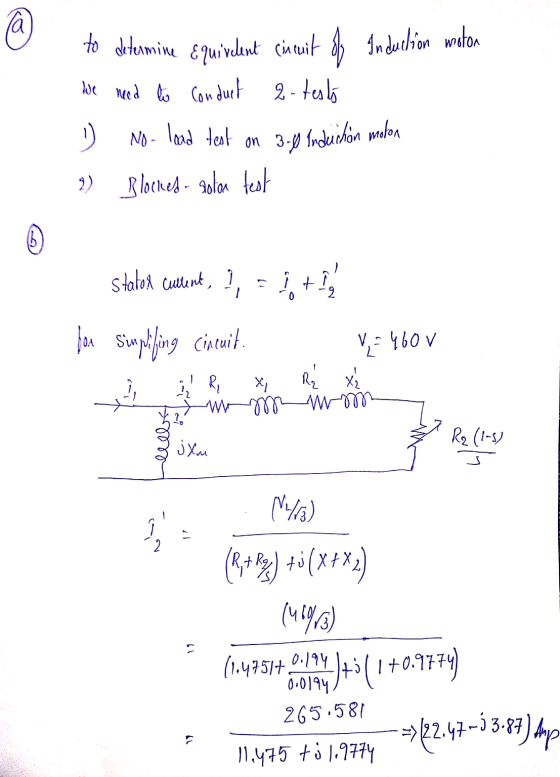
Problem#(50 points) The nameplate for a three phase induction motor is shown below. The "NEMA NOM. EFF." of 93.6% can be taken to be the efficiency. Keep in mind that voltage and cu...
 Problem#(50 points) The nameplate for a three phase induction motor is shown below. The "NEMA NOM. EFF." of 93.6% can be taken to be the efficiency. Keep in mind that voltage and current in a 3PH system are specified as line voltage and current SIEMENS PE 21 PLUS PREMUM EFFICE 40 LL AND CHEMICAL DUITY QUALL Part A Assume the motor is run at the rated nameplate conditions: (a) Find the real electrical input power. (b) Find the numerical value...
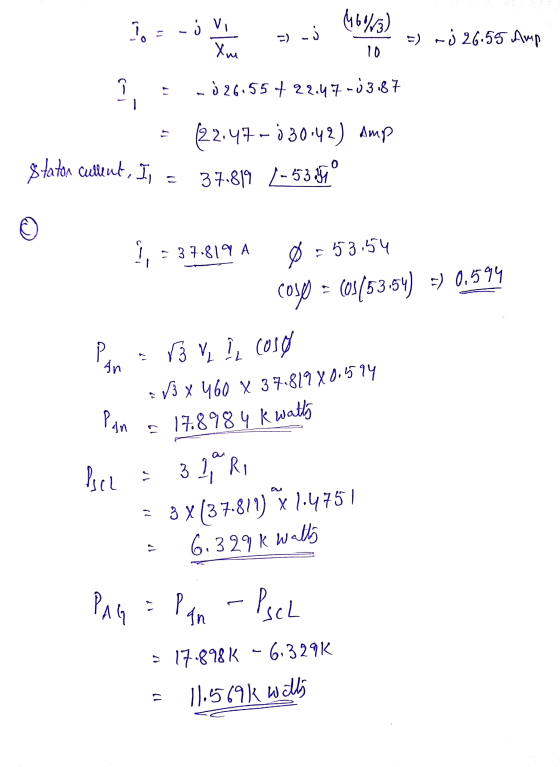
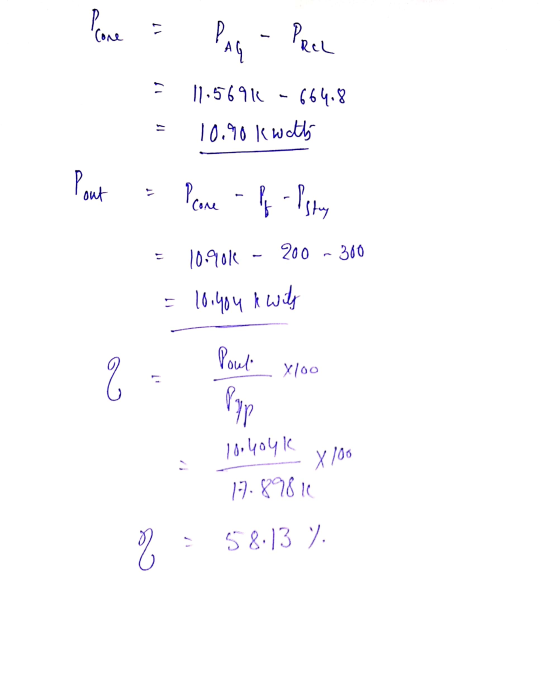
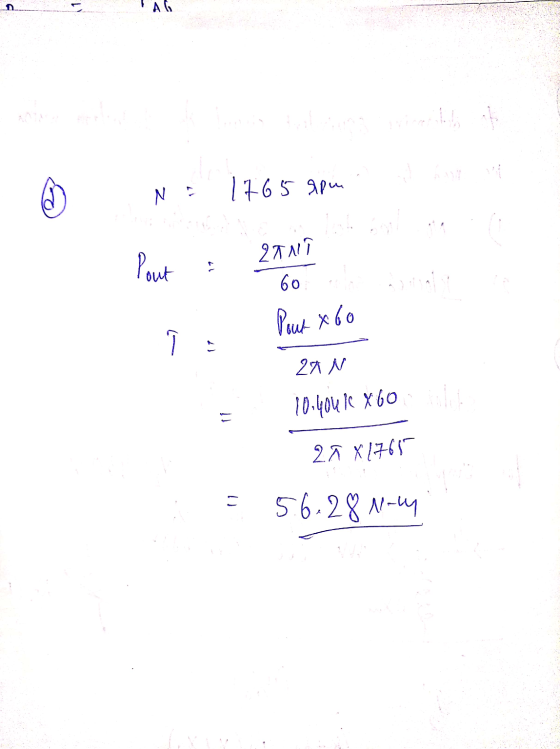
Question 3. (25 Marks) Parameters of a three-phase, 400 v, 50 Hz, 4-pole, star-connected induction motor...
 Question 3. (25 Marks) Parameters of a three-phase, 400 v, 50 Hz, 4-pole, star-connected induction motor are as follows: bl The sum of friction, windage and stray losses are 0.15 kW. The motor is running at 1440 rpm. (a) Calculate the input line current (b) Calculate the stator copper loss and rotor copper loss. (c) Calculate the output power and efficiency.
A three-phase Delta-connected, 15 hp, 440 VL-L, 60 Hz, six-pole induction motor is running at a...
 A three-phase Delta-connected, 15 hp, 440 VL-L, 60 Hz, six-pole induction motor is running at a shaft speed of 1182 rpm. The motor has the following parameters in ohms per phase: Rs = 0.2 Rp = 0.25 Rc = 317 Xs = 1.2 Xr= 1.3 Xm = 42 The rotational loss is 1500 W. Determine: a. Stator current b. Core loss c. Mechanical power d. Maximum developed torque e. Additional rotor resistance to be added to the rotor circuit such...
4. A certain four-pole 240-V-rms 50-Hz delta-connected three-phase induction motor operates at slip 5% at full...
4. A certain four-pole 240-V-rms 50-Hz delta-connected three-phase induction motor operates at slip 5% at full load and has rotational losses (windage + friction) of 100 W. The stator resistance per phase is 0.2 Ohm. The results of no-load and locked-rotor tests on this motor are as follows: No-load test Locked-rotor test Line-to-line input voltage: 240 V 45 V Input active power: 1100 W 1300 W Input line current: 10 A 30 A Using the tests data, determine parameters of...
A 25-hp, 208-V, 60-Hz, two-pole, Y-connected induction motor operates at slip of 5% at rated conditions....
A 25-hp, 208-V, 60-Hz, two-pole, Y-connected induction motor operates at slip of 5% at rated conditions. The motor parameters are given in ohms per phase as follows: ??=0.3 ??=0.4 ??=0.1 ??=0.4 ??=25.0 Assume core loss of 150 W and rotational loss of 225 W, Find Stator Current, Electromechanical torque, Power out, Efficiency, Power Factor and PowerFlow Diagram. Use the exact model circuit.
Two tests were performed on a 230-V, 60-Hz, 4-pole, Y-connected, three-phase induction motor and the obtained...
 Two tests were performed on a 230-V, 60-Hz, 4-pole, Y-connected, three-phase induction motor and the obtained data are given in the table below. The friction and windage loss is 15 W, and the stator winding resistance between any two lines is 3.96ohm Determine: 1) The equivalent circuit parameters of the motor 3) The motor efficiency at a slip of 8%. No-load test 137 0.43 230 Blocked-rotor test 70 1.18 47 3-phase power input, W Line-line voltage, V
2. A 208V, two pole, 60 Hz, y connected wound rotor induction motor is rated at...
 2. A 208V, two pole, 60 Hz, y connected wound rotor induction motor is rated at 15hp. Its equivalent circuit parameters are R:-0.200, R:-0.120, X.-X-0.410, X-150. The rotational losses are 430W. The motor drives a mechanical load with a slip of 5 percent. By using simplified equivalent circuit calculate; (30 pts) a) The motor speed in revolutions per minute and radians per second. b) The line current c) The stator copper losses. d) The air gap power. e) The power...
(b) A Y-connected induction motor. The equivalent circuit parameters are R X, X, M PF&W P....
 (b) A Y-connected induction motor. The equivalent circuit parameters are R X, X, M PF&W P. misc core (lumped with rotational losses) [14 points) For a slip Sind (1) The line current I _ - [3 points] (2) The stator power factor. [1 point] (3) The rotor power factor. [1 point] (4) The rotor frequency. [1 point] (5) The stator copper losses Pscz - [1 point] (6) The air-gap power PAG - [1 point] (7) The power converted from electrical...
5.7) An induction motor is installed in a factory. Under conditions in which the three-phase 415-volt...
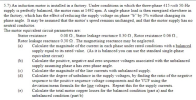 5.7) An induction motor is installed in a factory. Under conditions in which the three-phase 415-volt 50-Hz supply is perfectly balanced, the motor runs at 1492 rpm. A single-phase load is then energised elsewhere in the factory, which has the effect of reducing the supply voltage on phase "6" by 5% without changing its phase angle. It may be assumed that the motor's speed remains unchanged, and that the motor supply has no neutral conductor. The motor equivalent circuit parameters...
4.6. A 460-V, 75 kW, 4-pole, delta-connected, 60-Hz, three- phase induction motor has a full-load slip of 5 percent, an efficiency of 92 percent and a power-factor of 0.87 lagging at full-load. At st...
 4.6. A 460-V, 75 kW, 4-pole, delta-connected, 60-Hz, three- phase induction motor has a full-load slip of 5 percent, an efficiency of 92 percent and a power-factor of 0.87 lagging at full-load. At start-up, the motor develops 1.9 times the full load developed torque but draws 7.5 times the rated current at the rated voltage. This motor is to be started with an auto- transformer reduced-voltage starter. Assume the stator resistance and the stator core loss to be negligible. Calculate...
 Problem#(50 points) The nameplate for a three phase induction motor is shown below. The "NEMA NOM. EFF." of 93.6% can be taken to be the efficiency. Keep in mind that voltage and current in a 3PH system are specified as line voltage and current SIEMENS PE 21 PLUS PREMUM EFFICE 40 LL AND CHEMICAL DUITY QUALL Part A Assume the motor is run at the rated nameplate conditions: (a) Find the real electrical input power. (b) Find the numerical value...
 Question 3. (25 Marks) Parameters of a three-phase, 400 v, 50 Hz, 4-pole, star-connected induction motor are as follows: bl The sum of friction, windage and stray losses are 0.15 kW. The motor is running at 1440 rpm. (a) Calculate the input line current (b) Calculate the stator copper loss and rotor copper loss. (c) Calculate the output power and efficiency.
 A three-phase Delta-connected, 15 hp, 440 VL-L, 60 Hz, six-pole induction motor is running at a shaft speed of 1182 rpm. The motor has the following parameters in ohms per phase: Rs = 0.2 Rp = 0.25 Rc = 317 Xs = 1.2 Xr= 1.3 Xm = 42 The rotational loss is 1500 W. Determine: a. Stator current b. Core loss c. Mechanical power d. Maximum developed torque e. Additional rotor resistance to be added to the rotor circuit such...
 Two tests were performed on a 230-V, 60-Hz, 4-pole, Y-connected, three-phase induction motor and the obtained data are given in the table below. The friction and windage loss is 15 W, and the stator winding resistance between any two lines is 3.96ohm Determine: 1) The equivalent circuit parameters of the motor 3) The motor efficiency at a slip of 8%. No-load test 137 0.43 230 Blocked-rotor test 70 1.18 47 3-phase power input, W Line-line voltage, V
 2. A 208V, two pole, 60 Hz, y connected wound rotor induction motor is rated at 15hp. Its equivalent circuit parameters are R:-0.200, R:-0.120, X.-X-0.410, X-150. The rotational losses are 430W. The motor drives a mechanical load with a slip of 5 percent. By using simplified equivalent circuit calculate; (30 pts) a) The motor speed in revolutions per minute and radians per second. b) The line current c) The stator copper losses. d) The air gap power. e) The power...
 (b) A Y-connected induction motor. The equivalent circuit parameters are R X, X, M PF&W P. misc core (lumped with rotational losses) [14 points) For a slip Sind (1) The line current I _ - [3 points] (2) The stator power factor. [1 point] (3) The rotor power factor. [1 point] (4) The rotor frequency. [1 point] (5) The stator copper losses Pscz - [1 point] (6) The air-gap power PAG - [1 point] (7) The power converted from electrical...
 5.7) An induction motor is installed in a factory. Under conditions in which the three-phase 415-volt 50-Hz supply is perfectly balanced, the motor runs at 1492 rpm. A single-phase load is then energised elsewhere in the factory, which has the effect of reducing the supply voltage on phase "6" by 5% without changing its phase angle. It may be assumed that the motor's speed remains unchanged, and that the motor supply has no neutral conductor. The motor equivalent circuit parameters...
 4.6. A 460-V, 75 kW, 4-pole, delta-connected, 60-Hz, three- phase induction motor has a full-load slip of 5 percent, an efficiency of 92 percent and a power-factor of 0.87 lagging at full-load. At start-up, the motor develops 1.9 times the full load developed torque but draws 7.5 times the rated current at the rated voltage. This motor is to be started with an auto- transformer reduced-voltage starter. Assume the stator resistance and the stator core loss to be negligible. Calculate...
Most questions answered within 3 hours.
-
Where is the error in this code sequence?
String s1 = "Hello";
String s2 = "ello";...
asked 11 months ago -
Financial data for Joel de Paris, Inc., for last year
follow:
Joel de Paris, Inc.
Balance...
asked 11 months ago -
Consider this reaction:
Al2(SO4)3 (aq)+ BaCl3
(aq) Al2Cl6 (aq)- +
3BaSO4(s) . What is the...
asked 11 months ago -
Suppose that Savneet is considering increasing her
recent random sample from 20 car rentals to 40...
asked 11 months ago -
Trucks arrive at an unloading terminal at an average rate of 120
per hour.
Trucks arrive...
asked 11 months ago -
Why are methanol and ethanol completely soluble in water while
octanol is not very little soluble....
asked 11 months ago -
A facilities manager at a university reads in a research report
that the mean amount of...
asked 11 months ago -
When the CuSO4 is rehydrated by adding water to the anhydrous
compound, is this an endothermic...
asked 11 months ago -
A ray of sunlight is passing from diamond into crown glass; the
angle of incidence is...
asked 11 months ago -
A block of mass 0.249 kg is placed on top of a light, vertical
spring of...
asked 11 months ago -
how do the kidneys compensate in the presences of acidosis
a) trigger hyperventilate
b) reserve acid...
asked 11 months ago -
Question 501 pts
The rental rate of capital to the firm increases. Which of the
following...
asked 11 months ago