
Homework Answers
Answer:-
Fermentation often uses C6H12O6 as the substrate.Fermentation is a biological process which converts sugars such as glucose, fructose, and sucrose into cellular energy, producing ethanol and carbon dioxide as by-products.
thank you
In fermentation of sugars by yeast, what are the reactants? O C.H12O6 + 2 CO2 O...
 In fermentation of sugars by yeast, what are the reactants? O C.H12O6 + 2 CO2 O C6H1206 O2 CO2 + 2 ATP O 2 C2H5OH + 2 ATP O 2 CO2+ 2 C2H5OH + 2 ATP
Is 02 converted into CO2 during cellular respiration? Explain. What is the purpose of fermentation? What...
 Is 02 converted into CO2 during cellular respiration? Explain. What is the purpose of fermentation? What are the two things we obtain by eating food? What are they used for?
Which of these equations best summarizes photosynthesis? CO2 + 6H20 – C6H1206 +602 H20-2H+ + 1/2O2...
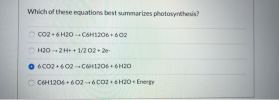 Which of these equations best summarizes photosynthesis? CO2 + 6H20 – C6H1206 +602 H20-2H+ + 1/2O2 + 2e- O 6CO2 +6 02-C6H1206 +6 H20 O C6H1206 +602-6CO2 + 6H2O + Energy
Limiting Reactant Calculations C6H1206(s) + 6 O2(g) → 6 CO2(g) + 6 H2O(g) Starting with 25.0...
 Limiting Reactant Calculations C6H1206(s) + 6 O2(g) → 6 CO2(g) + 6 H2O(g) Starting with 25.0 g C6H12O6 and 15.5 g 02, what is the theoretical yield of CO2 in grams? Calculation based upon C6H1206 Calculation based upon 02 What is the limiting reactant? What is the theoretical yield?
C6H12O6(s) + 6 02(g) → 6 CO2(g) + 6 H2O(g) Starting with 25.0 g C6H12O6 and...
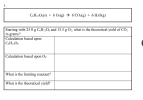 C6H12O6(s) + 6 02(g) → 6 CO2(g) + 6 H2O(g) Starting with 25.0 g C6H12O6 and 15.5 g 02, what is the theoretical yield of CO2 in grams? Calculation based upon C6H1206 Calculation based upon 02 What is the limiting reactant? What is the theoretical yield?
The reaction 2H2022H20 + 02 has the following mechanism: step 1: H202+H20IO step 2: IO+ H202...
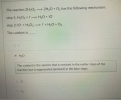 The reaction 2H2022H20 + 02 has the following mechanism: step 1: H202+H20IO step 2: IO+ H202 + H20+ O2 The catalyst is. e H20 The catalyst is the species that is reactant in the earlier steps of the reaction but is regenerated (product) in the later steps io 02
Table 1: Tube contents for Alcohol Fermentation in Yeast. Tube: Sample: DH2O: Yeast Suspension: (ml) Substrate/Reagent...
 Table 1: Tube contents for Alcohol Fermentation in Yeast. Tube: Sample: DH2O: Yeast Suspension: (ml) Substrate/Reagent Glucose 1ml 3ml 3ml of 10% glucose 1ml 3ml Variable 1: White chocolate 3ml of 10% melted chocolate 1ml 3ml Variable 2: Dark chocolate 3ml of 10% melted chocolate 1ml 3ml Variable 3: Milk chocolate 3ml of 10% melted chocolate What is the purpose of this experiment? Testing if yeast will ferment in different flavors of chocolate (white chocolate, milk chocolate, & dark chocolate)...
2. Yeast and other organisms can convert glucose (C6H1206) to ethanol (C2H5OH) through a process called...
 2. Yeast and other organisms can convert glucose (C6H1206) to ethanol (C2H5OH) through a process called alcoholic fermentation. The net reaction is C6H12O6(s)—2 C2H5OH(1) + 2 CO2(g). Calculate the mass of glucose required to produce 1.0 L of CO2 at a pressure of 1.0 atm and temperature 300 K. 0 3.654g 0 180.0 g 05.820g 0 45.0 g
10. Describe the substrate that yeasts use for alcoholic fermentation. (3 points) 11. Which product of...
 10. Describe the substrate that yeasts use for alcoholic fermentation. (3 points) 11. Which product of alcoholic fermentation did you measure in this experimen 22. Please identify the four stages of mitosis in the following figures (4 points)
Question 13 (4 points) The unbalanced equation below describes the process of fermentation of sugar to...
 Question 13 (4 points) The unbalanced equation below describes the process of fermentation of sugar to yield ethanol: C6H1206 → C2H4O + CO2 For every 1 mol of CH 20 fermented, how many grams of ethanol, CyH60 are produced? 0928 92 g 0 466 140 g 0.26 g
 In fermentation of sugars by yeast, what are the reactants? O C.H12O6 + 2 CO2 O C6H1206 O2 CO2 + 2 ATP O 2 C2H5OH + 2 ATP O 2 CO2+ 2 C2H5OH + 2 ATP
 Is 02 converted into CO2 during cellular respiration? Explain. What is the purpose of fermentation? What are the two things we obtain by eating food? What are they used for?
 Which of these equations best summarizes photosynthesis? CO2 + 6H20 – C6H1206 +602 H20-2H+ + 1/2O2 + 2e- O 6CO2 +6 02-C6H1206 +6 H20 O C6H1206 +602-6CO2 + 6H2O + Energy
 Limiting Reactant Calculations C6H1206(s) + 6 O2(g) → 6 CO2(g) + 6 H2O(g) Starting with 25.0 g C6H12O6 and 15.5 g 02, what is the theoretical yield of CO2 in grams? Calculation based upon C6H1206 Calculation based upon 02 What is the limiting reactant? What is the theoretical yield?
 C6H12O6(s) + 6 02(g) → 6 CO2(g) + 6 H2O(g) Starting with 25.0 g C6H12O6 and 15.5 g 02, what is the theoretical yield of CO2 in grams? Calculation based upon C6H1206 Calculation based upon 02 What is the limiting reactant? What is the theoretical yield?
 The reaction 2H2022H20 + 02 has the following mechanism: step 1: H202+H20IO step 2: IO+ H202 + H20+ O2 The catalyst is. e H20 The catalyst is the species that is reactant in the earlier steps of the reaction but is regenerated (product) in the later steps io 02
 Table 1: Tube contents for Alcohol Fermentation in Yeast. Tube: Sample: DH2O: Yeast Suspension: (ml) Substrate/Reagent Glucose 1ml 3ml 3ml of 10% glucose 1ml 3ml Variable 1: White chocolate 3ml of 10% melted chocolate 1ml 3ml Variable 2: Dark chocolate 3ml of 10% melted chocolate 1ml 3ml Variable 3: Milk chocolate 3ml of 10% melted chocolate What is the purpose of this experiment? Testing if yeast will ferment in different flavors of chocolate (white chocolate, milk chocolate, & dark chocolate)...
 2. Yeast and other organisms can convert glucose (C6H1206) to ethanol (C2H5OH) through a process called alcoholic fermentation. The net reaction is C6H12O6(s)—2 C2H5OH(1) + 2 CO2(g). Calculate the mass of glucose required to produce 1.0 L of CO2 at a pressure of 1.0 atm and temperature 300 K. 0 3.654g 0 180.0 g 05.820g 0 45.0 g
 10. Describe the substrate that yeasts use for alcoholic fermentation. (3 points) 11. Which product of alcoholic fermentation did you measure in this experimen 22. Please identify the four stages of mitosis in the following figures (4 points)
 Question 13 (4 points) The unbalanced equation below describes the process of fermentation of sugar to yield ethanol: C6H1206 → C2H4O + CO2 For every 1 mol of CH 20 fermented, how many grams of ethanol, CyH60 are produced? 0928 92 g 0 466 140 g 0.26 g
Most questions answered within 3 hours.
-
Where is the error in this code sequence?
String s1 = "Hello";
String s2 = "ello";...
asked 10 months ago -
Financial data for Joel de Paris, Inc., for last year
follow:
Joel de Paris, Inc.
Balance...
asked 10 months ago -
Consider this reaction:
Al2(SO4)3 (aq)+ BaCl3
(aq) Al2Cl6 (aq)- +
3BaSO4(s) . What is the...
asked 10 months ago -
Suppose that Savneet is considering increasing her
recent random sample from 20 car rentals to 40...
asked 10 months ago -
Trucks arrive at an unloading terminal at an average rate of 120
per hour.
Trucks arrive...
asked 10 months ago -
Why are methanol and ethanol completely soluble in water while
octanol is not very little soluble....
asked 10 months ago -
A facilities manager at a university reads in a research report
that the mean amount of...
asked 10 months ago -
When the CuSO4 is rehydrated by adding water to the anhydrous
compound, is this an endothermic...
asked 10 months ago -
A ray of sunlight is passing from diamond into crown glass; the
angle of incidence is...
asked 10 months ago -
A block of mass 0.249 kg is placed on top of a light, vertical
spring of...
asked 10 months ago -
how do the kidneys compensate in the presences of acidosis
a) trigger hyperventilate
b) reserve acid...
asked 10 months ago -
Question 501 pts
The rental rate of capital to the firm increases. Which of the
following...
asked 10 months ago