
Homework Answers
Answer) False
It is false that light dependent reactions are Photocidative Phosphorylation.
Instead light dependent reactions which is also known as photosynthesis reactions are Oxidative Phosphorylation.
Hope it helps!!!
Add Answer to:
Light dependent reactions are Photocidative
Phosphorylation
Light dependent reactions are Photooxidative Phosphorylation Select one: a. True...
Photosystems Photosystems: 1. Circle the letter of each sentence that is true about the light-dependent reactions....
 Photosystems
: 1. Circle the letter of each sentence that is true about the light-dependent reactions. Correct the false statements. a. They convert ADP into ATP. b. They produce oxygen gas. C. They convert oxygen into carbon dioxide. d. They convert NADP* into NADPH. 2. Where do the light-dependent reactions take place? 3. What happens to water in the light-dependent reactions?
Photosystems
Photosystems: 1. Circle the letter of each sentence that is true about the light-dependent reactions. Correct the false statements. a. They convert ADP into ATP. b. They produce oxygen gas. C. They convert oxygen into carbon dioxide. d. They convert NADP* into NADPH. 2. Where do the light-dependent reactions take place? 3. What happens to water in the light-dependent reactions?
Rhodopsin, a light-sensitive GPCR whose role in vision is dependent on its phosphorylation status, is influenced...
Rhodopsin, a light-sensitive GPCR whose role in vision is dependent on its phosphorylation status, is influenced in part by the protein arrestin. Which of the following is true in regards to rhodopsin and vision? Select one: a. Rhodopsin phosphatase increases the degree of rhodopsin phosphorylation b. Arrestin binds to the completely phosphorylated opsin to inhibit signaling c. Rhodopsin activation promotes the opening of a cGMP-gated ion channel d. none of the above
In photosynthesis, all of the following reactions are directly dependent on light except Select one: a....
In photosynthesis, all of the following reactions are directly dependent on light except Select one: a. carbon fixation b. synthesis of ATP c. electron transport d. removal of electrons from H2O
True or False: Both cellular respiration and the light dependent reactions of photosynthesis use a Hydrogen...
True or False: Both cellular respiration and the light dependent reactions of photosynthesis use a Hydrogen gradient in order to generate ATP by way of ATP synthase in the process of chemiosmosis.
Which of the following reactions are associated with respiration Select one: a. Oxidative phosphorylation b. Glycolysis...
 Which of the following reactions are associated with respiration Select one: a. Oxidative phosphorylation b. Glycolysis c. all of the choices d. TCA cycle
In which of the following reactions is carbon dioxide given off Select one: a. Oxidative phosphorylation...
 In which of the following reactions is carbon dioxide given off Select one: a. Oxidative phosphorylation b. TCA cycle c. All of the choices d. Glycolysis
QUESTION 8 Put the following statements about the light dependent reactions in order (1-4) Electrons that...
 QUESTION 8 Put the following statements about the light dependent reactions in order (1-4) Electrons that leave PSI travel through a transport chain, which allows H+ to be actively transported to high concentration Light energy excites electrons of antenna pigment molecules at PSII (and PSI) Electrons are ultimately accepted by NADP+ (forming NADPH) and the H+ gradient pass through ATP synthase, allowing ATP to be produced Energy from excited electrons of antenna pigments is passed to the reaction center of...
A genetic alteration which caused both photosystems of the light-dependent reactions to incorporate P700 chlorophyll molecules...
 A genetic alteration which caused both photosystems of the
light-dependent reactions to incorporate P700 chlorophyll molecules
into their reaction centers would be disastrous for a plant’s
photosynthetic ability. [Hint: your answer should include some
discussion of redox potential.]
Question 13 4 pts Open-response true/false question A genetic alteration which caused both photosystems of the light-dependent reactions to incorporate P700 chlorophyll molecules into their reaction centers would be disastrous for a plant's photosynthetic ability. (Hint: your answer should include some discussion...
A genetic alteration which caused both photosystems of the
light-dependent reactions to incorporate P700 chlorophyll molecules
into their reaction centers would be disastrous for a plant’s
photosynthetic ability. [Hint: your answer should include some
discussion of redox potential.]
Question 13 4 pts Open-response true/false question A genetic alteration which caused both photosystems of the light-dependent reactions to incorporate P700 chlorophyll molecules into their reaction centers would be disastrous for a plant's photosynthetic ability. (Hint: your answer should include some discussion...
Question 26 (1 point) How are the light-dependent and light-independent reactions of photosynthesis related? The products...
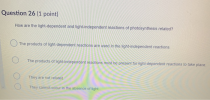 Question 26 (1 point) How are the light-dependent and light-independent reactions of photosynthesis related? The products of light-dependent reactions are used in the light-independent reactions, The products of light-independent reactions must be present for light-dependent reactions to take place. They are not related They cannot occur in the absence of light.
Which of the following components of the light dependent reactions is NOT involved in redox reactions?...
Which of the following components of the light dependent reactions is NOT involved in redox reactions? a. Electron Transport Chain b. P680 c. P700 d. ATP synthase e. All of these are involved in redox reactions Can you explain your reasoning and what they mean by redox reactions?
 Photosystems
: 1. Circle the letter of each sentence that is true about the light-dependent reactions. Correct the false statements. a. They convert ADP into ATP. b. They produce oxygen gas. C. They convert oxygen into carbon dioxide. d. They convert NADP* into NADPH. 2. Where do the light-dependent reactions take place? 3. What happens to water in the light-dependent reactions?
Photosystems
Photosystems: 1. Circle the letter of each sentence that is true about the light-dependent reactions. Correct the false statements. a. They convert ADP into ATP. b. They produce oxygen gas. C. They convert oxygen into carbon dioxide. d. They convert NADP* into NADPH. 2. Where do the light-dependent reactions take place? 3. What happens to water in the light-dependent reactions?
 Which of the following reactions are associated with respiration Select one: a. Oxidative phosphorylation b. Glycolysis c. all of the choices d. TCA cycle
 In which of the following reactions is carbon dioxide given off Select one: a. Oxidative phosphorylation b. TCA cycle c. All of the choices d. Glycolysis
 QUESTION 8 Put the following statements about the light dependent reactions in order (1-4) Electrons that leave PSI travel through a transport chain, which allows H+ to be actively transported to high concentration Light energy excites electrons of antenna pigment molecules at PSII (and PSI) Electrons are ultimately accepted by NADP+ (forming NADPH) and the H+ gradient pass through ATP synthase, allowing ATP to be produced Energy from excited electrons of antenna pigments is passed to the reaction center of...
 A genetic alteration which caused both photosystems of the
light-dependent reactions to incorporate P700 chlorophyll molecules
into their reaction centers would be disastrous for a plant’s
photosynthetic ability. [Hint: your answer should include some
discussion of redox potential.]
Question 13 4 pts Open-response true/false question A genetic alteration which caused both photosystems of the light-dependent reactions to incorporate P700 chlorophyll molecules into their reaction centers would be disastrous for a plant's photosynthetic ability. (Hint: your answer should include some discussion...
A genetic alteration which caused both photosystems of the
light-dependent reactions to incorporate P700 chlorophyll molecules
into their reaction centers would be disastrous for a plant’s
photosynthetic ability. [Hint: your answer should include some
discussion of redox potential.]
Question 13 4 pts Open-response true/false question A genetic alteration which caused both photosystems of the light-dependent reactions to incorporate P700 chlorophyll molecules into their reaction centers would be disastrous for a plant's photosynthetic ability. (Hint: your answer should include some discussion...
 Question 26 (1 point) How are the light-dependent and light-independent reactions of photosynthesis related? The products of light-dependent reactions are used in the light-independent reactions, The products of light-independent reactions must be present for light-dependent reactions to take place. They are not related They cannot occur in the absence of light.
Most questions answered within 3 hours.
-
Where is the error in this code sequence?
String s1 = "Hello";
String s2 = "ello";...
asked 10 months ago -
Financial data for Joel de Paris, Inc., for last year
follow:
Joel de Paris, Inc.
Balance...
asked 10 months ago -
Consider this reaction:
Al2(SO4)3 (aq)+ BaCl3
(aq) Al2Cl6 (aq)- +
3BaSO4(s) . What is the...
asked 10 months ago -
Suppose that Savneet is considering increasing her
recent random sample from 20 car rentals to 40...
asked 10 months ago -
Trucks arrive at an unloading terminal at an average rate of 120
per hour.
Trucks arrive...
asked 10 months ago -
Why are methanol and ethanol completely soluble in water while
octanol is not very little soluble....
asked 10 months ago -
A facilities manager at a university reads in a research report
that the mean amount of...
asked 10 months ago -
When the CuSO4 is rehydrated by adding water to the anhydrous
compound, is this an endothermic...
asked 10 months ago -
A ray of sunlight is passing from diamond into crown glass; the
angle of incidence is...
asked 10 months ago -
A block of mass 0.249 kg is placed on top of a light, vertical
spring of...
asked 10 months ago -
how do the kidneys compensate in the presences of acidosis
a) trigger hyperventilate
b) reserve acid...
asked 10 months ago -
Question 501 pts
The rental rate of capital to the firm increases. Which of the
following...
asked 10 months ago