True or False: Both cellular respiration and the light dependent reactions of photosynthesis use a Hydrogen...
True or False: Both cellular respiration and the light dependent reactions of photosynthesis use a Hydrogen gradient in order to generate ATP by way of ATP synthase in the process of chemiosmosis.
Homework Answers
True
During electron transport chain of cellular respiration, ATP is generated with the help of ATP synthase from a hydrogen gradient through the process of chemiosmosis. The same procedure occurs during the light dependent reactions of photosynthesis.
Add Answer to:
True or False: Both cellular respiration and the light dependent
reactions of photosynthesis use a Hydrogen...
Respiration and the light reactions of photosynthesis have several features in common. Which of the following...
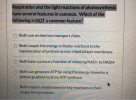 Respiration and the light reactions of photosynthesis have several features in common. Which of the following is NOT a common feature? O Both use an electron transport chain. Both couple the energy in Redox reactions to the translocation of protons across a lipid bilayer membrane. O Both have a primary function of reducing NAD+ to NADH Both can generate ATP by using the energy stored in a proton gradient to drive ATP synthase. Both require membranes for key reactions in...
Compare and contrast the light reactions of Photosynthesis to electron transport chain and chemiosmosis of Cellular...
Compare and contrast the light reactions of Photosynthesis to electron transport chain and chemiosmosis of Cellular Respiration.
Give a general description of what photosynthesis and cellular respiration each accomplish. Describe and compare the...
Give a general description of what photosynthesis and cellular respiration each accomplish. Describe and compare the process of chemiosmosis in photosynthesis and cellular respiration. Identify the source of the high-energy electrons that drop down the electron transport chain in photo-phosphorylation versus oxidative phosphorylation. Where is the ATP produced in each process? What is the proton-motive force?
PartA Drag the terms on the left to the appropriate blanks on the right to complete...
 PartA Drag the terms on the left to the appropriate blanks on the right to complete the sentences. Reset Help chemiosmosis 1. ATP synthesis in both chloroplasts and mitochondria involves the process called electron transport chain 2. In both cellular respiration and photosynthesis, a(n) membrane as electrons are passed from one electron carrier to the next in a series of redox reactions built into a membrane pumps H" across the oxygen ATP synthase NADPH 3. In respiration, the electrons come...
True or False? Only eukaryotes need ATP to power their cells. True False Important: For this...
True or False? Only eukaryotes need ATP to power their cells. True False Important: For this question, there may be more than one answer, so check ALL that apply. Which statements are incorrect? In eukaryotic cells, photosynthesis occurs in chloroplasts. In eukaryotic cells, cellular respiration occurs in mitochondria. Cellular respiration and photosynthesis both produce ATP to power cellular work. Only heterotrophs perform cellular respiration. Photosynthesis produces sugars (glucose), which can then be used in cellular respiration to produce ATP.
1.A How is the light reaction and dark reaction of photosynthesis related? The products of the...
 1.A How is the light reaction and dark reaction of photosynthesis related? The products of the light reactions are used in the dark reactions O They are not related The products of the dark reactions are used in the light reactions The products of the dark reactions must be present for the light reactions to take place B. Which of the following processes of cellular respiration is CO2 released? Select all that are correct. chemiosmosis glycolysis citric acid cycle electron...
A) what is the relationship between photosynthesis and cell respiration? 1. photosynthesis removes carbon dioxide from...
A) what is the relationship between photosynthesis and cell respiration? 1. photosynthesis removes carbon dioxide from the atmosphere and cellular respiration puts it back. 2. photosynthesis releases oxygen into the admosphere, and cellular respiration uses that oxygen to release energy from food. B) what color found in many plants is produced by which pigment? C)what color of light are green plants the best at reflecting? 1. yellow 2. green 3. blue. 4 red D) what are the two main sets...
The electron transport chain in cellular respiration converts electrical energy to the transport of_ Select one:...
 The electron transport chain in cellular respiration converts electrical energy to the transport of_ Select one: a. H+ b. O2 c. CO2 d. OH- e. glucose The process of glycolysis converts one molecule of glucose to two molecules of pyruvate. Select one: a. 2 carbon X b. 3 carbon c. 4 carbon d. 5 carbon e. 6 carbon ATP synthesis during cellular respiration depends on a gradient of Select one: a. NaCI b. electrons c. 02 d. pyruvate e. Hydrogen...
13. Describe 2 mechanisms whereby ATP is generated during cellular respiration Mechanism 1: Mechanism 2: 14....
 13. Describe 2 mechanisms whereby ATP is generated during cellular respiration Mechanism 1: Mechanism 2: 14. Indicate the MAIN molecules that enter and exit each of these processes? Molecule(s) IN Process Molecule(s) OUT Glycolysis Pyruvate Oxidation Citric Acid/Krebs Cycle ETC Photophosphorylation Calvin Cycle 15. Isocitrate is a 6 carbon molecule that is oxidized to a-ketoglutarate (a 5 carbon molecule) by the enzyme isocitrate dehydrogenase. What happens to the extra carbon atom in this reaction and in which process (listed in...
The relationship between the light-dependent and light-independent reaction in photosynthesis is that... a. The ATP made...
 The relationship between the light-dependent and light-independent reaction in photosynthesis is that... a. The ATP made during the light-dependent reaction is used for the growth and development of the cell and the ATP from the oxidation of glucose drives the light reaction b. The light-independent reactions are driven by the ATP and NADPH generated from the light reactions C. The energy stored in the glucose made during the Calvin cycle is used to drive the light reactions. d. The light-dependent...
 Respiration and the light reactions of photosynthesis have several features in common. Which of the following is NOT a common feature? O Both use an electron transport chain. Both couple the energy in Redox reactions to the translocation of protons across a lipid bilayer membrane. O Both have a primary function of reducing NAD+ to NADH Both can generate ATP by using the energy stored in a proton gradient to drive ATP synthase. Both require membranes for key reactions in...
 PartA Drag the terms on the left to the appropriate blanks on the right to complete the sentences. Reset Help chemiosmosis 1. ATP synthesis in both chloroplasts and mitochondria involves the process called electron transport chain 2. In both cellular respiration and photosynthesis, a(n) membrane as electrons are passed from one electron carrier to the next in a series of redox reactions built into a membrane pumps H" across the oxygen ATP synthase NADPH 3. In respiration, the electrons come...
 1.A How is the light reaction and dark reaction of photosynthesis related? The products of the light reactions are used in the dark reactions O They are not related The products of the dark reactions are used in the light reactions The products of the dark reactions must be present for the light reactions to take place B. Which of the following processes of cellular respiration is CO2 released? Select all that are correct. chemiosmosis glycolysis citric acid cycle electron...
 The electron transport chain in cellular respiration converts electrical energy to the transport of_ Select one: a. H+ b. O2 c. CO2 d. OH- e. glucose The process of glycolysis converts one molecule of glucose to two molecules of pyruvate. Select one: a. 2 carbon X b. 3 carbon c. 4 carbon d. 5 carbon e. 6 carbon ATP synthesis during cellular respiration depends on a gradient of Select one: a. NaCI b. electrons c. 02 d. pyruvate e. Hydrogen...
 13. Describe 2 mechanisms whereby ATP is generated during cellular respiration Mechanism 1: Mechanism 2: 14. Indicate the MAIN molecules that enter and exit each of these processes? Molecule(s) IN Process Molecule(s) OUT Glycolysis Pyruvate Oxidation Citric Acid/Krebs Cycle ETC Photophosphorylation Calvin Cycle 15. Isocitrate is a 6 carbon molecule that is oxidized to a-ketoglutarate (a 5 carbon molecule) by the enzyme isocitrate dehydrogenase. What happens to the extra carbon atom in this reaction and in which process (listed in...
 The relationship between the light-dependent and light-independent reaction in photosynthesis is that... a. The ATP made during the light-dependent reaction is used for the growth and development of the cell and the ATP from the oxidation of glucose drives the light reaction b. The light-independent reactions are driven by the ATP and NADPH generated from the light reactions C. The energy stored in the glucose made during the Calvin cycle is used to drive the light reactions. d. The light-dependent...
Most questions answered within 3 hours.
-
Where is the error in this code sequence?
String s1 = "Hello";
String s2 = "ello";...
asked 11 months ago -
Financial data for Joel de Paris, Inc., for last year
follow:
Joel de Paris, Inc.
Balance...
asked 11 months ago -
Consider this reaction:
Al2(SO4)3 (aq)+ BaCl3
(aq) Al2Cl6 (aq)- +
3BaSO4(s) . What is the...
asked 11 months ago -
Suppose that Savneet is considering increasing her
recent random sample from 20 car rentals to 40...
asked 11 months ago -
Trucks arrive at an unloading terminal at an average rate of 120
per hour.
Trucks arrive...
asked 11 months ago -
Why are methanol and ethanol completely soluble in water while
octanol is not very little soluble....
asked 11 months ago -
A facilities manager at a university reads in a research report
that the mean amount of...
asked 11 months ago -
When the CuSO4 is rehydrated by adding water to the anhydrous
compound, is this an endothermic...
asked 11 months ago -
A ray of sunlight is passing from diamond into crown glass; the
angle of incidence is...
asked 11 months ago -
A block of mass 0.249 kg is placed on top of a light, vertical
spring of...
asked 11 months ago -
how do the kidneys compensate in the presences of acidosis
a) trigger hyperventilate
b) reserve acid...
asked 11 months ago -
Question 501 pts
The rental rate of capital to the firm increases. Which of the
following...
asked 11 months ago