Compare and contrast the light reactions of Photosynthesis to electron transport chain and chemiosmosis of Cellular...
Compare and contrast the light reactions of Photosynthesis to electron transport chain and chemiosmosis of Cellular Respiration.
Homework Answers
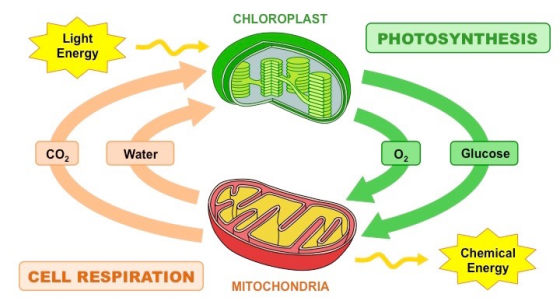
In many respects, photosynthesis and cell respiration are complementary reactions within the environment. The products of photosynthesis function as the inputs of cell respiration (oxygen and glucose) whereas the products of cell respiration function as the inputs of photosynthesis (carbon dioxide and water). Most producers (i.e. photoautotrophs) undertake both photosynthesis and cell respiration to survive. Consumers (i.e. heterotrophs) only undertake cell respiration, but will ingest or absorb photosynthetic products.
Interrelationship Between Processes
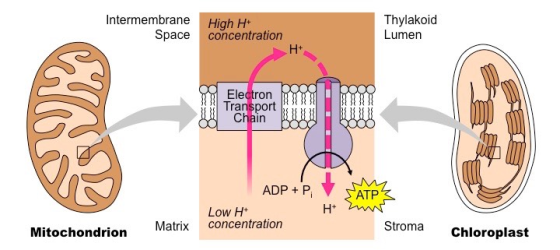
Photosynthesis and cell respiration both involve the production of chemical energy (ATP). In photosynthesis, ATP is produced via light energy (photophosphorylation) and used to make organic molecules. In cell respiration, ATP is produced by breaking down organic molecules (oxidative phosphorylation).
In both cases, the production of ATP involves an electron transport chain and chemiosmosis. In photosynthesis, electrons are donated by chlorophyll and protons accumulate within the lumen of the thylakoid. In cell respiration, electrons are donated by hydrogen carriers and protons accumulate in the intermembrane space.
Comparison of ATP Production
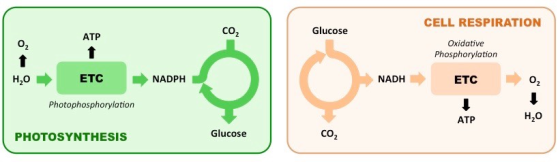
Photosynthesis and cell respiration are in many respects the reverse of one another. Photosynthesis is an anabolic process, whereas cell respiration is a catabolic process.
Photosynthesis:
- Water is broken down to oxygen to release electrons for an electron transport chain
- Electrons from the transport chain are taken up by hydrogen carriers (NADPH specifically)
- Uses the Calvin cycle to synthesise glucose (requires hydrogen carriers and carbon dioxide)
Cell Respiration:
- Uses the Krebs cycle to break down glucose (releases hydrogen carriers and carbon dioxide
- Hydrogen carriers release electrons for an electron transport chain (NADH and FADH2specifically)
- Electrons from the transport chain are taken up by oxygen (to form water).
Differences Between Photosynthesis and Cell Respiration
Add Answer to:
Compare and contrast the light reactions of
Photosynthesis to electron transport chain and chemiosmosis of
Cellular...
Compare and contrast the role of the electron transport chain in photosynthesis and respiration. *Do not...
Compare and contrast the role of the electron transport chain in photosynthesis and respiration. *Do not just list the similiarities and differences. Explain each one of them with detail and why they are different or similar to one another.*
Give a general description of what photosynthesis and cellular respiration each accomplish. Describe and compare the...
Give a general description of what photosynthesis and cellular respiration each accomplish. Describe and compare the process of chemiosmosis in photosynthesis and cellular respiration. Identify the source of the high-energy electrons that drop down the electron transport chain in photo-phosphorylation versus oxidative phosphorylation. Where is the ATP produced in each process? What is the proton-motive force?
1.A How is the light reaction and dark reaction of photosynthesis related? The products of the...
 1.A How is the light reaction and dark reaction of photosynthesis related? The products of the light reactions are used in the dark reactions O They are not related The products of the dark reactions are used in the light reactions The products of the dark reactions must be present for the light reactions to take place B. Which of the following processes of cellular respiration is CO2 released? Select all that are correct. chemiosmosis glycolysis citric acid cycle electron...
True or False: Both cellular respiration and the light dependent reactions of photosynthesis use a Hydrogen...
True or False: Both cellular respiration and the light dependent reactions of photosynthesis use a Hydrogen gradient in order to generate ATP by way of ATP synthase in the process of chemiosmosis.
compare and contrast photosynthesis and cellular respiration in plant cells with a special emphasis on energy...
compare and contrast photosynthesis and cellular respiration in plant cells with a special emphasis on energy sources, sites of reactions in cellular and subcellular structures, enzymatic chemical reactions, substrate level photophosphorylation and oxidative phosphorylation
Create a table to compare and contrast photosynthesis and cellular respiration with key components of each...
Create a table to compare and contrast photosynthesis and cellular respiration with key components of each included. Relate each component back to the processes’ formula.
27) Which one of the following best describes the electron transport chain? A) Electrons are passed...
 27) Which one of the following best describes the electron transport chain? A) Electrons are passed from one carrier to another releasing a little energy at each B) Hydrogen atoms are added to CO2 to make an energy-rich compound. C) Electrons are pumped across a membrane by active transport. D) Glucose is broken down to a three-carbon compound 28) After completion of the citric acid cycle, most of the usable energy from the one molecule is in the form of...
Which two processes make up oxidative phosphorylation? A. Chemiosmosis and ATP synthesis B. Electron transport chain...
Which two processes make up oxidative phosphorylation? A. Chemiosmosis and ATP synthesis B. Electron transport chain and chemiosmosis C. Pyruvate oxidation and electron transport chain D. Proton motive force and chemiosmosis What is the final electron acceptor in the electron transport chain? A. FADH2 B. Water C. Oxygen D. NADH
How are electrons supplied to the noncyclical electron transport pathway? a. photosynthesis b. chemiosmosis c. photolysis...
How are electrons supplied to the noncyclical electron transport pathway? a. photosynthesis b. chemiosmosis c. photolysis d. glycolysis e. ATP synthesis
Cellular respiration: The Electron Transport Chain The breakdown of glucose ends during the Krebs cydle; however,...
 Cellular respiration: The Electron Transport Chain The breakdown of glucose ends during the Krebs cydle; however, it is important to note that the energy previously contained in glucose is mostly stored in NADH and FADHz. In the last step of celular respiration, the high-energy electrons within NADH and FADH2 are passed within a set of proteins found in the inner membrane of the mitochondrion, collectively known as the electron transport chain. The electrons provide the energy to create ATP, which...
 1.A How is the light reaction and dark reaction of photosynthesis related? The products of the light reactions are used in the dark reactions O They are not related The products of the dark reactions are used in the light reactions The products of the dark reactions must be present for the light reactions to take place B. Which of the following processes of cellular respiration is CO2 released? Select all that are correct. chemiosmosis glycolysis citric acid cycle electron...
 27) Which one of the following best describes the electron transport chain? A) Electrons are passed from one carrier to another releasing a little energy at each B) Hydrogen atoms are added to CO2 to make an energy-rich compound. C) Electrons are pumped across a membrane by active transport. D) Glucose is broken down to a three-carbon compound 28) After completion of the citric acid cycle, most of the usable energy from the one molecule is in the form of...
 Cellular respiration: The Electron Transport Chain The breakdown of glucose ends during the Krebs cydle; however, it is important to note that the energy previously contained in glucose is mostly stored in NADH and FADHz. In the last step of celular respiration, the high-energy electrons within NADH and FADH2 are passed within a set of proteins found in the inner membrane of the mitochondrion, collectively known as the electron transport chain. The electrons provide the energy to create ATP, which...
Most questions answered within 3 hours.
-
Where is the error in this code sequence?
String s1 = "Hello";
String s2 = "ello";...
asked 10 months ago -
Financial data for Joel de Paris, Inc., for last year
follow:
Joel de Paris, Inc.
Balance...
asked 10 months ago -
Consider this reaction:
Al2(SO4)3 (aq)+ BaCl3
(aq) Al2Cl6 (aq)- +
3BaSO4(s) . What is the...
asked 10 months ago -
Suppose that Savneet is considering increasing her
recent random sample from 20 car rentals to 40...
asked 10 months ago -
Trucks arrive at an unloading terminal at an average rate of 120
per hour.
Trucks arrive...
asked 10 months ago -
Why are methanol and ethanol completely soluble in water while
octanol is not very little soluble....
asked 10 months ago -
A facilities manager at a university reads in a research report
that the mean amount of...
asked 10 months ago -
When the CuSO4 is rehydrated by adding water to the anhydrous
compound, is this an endothermic...
asked 10 months ago -
A ray of sunlight is passing from diamond into crown glass; the
angle of incidence is...
asked 10 months ago -
A block of mass 0.249 kg is placed on top of a light, vertical
spring of...
asked 10 months ago -
how do the kidneys compensate in the presences of acidosis
a) trigger hyperventilate
b) reserve acid...
asked 10 months ago -
Question 501 pts
The rental rate of capital to the firm increases. Which of the
following...
asked 10 months ago