describing how the nutrients of a hamburger meal is processed through the body, including digestion, absorption,...
Homework Answers
Digestion actually begins in the mouth, as the enzymes in saliva
begin to break down carbohydrate. As Hamburger is chewed, it
becomes lubricated, warmer, and easier to swallow and digest. The
teeth and mouth work together to convert each bite of hamburger
into a bolus that can readily move into the esophagus. After the
bolus is swallowed, it enters the esophagus where it continues to
be warmed and lubricated as it moves toward the stomach. The acidic
environment of the stomach and the action of gastric enzymes
convert the bolus into chyme. Pepsinogen gets activated by the
hydrochloric acid in stomach,which turns to pepsin which digest
protein.
From pancrease powerful digestive enzymes required to chemically
breakdown fats carbohydrates and Proteins are
produced.Carbohydrates tend to leave the stomach rapidly and enter
the small intestine; proteins leave the stomach less rapidly; and
fats linger there the longest.The small intestine is the part of
the intestine wherr 90% of
is the part of the intestine wherr 90% of digestion and absorption
of hamburger occurs. The nutrients are rendered small enough so
that they may pass or be transported across the epithelial cells of
gastrointestinal tract.
The food in small intestine is mixed with bile which helps in fat
digestion, pancreatic juice,and intestinal juice. Bile contains
pigments by products of red blood cells that leave with feaces.
These add several enzymes such as maltose, lactose which produces
sugar.
Most of the nutrient absorption takes place in small intestine.The
blood has now absorbed the nutrients and is carried away from the
small intestine through the Hepatic Portal Vein to the liver.ln
liver it is filtered. The toxins are removed and nutrients are
processed.After that food goes to Large intestine. The water is
reabsorbed. The food that cannot go through the villi in small
intestine (fibre) can be stored in large intestine. The food that
cannot be broken down is called feces.
Metabolism basically refers to all the chemical reactions within
the body used to produce energy. This involves a complex set of
processes that convert fuels into specialised compounds loaded with
energy. In the body, the primary final agent to produce energy is
called adenosine triphosphate (ATP). When ATP is broken down or
used by cells huge amounts of energy is released. This energy is
essential for cells to grow and divide, synthesise important
compounds, for muscles to contract and numerous other important
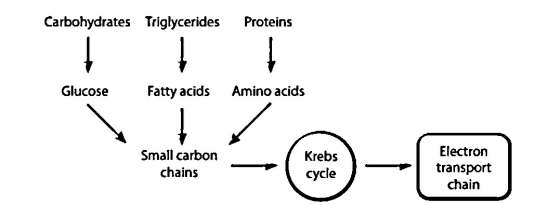
functions. Carbohydrates, proteins, and fats are digested in the
intestine, where they are broken down into their basic units:
Carbohydrates into sugars Proteins into amino acids Fats into fatty
acids and glycerol
The body uses these basic units to build substances it needs for
growth, maintenance, and activity (including other carbohydrates,
proteins, and fats).
The body has three
main types of molecules it uses for energy:
Carbohydrates: These are the sugar type compounds
in the body. Carbohydrates come from foods such as bread, cereal,
potatoes, fruits and sugar-containing foods or bevarages. When
carbohydrates are digested in the gastrointestinal system they are
broken down into smaller molecules such as glucose (a simple
sugar). The main storage sites for carbohydrates in the body are
the liver and muscles.
Lipids: This basically refers to fats (such as
cholesterol) from the diet or stored in adipose tissue (in other
words the body fat). Lipids are broken down into smaller components
called fatty acids for energy. Therefore lipids are really just
chains of fatty acids joined together.
Proteins: These make up nearly three quarters of
all the solid materials in the body. Proteins are thus the basic
structural components in the body. They are made up of smaller
agents called amino acids — considered the building blocks of
proteins. Protein is present in the diet in foods such as meat,
eggs, nuts and dairy products.
In general, carbohydrates form the main energy source for the body.
They are the most efficient at producing ATP or energy (meaning
they produce lots more ATP per amount of the fuel broken down). The
body preferentially breaks down carbohydrates first, and then fats
and finally proteins only if the other two fuels are depleted. This
is important as proteins are generally less efficient at generating
energy. In addition, proteins perform several important functions
so if they were broken down several systems could fail.
-----------------------------------XXXXXXXXXXXXXXXXXXXXXXXXXXXXXXXXXXXXXXXXXXXX---------------------------
please vote positively
Add Answer to:
describing how the nutrients of a hamburger meal is processed
through the body, including digestion, absorption,...
nces Mailings Review View Help Acrobat Be able to recall the following intormation from memory. Digestion, Absorpti...
 nces Mailings Review View Help Acrobat Be able to recall the following intormation from memory. Digestion, Absorption and Metabolism What are the organs of digestion? What is the function of each of the digestive system, including the accessory organs? What are the parts of the small intestine (and lengths) and large intestine? What is the definition of peristalsis, segmentation? What muscles are involved in mechanical digestion? What are the sphincter locations, functions and names? Test What is the function and...
Proteins contain the same 3 atoms as carbohydrates, and fat and those 3 atoms are? What...
Proteins contain the same 3 atoms as carbohydrates, and fat and those 3 atoms are? What does protein contain that carbohydrate and fat do not? Amino means? Proteins are synthesized from building blocks called? There are 20 amino acids in the body; nine are classified as: What is the difference between essential and nonessential amino acids? What is the name of the bond that unites one amino acids to one another? Discuss the difference between hydrolysis and condensation Digestion and...
Track a piece of pizza through Mary’s digestive system by drawing a simplified sketch of how...
Track a piece of pizza through Mary’s digestive system by drawing a simplified sketch of how various biological molecules are processed by Mary’s digestive system. Start with the pizza entering through the mouth and show how the various enzymes break it down into nutrients that can be absorbed within the body. For this question, you may assume that the only biological molecules in the pizza are polysaccharides, from the starch-filled dough, and lactose, from the cheese. You may ignore any...
I have been working and unable to complete the study guide please make sure it legible for me to study please panc...
 I
have been working and unable to complete the study guide please
make sure it legible for me to study please
pancreas Lives and What are the organs of digestion? Small instestine, Lives an instestine, 263 Exam 2 Review Be able to recall the following information from memory. Digestion, Absorption and Metabolism What is the function of each of the digestive system, including the accessory organs? • What are the parts of the small intestine (and lengths) and large intestine?...
I
have been working and unable to complete the study guide please
make sure it legible for me to study please
pancreas Lives and What are the organs of digestion? Small instestine, Lives an instestine, 263 Exam 2 Review Be able to recall the following information from memory. Digestion, Absorption and Metabolism What is the function of each of the digestive system, including the accessory organs? • What are the parts of the small intestine (and lengths) and large intestine?...
List and describe at least four benefits of maintaining fitness, including how physical activity conveys the...
List and describe at least four benefits of maintaining fitness, including how physical activity conveys the benefits you covered. Describe what is meant by the term cardiorespiratory conditioning. Distinguish between exercises that are aerobic and those that become anaerobic. Describe physiologically what happens during intense activity when muscle cells convert to anaerobic respiration. Alan is training for the upcoming Boston Marathon, a 26 mile run that takes place every year. In addition to physical training, Alan has adjusted his diet...
1. Identify the chemical elements of protein. How many amino acids are there that build body...
1. Identify the chemical elements of protein. How many amino acids are there that build body proteins. How many essential amino acids are there. 2. What is the difference between indispensable (essential), dispensable (nonessential), and conditionally indispensable (essential) amino acids. 3. What are the major functions of proteins in the body. 3. Describe nitrogen balance and the conditions that may result in positive and negative nitrogen balance. 4. What are complete and incomplete proteins. Identify food items that contain complete...
1) Zinc is a trace mineral that has hundreds of important functions, including a role in...
1) Zinc is a trace mineral that has hundreds of important functions, including a role in Vitamin A metabolism. Certain food sources are better absorbed than others. Deficiency is not uncommon, depending on dietary lifestyle. Fluoride is a trace mineral that integrates with calcium and phosphorus in bones and teeth. In some areas it is added to the water supply to prevent tooth decay in kids, and it is added to most toothpastes. There are two ways it is utilized...
1. Artificial flavors, colors, and commonly added to processed foods. that keep food fresh longer are...
 1. Artificial flavors, colors, and commonly added to processed foods. that keep food fresh longer are non-nutritive chemical substances is the study of the intake of nutrients into the body and how the body processes and uses these nutrients. 3. Toxicity is most likely to occur with vitamins because they are stored in tissues composed of lipids and in the liver and are not carried easily into the bloodstream. 4. The best sources of complete proteins are meats and animal...
Chapter 1: 1. What is homeostasis? 2. What are the 3 sources of energy? 3. What...
 Chapter 1: 1. What is homeostasis? 2. What are the 3 sources of energy? 3. What is the storage form of carbohydrate? Chapter 2: 1. Trace the path of a piece of bread from ingestion to absorption to elimination. 2. Describe chemical and mechanical digestion Chapter 3: 1. What are the monosacchrides? 2. Describe the digestion of carbohydrate. What enzyme is involved? 3. What is fiber? Chapter 4: 1. Describe the digestion of fat. What enzyme is involved? 2. How...
3. How might long-term antibiotic use affect the overall function of the gastrointestinal tract? What might...
 3. How might long-term antibiotic use affect the overall function of the gastrointestinal tract? What might be the consequences for nutritional status and health? or 7. 15 Or. II Hot Heeded for protein synthesis, are broken used for other purposes. The breakdown of amino acids parts: (1) the nitrogen-containing group and (2) the re nitrogen residue, as follows: group: The nitrogen portion is split off first, a process amination. This nitrogen can be converted to ammon ed in the urine...
 nces Mailings Review View Help Acrobat Be able to recall the following intormation from memory. Digestion, Absorption and Metabolism What are the organs of digestion? What is the function of each of the digestive system, including the accessory organs? What are the parts of the small intestine (and lengths) and large intestine? What is the definition of peristalsis, segmentation? What muscles are involved in mechanical digestion? What are the sphincter locations, functions and names? Test What is the function and...
 I
have been working and unable to complete the study guide please
make sure it legible for me to study please
pancreas Lives and What are the organs of digestion? Small instestine, Lives an instestine, 263 Exam 2 Review Be able to recall the following information from memory. Digestion, Absorption and Metabolism What is the function of each of the digestive system, including the accessory organs? • What are the parts of the small intestine (and lengths) and large intestine?...
I
have been working and unable to complete the study guide please
make sure it legible for me to study please
pancreas Lives and What are the organs of digestion? Small instestine, Lives an instestine, 263 Exam 2 Review Be able to recall the following information from memory. Digestion, Absorption and Metabolism What is the function of each of the digestive system, including the accessory organs? • What are the parts of the small intestine (and lengths) and large intestine?...
 1. Artificial flavors, colors, and commonly added to processed foods. that keep food fresh longer are non-nutritive chemical substances is the study of the intake of nutrients into the body and how the body processes and uses these nutrients. 3. Toxicity is most likely to occur with vitamins because they are stored in tissues composed of lipids and in the liver and are not carried easily into the bloodstream. 4. The best sources of complete proteins are meats and animal...
 Chapter 1: 1. What is homeostasis? 2. What are the 3 sources of energy? 3. What is the storage form of carbohydrate? Chapter 2: 1. Trace the path of a piece of bread from ingestion to absorption to elimination. 2. Describe chemical and mechanical digestion Chapter 3: 1. What are the monosacchrides? 2. Describe the digestion of carbohydrate. What enzyme is involved? 3. What is fiber? Chapter 4: 1. Describe the digestion of fat. What enzyme is involved? 2. How...
 3. How might long-term antibiotic use affect the overall function of the gastrointestinal tract? What might be the consequences for nutritional status and health? or 7. 15 Or. II Hot Heeded for protein synthesis, are broken used for other purposes. The breakdown of amino acids parts: (1) the nitrogen-containing group and (2) the re nitrogen residue, as follows: group: The nitrogen portion is split off first, a process amination. This nitrogen can be converted to ammon ed in the urine...
Most questions answered within 3 hours.
-
Where is the error in this code sequence?
String s1 = "Hello";
String s2 = "ello";...
asked 11 months ago -
Financial data for Joel de Paris, Inc., for last year
follow:
Joel de Paris, Inc.
Balance...
asked 11 months ago -
Consider this reaction:
Al2(SO4)3 (aq)+ BaCl3
(aq) Al2Cl6 (aq)- +
3BaSO4(s) . What is the...
asked 11 months ago -
Suppose that Savneet is considering increasing her
recent random sample from 20 car rentals to 40...
asked 11 months ago -
Trucks arrive at an unloading terminal at an average rate of 120
per hour.
Trucks arrive...
asked 11 months ago -
Why are methanol and ethanol completely soluble in water while
octanol is not very little soluble....
asked 11 months ago -
A facilities manager at a university reads in a research report
that the mean amount of...
asked 11 months ago -
When the CuSO4 is rehydrated by adding water to the anhydrous
compound, is this an endothermic...
asked 11 months ago -
A ray of sunlight is passing from diamond into crown glass; the
angle of incidence is...
asked 11 months ago -
A block of mass 0.249 kg is placed on top of a light, vertical
spring of...
asked 11 months ago -
how do the kidneys compensate in the presences of acidosis
a) trigger hyperventilate
b) reserve acid...
asked 11 months ago -
Question 501 pts
The rental rate of capital to the firm increases. Which of the
following...
asked 11 months ago