![int main() { float x = 3.14, *p = &x; int r, a = 2, b[] = {5, 6, 7}; <more code here> r = Foo(x, p, &a, b) <more code here> }](http://img.homeworklib.com/questions/1338fd80-08d3-11eb-8b47-3d2d08c35257.png?x-oss-process=image/resize,w_560)
Homework Answers
Statement 1: *y += 1.86
- p is a variable of type float *, the value that it points to(variable x) incremented by 1.86. x in the main() function will change to 5.00.
- Also, since there is no modification in local variables or parameters of foo() there is no change in its AF.
- howver, the value of x changes, since this is a local variable in main() , the AF of main will change
- Answer:
- Result : x = 5
- change in foo() AF: NO
- change in main() AF: YES
statement 2: z+= 1
- Z points to the variable a in main().
- Which means, Z holds the address of a.
- if we increment z, the address will altered.
- So, only the parameter z will change, and there is no change to anything else.
- So, only the AF of foo() will be modified
- Answer:
- Result : z = address
- change in foo() AF: yes
- change in main() AF : no
statement 3: w[1] += 20.
- w is being passed as a integer pointer.
- altering w[1] will alter the value at *(w+1). So, w will be altered in main().
- 20 will be added to w[1], and the result will be w[1] = 6+20 = 26
- Answer:
- Result : w = {5,26,7}
- change in foo() AF: no
- change in main() AF: yes
statement 4: return *z + *w
- The values in *z and *w is being added and returned.
- The value of r in the main() function stores this return values, so it will be altered.
- The return value will be 2+5 = 7
- Answer:
- Result: 7
- change in foo() AF: no
- change in main() AF: yes
Add Answer to:
Consider the following in C
int main() { float x = 3.14, *p = &x; int...
Consider the following code: 1. float foo (int a, int b, int c, int d, float...
Consider the following code: 1. float foo (int a, int b, int c, int d, float e) { 2. float e; 3. if (a == 0) { 4. return 0; 5. } 6. int x = 0; 7. if ((a==b) || ((c == d) && bug(a) )) { 8. x=1; 9. } 10. e = 1/x; 11. return e; 12. } Function bug(a) should return a value of true when passed a value of a=1. Build: • a test suite...
given the following declarations int x; float y = 99.5; write a C++ code that will...
given the following declarations int x; float y = 99.5; write a C++ code that will cast y to an int and store the result in x.
Given the following structure: 4. struct int x; float y[10]; bool z; char w } s;...
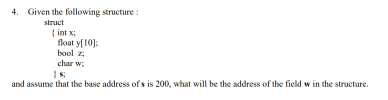 Given the following structure: 4. struct int x; float y[10]; bool z; char w } s; and assume that the base address of s is 200, what will be the address of the field w in the structure
Given the following Java code: class C { public int foo(C p) { return 1; }...
Given the following Java code: class C { public int foo(C p) { return 1; } } class D extends C { public int foo(C p) { return 2; } public int foo(D p) { return 3; } } C p = new C(); C q = new D(); D r = new D(); int i = p.foo(r); int j = q.foo(q); int k = q.foo(r); (Remember that in Java every object is accessed through a pointer and that methods...
#include <stdio.h> int main(int argc, char *argv[]) { char a, *pc, c[9]; int i, *pk, k[9]; a='...
#include <stdio.h> int main(int argc, char *argv[]) { char a, *pc, c[9]; int i, *pk, k[9]; a='z'; pc=&(c[8]); pk=&(k[0]); for (i=0; i<9; i++) { *pc=a-(char)i; pc--; *pk=(int)a-i; pk++; } return 0; }//end of main Answer the below questions with the above code Write out the memory map for the above C code in the following table. For array variables, list the address range for the entire array. Assume the memory address starts from 100, that is, the address for a...
Suppose x, y, and z are int variables and w and t are double variables. What...
Suppose x, y, and z are int variables and w and t are double variables. What value is assigned to each of these variables after the last statement executes? a) x = 17; b) y = 15; c) x = x + y / 4; d) z = x % 3 + 4; e) w = 17 / 3 + 6.5; f) t = x / 4.0 + 15 % 4 - 3.5;
b) Consider the following code. public static int f(int n) if (n == 1) return 0;...
 b) Consider the following code. public static int f(int n) if (n == 1) return 0; else if (n % 2 == 0). return g(n/2); else return g(n+1); public static int g(int n) int r = n % 3; if (r == 0) return f(n/3); else if (r == 1) return f(n+2); else return f(2 * n); // (HERE) public static void main(String[] args) { int x = 3; System.out.println(f(x)); (1) (5 points) Draw the call stack as it would...
Given the following code segment, int x = 20; int y = 7; what is the...
Given the following code segment, int x = 20; int y = 7; what is the data type of the value of the expression (x % y) ? (3 points) Question 1 options: 1) int 2) double 3) numeric 4) Error: possible loss of precision 5) Unable to be determined Question 2 (3 points) Given the following code segment, double x = 42.3; double y = 11.7; what is the data type of the value of the expression (x %...
Question 19 Given the following class: public class Swapper ( private int x; private String y...
 Question 19 Given the following class: public class Swapper ( private int x; private String y public int z; public Swapper( int a, String b, int c) ( x-a; y b; zC; public String swap() ( int temp -x; x-z z temp; return y: public String tostring() ( if (x<z) return y: else return" +x+z What would the following code output? Swapper r new Suapper( 5, "no", 10); System.out.printin( r. swap ) ): no no510 510 e 15 Question 20...
Consider the following program: # include <iostream> int x = 3, y = 5; void foo(void)...
Consider the following program: # include <iostream> int x = 3, y = 5; void foo(void) { x = x + 2; y = y + 4; } void bar(void) { int x = 10; y = y + 3; foo( ); cout << x << endl; cout << y << endl; } void baz(void) { int y = 7; bar( ); cout << y << endl; } void main( ) { baz( ); } What output does this program...
 Given the following structure: 4. struct int x; float y[10]; bool z; char w } s; and assume that the base address of s is 200, what will be the address of the field w in the structure
 b) Consider the following code. public static int f(int n) if (n == 1) return 0; else if (n % 2 == 0). return g(n/2); else return g(n+1); public static int g(int n) int r = n % 3; if (r == 0) return f(n/3); else if (r == 1) return f(n+2); else return f(2 * n); // (HERE) public static void main(String[] args) { int x = 3; System.out.println(f(x)); (1) (5 points) Draw the call stack as it would...
 Question 19 Given the following class: public class Swapper ( private int x; private String y public int z; public Swapper( int a, String b, int c) ( x-a; y b; zC; public String swap() ( int temp -x; x-z z temp; return y: public String tostring() ( if (x<z) return y: else return" +x+z What would the following code output? Swapper r new Suapper( 5, "no", 10); System.out.printin( r. swap ) ): no no510 510 e 15 Question 20...
Most questions answered within 3 hours.
-
Where is the error in this code sequence?
String s1 = "Hello";
String s2 = "ello";...
asked 10 months ago -
Financial data for Joel de Paris, Inc., for last year
follow:
Joel de Paris, Inc.
Balance...
asked 10 months ago -
Consider this reaction:
Al2(SO4)3 (aq)+ BaCl3
(aq) Al2Cl6 (aq)- +
3BaSO4(s) . What is the...
asked 10 months ago -
Suppose that Savneet is considering increasing her
recent random sample from 20 car rentals to 40...
asked 10 months ago -
Trucks arrive at an unloading terminal at an average rate of 120
per hour.
Trucks arrive...
asked 10 months ago -
Why are methanol and ethanol completely soluble in water while
octanol is not very little soluble....
asked 10 months ago -
A facilities manager at a university reads in a research report
that the mean amount of...
asked 10 months ago -
When the CuSO4 is rehydrated by adding water to the anhydrous
compound, is this an endothermic...
asked 10 months ago -
A ray of sunlight is passing from diamond into crown glass; the
angle of incidence is...
asked 10 months ago -
A block of mass 0.249 kg is placed on top of a light, vertical
spring of...
asked 10 months ago -
how do the kidneys compensate in the presences of acidosis
a) trigger hyperventilate
b) reserve acid...
asked 10 months ago -
Question 501 pts
The rental rate of capital to the firm increases. Which of the
following...
asked 10 months ago