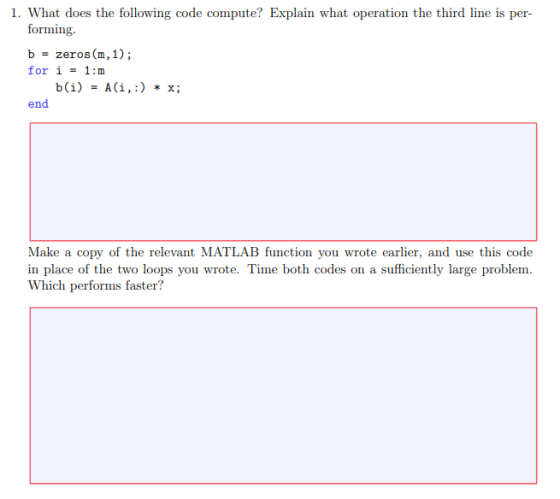
Using MATLAB please.
A = rand(m,n)
x = rand(n,1)
b = A * x
Homework Answers
`Hey,
Note: If you have any queries related to the answer please do comment. I would be very happy to resolve all your queries.
a)
Third line is basically assigning value at index i in b vector to the value ith row of A multiplied by column vector x
b)
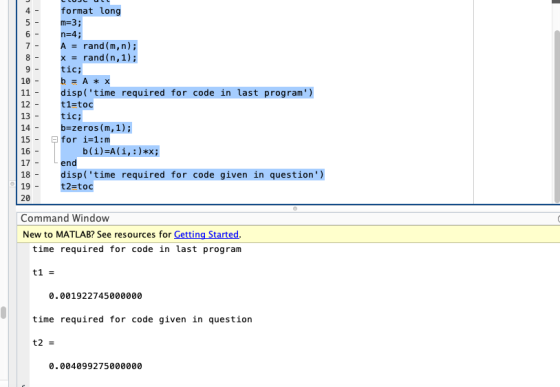
clc
clear all
close all
format long
m=3;
n=4;
A = rand(m,n);
x = rand(n,1);
tic;
b = A * x
disp('time required for code in last program')
t1=toc
tic;
b=zeros(m,1);
for i=1:m
b(i)=A(i,:)*x;
end
disp('time required for code given in question')
t2=toc
Kindly revert for any queries
Thanks.
Add Answer to:
Using MATLAB please.
A = rand(m,n)
x = rand(n,1)
b = A * x
1. What...
2. What does the following code compute? Explain what operation the third line is per- forming....
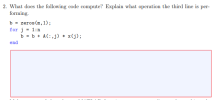 2. What does the following code compute? Explain what operation the third line is per- forming. b = zeros(m, 1); for j = 1:n b = b + AC:,j) * x(j); end
Solve using loops in MATLAB provide screenshots id. Matrix Multiplication Matrix Multiplication of an M x...
 Solve using loops in MATLAB provide screenshots
id. Matrix Multiplication Matrix Multiplication of an M x P matrix (A) with a P x N matrix (B) yields an M x N matrix (C) with the Matlab command: C=A*B Replicate this result by using three nested loops. Your code should work for any compatible matrices A, B.
Solve using loops in MATLAB provide screenshots
id. Matrix Multiplication Matrix Multiplication of an M x P matrix (A) with a P x N matrix (B) yields an M x N matrix (C) with the Matlab command: C=A*B Replicate this result by using three nested loops. Your code should work for any compatible matrices A, B.
1) a) Write MATLAB function that accepts a positive integer parameter n and returns a vector...
 1)
a) Write MATLAB function that accepts a positive integer
parameter n and returns a vector containing the values of the
integral (A) for n= 1,2,3,..., n. The function must use the
relation (B) and the value of y(1). Your function must preallocate
the array that it returns. Use for loop when writing your code.
b) Write MATLAB script that uses your function to calculate the
values of the integral (A) using the recurrence relation (B), y(n)
for n=1,2,... 19...
1)
a) Write MATLAB function that accepts a positive integer
parameter n and returns a vector containing the values of the
integral (A) for n= 1,2,3,..., n. The function must use the
relation (B) and the value of y(1). Your function must preallocate
the array that it returns. Use for loop when writing your code.
b) Write MATLAB script that uses your function to calculate the
values of the integral (A) using the recurrence relation (B), y(n)
for n=1,2,... 19...
3. Consider the following Matlab code. s-0; clear s.norm for i 1:10000 r-rand(1); % generate a uniform random, numb...
 3. Consider the following Matlab code. s-0; clear s.norm for i 1:10000 r-rand(1); % generate a uniform random, number on [0,1] S-S+(3+rr) s.norm(i)-S/i end plot( 1:10000,s.norm) % make a plot of s.norma) versus i (5 pts) What will the plot look like? (10 pts) Will the function/vector s.norm(n) converge to something as n gets large? If so, what? If not, why not? Justify your answer. (5 pts) If we were to run this code multiple times - overlaying the plots...
matlab Problem 6: The Matlab command 'randn(m,n) produces an m x n matrix of random numbers...
 matlab
Problem 6: The Matlab command 'randn(m,n) produces an m x n matrix of random numbers that are a realization of a white random process with some probability density function. Moreover, the Matlab command 'rand(m,n)' produces an mxn matrix of random numbers between 0 and 1 that are a realization of a white random process with some probability density function. a) Use Matlab to do the following steps: 1) Let u-randn (10000,1); and plot u. 2) Use the command 'mean(u)'...
matlab
Problem 6: The Matlab command 'randn(m,n) produces an m x n matrix of random numbers that are a realization of a white random process with some probability density function. Moreover, the Matlab command 'rand(m,n)' produces an mxn matrix of random numbers between 0 and 1 that are a realization of a white random process with some probability density function. a) Use Matlab to do the following steps: 1) Let u-randn (10000,1); and plot u. 2) Use the command 'mean(u)'...
What’s the answer for (a) and (b) using Matlab? Problem 1: Consider the following sequences x(n)...
 What’s the answer for (a) and (b) using Matlab?
Problem 1: Consider the following sequences x(n) = {-4, 5, 1,-2,-3, 0, 2, 45),-35ns4 y(n) = {6,-3,-1, 0, 8, 7,-2).-Isn 5 n(n) = {3, 2, 2,-1, 0,-2,5), 2sns8 The sample values of each of the above sequences outside the ranges specified are all zeros. Generate and plot the following sequences using MATLAB functions (c.g SIGSHIFT, SIGADD, fold, shift, etc.): (a) u(n) = x(n) + y(n-2) (b) s(n) =-y(n) + w(n +...
What’s the answer for (a) and (b) using Matlab?
Problem 1: Consider the following sequences x(n) = {-4, 5, 1,-2,-3, 0, 2, 45),-35ns4 y(n) = {6,-3,-1, 0, 8, 7,-2).-Isn 5 n(n) = {3, 2, 2,-1, 0,-2,5), 2sns8 The sample values of each of the above sequences outside the ranges specified are all zeros. Generate and plot the following sequences using MATLAB functions (c.g SIGSHIFT, SIGADD, fold, shift, etc.): (a) u(n) = x(n) + y(n-2) (b) s(n) =-y(n) + w(n +...
on matlab (1) Matrices are entered row-wise. Row commas. Enter 1 2 3 (2) Element A,...
 on matlab
(1) Matrices are entered row-wise. Row commas. Enter 1 2 3 (2) Element A, of matrix A is accesser (3) Correcting an entry is easy to (4) Any submatrix of Ais obtained by d row wise. Rows are separated by semicolons and columns are separated by spaces ner A l 23:45 6. B and hit the return/enter kry matrix A is accessed as A Enter and hit the returnerter key an entry is easy through indesine Enter 19...
on matlab
(1) Matrices are entered row-wise. Row commas. Enter 1 2 3 (2) Element A, of matrix A is accesser (3) Correcting an entry is easy to (4) Any submatrix of Ais obtained by d row wise. Rows are separated by semicolons and columns are separated by spaces ner A l 23:45 6. B and hit the return/enter kry matrix A is accessed as A Enter and hit the returnerter key an entry is easy through indesine Enter 19...
Implement the following equation using matlab code N-1 1 Em N x(mN) i-0 N-1 1 Em N x(mN) i-0
 Implement the following equation using matlab code
N-1 1 Em N x(mN) i-0
N-1 1 Em N x(mN) i-0
Implement the following equation using matlab code
N-1 1 Em N x(mN) i-0
N-1 1 Em N x(mN) i-0
************PLEASE INCLUDE MATLAB CODES*********** Find y(n) by Performing graphical convolution of the following sequences and confirm...
************PLEASE INCLUDE MATLAB CODES*********** Find y(n) by Performing graphical convolution of the following sequences and confirm your results via Matlab (Include Matlab code and graphics). Bold sample represent the sample value at n = 0 a. x(n) = {1, 2, 1, 1}, h(n) = {1, -1, 0, 0, 1, 1} b. x(n) = {1, 1, 0, 1, 1}, h(n) = {1, 2, 3, 2, 1}
Matlab Question. Please be detailed Write a user-defined function that performs LU decomposition (using Gauss Elimination...
Matlab Question. Please be detailed Write a user-defined function that performs LU decomposition (using Gauss Elimination without partial pivoting) of a square matrix. Do not use built-in MATLAB functions lu( ), inv(), \, linsolve(). Matrices (in [A]*{x}={B} form) A=[15 -3 -1; -3 15 -6; -4 -1 12] B=[3800; 1200; 2350] Given code lines: function[L,U]=myLUFact_username(A) [m,n]=size(A); %numbers of rows/comlumns of A assert(m==n, 'A should be a square matrix');
 2. What does the following code compute? Explain what operation the third line is per- forming. b = zeros(m, 1); for j = 1:n b = b + AC:,j) * x(j); end
 Solve using loops in MATLAB provide screenshots
id. Matrix Multiplication Matrix Multiplication of an M x P matrix (A) with a P x N matrix (B) yields an M x N matrix (C) with the Matlab command: C=A*B Replicate this result by using three nested loops. Your code should work for any compatible matrices A, B.
Solve using loops in MATLAB provide screenshots
id. Matrix Multiplication Matrix Multiplication of an M x P matrix (A) with a P x N matrix (B) yields an M x N matrix (C) with the Matlab command: C=A*B Replicate this result by using three nested loops. Your code should work for any compatible matrices A, B.
 1)
a) Write MATLAB function that accepts a positive integer
parameter n and returns a vector containing the values of the
integral (A) for n= 1,2,3,..., n. The function must use the
relation (B) and the value of y(1). Your function must preallocate
the array that it returns. Use for loop when writing your code.
b) Write MATLAB script that uses your function to calculate the
values of the integral (A) using the recurrence relation (B), y(n)
for n=1,2,... 19...
1)
a) Write MATLAB function that accepts a positive integer
parameter n and returns a vector containing the values of the
integral (A) for n= 1,2,3,..., n. The function must use the
relation (B) and the value of y(1). Your function must preallocate
the array that it returns. Use for loop when writing your code.
b) Write MATLAB script that uses your function to calculate the
values of the integral (A) using the recurrence relation (B), y(n)
for n=1,2,... 19...
 3. Consider the following Matlab code. s-0; clear s.norm for i 1:10000 r-rand(1); % generate a uniform random, number on [0,1] S-S+(3+rr) s.norm(i)-S/i end plot( 1:10000,s.norm) % make a plot of s.norma) versus i (5 pts) What will the plot look like? (10 pts) Will the function/vector s.norm(n) converge to something as n gets large? If so, what? If not, why not? Justify your answer. (5 pts) If we were to run this code multiple times - overlaying the plots...
 matlab
Problem 6: The Matlab command 'randn(m,n) produces an m x n matrix of random numbers that are a realization of a white random process with some probability density function. Moreover, the Matlab command 'rand(m,n)' produces an mxn matrix of random numbers between 0 and 1 that are a realization of a white random process with some probability density function. a) Use Matlab to do the following steps: 1) Let u-randn (10000,1); and plot u. 2) Use the command 'mean(u)'...
matlab
Problem 6: The Matlab command 'randn(m,n) produces an m x n matrix of random numbers that are a realization of a white random process with some probability density function. Moreover, the Matlab command 'rand(m,n)' produces an mxn matrix of random numbers between 0 and 1 that are a realization of a white random process with some probability density function. a) Use Matlab to do the following steps: 1) Let u-randn (10000,1); and plot u. 2) Use the command 'mean(u)'...
 What’s the answer for (a) and (b) using Matlab?
Problem 1: Consider the following sequences x(n) = {-4, 5, 1,-2,-3, 0, 2, 45),-35ns4 y(n) = {6,-3,-1, 0, 8, 7,-2).-Isn 5 n(n) = {3, 2, 2,-1, 0,-2,5), 2sns8 The sample values of each of the above sequences outside the ranges specified are all zeros. Generate and plot the following sequences using MATLAB functions (c.g SIGSHIFT, SIGADD, fold, shift, etc.): (a) u(n) = x(n) + y(n-2) (b) s(n) =-y(n) + w(n +...
What’s the answer for (a) and (b) using Matlab?
Problem 1: Consider the following sequences x(n) = {-4, 5, 1,-2,-3, 0, 2, 45),-35ns4 y(n) = {6,-3,-1, 0, 8, 7,-2).-Isn 5 n(n) = {3, 2, 2,-1, 0,-2,5), 2sns8 The sample values of each of the above sequences outside the ranges specified are all zeros. Generate and plot the following sequences using MATLAB functions (c.g SIGSHIFT, SIGADD, fold, shift, etc.): (a) u(n) = x(n) + y(n-2) (b) s(n) =-y(n) + w(n +...
 on matlab
(1) Matrices are entered row-wise. Row commas. Enter 1 2 3 (2) Element A, of matrix A is accesser (3) Correcting an entry is easy to (4) Any submatrix of Ais obtained by d row wise. Rows are separated by semicolons and columns are separated by spaces ner A l 23:45 6. B and hit the return/enter kry matrix A is accessed as A Enter and hit the returnerter key an entry is easy through indesine Enter 19...
on matlab
(1) Matrices are entered row-wise. Row commas. Enter 1 2 3 (2) Element A, of matrix A is accesser (3) Correcting an entry is easy to (4) Any submatrix of Ais obtained by d row wise. Rows are separated by semicolons and columns are separated by spaces ner A l 23:45 6. B and hit the return/enter kry matrix A is accessed as A Enter and hit the returnerter key an entry is easy through indesine Enter 19...
 Implement the following equation using matlab code
N-1 1 Em N x(mN) i-0
N-1 1 Em N x(mN) i-0
Implement the following equation using matlab code
N-1 1 Em N x(mN) i-0
N-1 1 Em N x(mN) i-0
Most questions answered within 3 hours.
-
Where is the error in this code sequence?
String s1 = "Hello";
String s2 = "ello";...
asked 10 months ago -
Financial data for Joel de Paris, Inc., for last year
follow:
Joel de Paris, Inc.
Balance...
asked 10 months ago -
Consider this reaction:
Al2(SO4)3 (aq)+ BaCl3
(aq) Al2Cl6 (aq)- +
3BaSO4(s) . What is the...
asked 10 months ago -
Suppose that Savneet is considering increasing her
recent random sample from 20 car rentals to 40...
asked 10 months ago -
Trucks arrive at an unloading terminal at an average rate of 120
per hour.
Trucks arrive...
asked 10 months ago -
Why are methanol and ethanol completely soluble in water while
octanol is not very little soluble....
asked 10 months ago -
A facilities manager at a university reads in a research report
that the mean amount of...
asked 10 months ago -
When the CuSO4 is rehydrated by adding water to the anhydrous
compound, is this an endothermic...
asked 10 months ago -
A ray of sunlight is passing from diamond into crown glass; the
angle of incidence is...
asked 10 months ago -
A block of mass 0.249 kg is placed on top of a light, vertical
spring of...
asked 10 months ago -
how do the kidneys compensate in the presences of acidosis
a) trigger hyperventilate
b) reserve acid...
asked 10 months ago -
Question 501 pts
The rental rate of capital to the firm increases. Which of the
following...
asked 10 months ago