
Homework Answers
g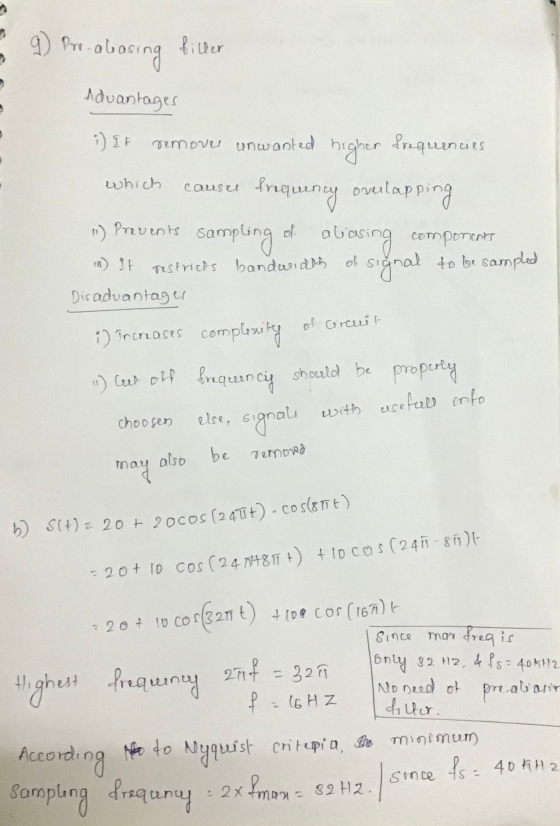
Add Answer to:
In all what follows, the sampling frequency is fixed to fs = 40KHz. Part 2 -...
A Digital Signal Processing system is taking at its input the following analogue signal s(t); s(t)...
 A Digital Signal Processing system is taking at its input the following analogue signal s(t); s(t) - 20+ 20 cos(24xt)cos(xt), Where time t is expressed in ms. Part 1 - Setting the sampling frequency: (11 Marks) As a start, the system comprises only a sampler and an ideal analogue reconstructor as follows: w(t) s(t) Sampler Analogue Reconstructor s,(t) Figure a) Find the frequency spectrum S(t) of s(t) and deduce its bandwidth. You may directly use the table provided at the...
Consider a sampler which samples the continuous-time input signal x(t) at a sampling frequency fs =...
 Consider a sampler which samples the continuous-time input signal x(t) at a sampling frequency fs = 8000 Hz and produces at its output a sampled discrete-time signal x$(t) = x(nTs), where To = 1/fs is the sampling period. If the sampled signal is passed through a unity-gain lowpass filter with cutoff frequency of fs/2, sketch the magnitude spectrum of the resulting signal for the following input signals: (a) x(t) = cos(6000nt). (b) x(t) = cos(12000nt). (c) x(t) = cos(18000nt).
3 Sampling and aliasing The aim of this part is to demonstrate the effects of aliasing...
 3 Sampling and aliasing The aim of this part is to demonstrate the effects of aliasing arising from improper sampling. A given analog signal z(t) is sampled at a rate fs = 1/T, the resulting samples (nT) are then reconstructed by an ideal reconstructor into the analog signal rat). Improper choice of f, will result in different signals ra(t) + (t), even though they agree at their sample values, that is, tanT) = x(nT). The procedure is illustrated by the...
number 2 ECE 300 Continuous-Time Signals and Systems H(jø π/2 Plot the spectrum Z (jø) of the filtered input signal z()...
 number 2
ECE 300 Continuous-Time Signals and Systems H(jø π/2 Plot the spectrum Z (jø) of the filtered input signal z(), the spectrum Z, (jo) of the sampled signal z.(t), and the spectrum Y(ja) of the reconstructed signal y(t). Show clearly how the output spectrum Y (ja) differs from the original spectrum G(jo) C. Which system, A or B, produces less distortion between the input g(t) and the output y(4) or ()? Explain. You can measure distortion by finding the...
number 2
ECE 300 Continuous-Time Signals and Systems H(jø π/2 Plot the spectrum Z (jø) of the filtered input signal z(), the spectrum Z, (jo) of the sampled signal z.(t), and the spectrum Y(ja) of the reconstructed signal y(t). Show clearly how the output spectrum Y (ja) differs from the original spectrum G(jo) C. Which system, A or B, produces less distortion between the input g(t) and the output y(4) or ()? Explain. You can measure distortion by finding the...
3.(30 points) Pulse Code Modulation A-to-D Ideal Lowf Pass Filter xit)- #x) cos(2rfet) (10 points...
 3.(30 points) Pulse Code Modulation A-to-D Ideal Lowf Pass Filter xit)- #x) cos(2rfet) (10 points) Consider the system in the above figure. The ideal low pass filter is one which has a brick-wall frequency response (or an ideal sinc function for its impulse response). If the bandwidth of the ideal low pass filter is IkHz and B 2kHz is the bandwidth of a bandpass signal x(t) that is centered at fo 19700Hz, determine the minimum sampling rate fs to avoid...
Problems: 1. Consider the system shown below. Let the input signal to the Ideal Sampler to be: s(...
 just looking for #2, 3, and 4
Problems: 1. Consider the system shown below. Let the input signal to the Ideal Sampler to be: s(t) = 2 cos(2m50t) + 4cos(2m100t) a. (10 points) Determine S(f) and plot it b. (20 points) Let the sampling rate to be: fs 300 samples/sec. Plot the spectrum of the Ideal sample, that is plot S8(f) c. Let the sampling rate to be: fs 175 samples/sec. i. (30 points) Plot S8(f) ii. (10 points) Let...
just looking for #2, 3, and 4
Problems: 1. Consider the system shown below. Let the input signal to the Ideal Sampler to be: s(t) = 2 cos(2m50t) + 4cos(2m100t) a. (10 points) Determine S(f) and plot it b. (20 points) Let the sampling rate to be: fs 300 samples/sec. Plot the spectrum of the Ideal sample, that is plot S8(f) c. Let the sampling rate to be: fs 175 samples/sec. i. (30 points) Plot S8(f) ii. (10 points) Let...
Program from problem 1: (Using MATLAB) % Sampling frequency and sampling period fs = 10000; ts...
 Program from problem 1: (Using MATLAB)
% Sampling frequency and sampling period
fs = 10000;
ts = 1/fs;
% Number of samples, assume 1000 samples
l = 1000;
t = 0:1:l-1;
t = t.*ts; % Convert the sample index into time for generation and
plotting of signal
% Frequency and amplitude of the sensor
f1 = 110;
a1 = 1.0;
% Frequency and amplitude of the power grid noise
f2 = 60;
a2 = 0.7;
% Generating the sinusoidal waves...
Program from problem 1: (Using MATLAB)
% Sampling frequency and sampling period
fs = 10000;
ts = 1/fs;
% Number of samples, assume 1000 samples
l = 1000;
t = 0:1:l-1;
t = t.*ts; % Convert the sample index into time for generation and
plotting of signal
% Frequency and amplitude of the sensor
f1 = 110;
a1 = 1.0;
% Frequency and amplitude of the power grid noise
f2 = 60;
a2 = 0.7;
% Generating the sinusoidal waves...
2. Consider the signal f(t) = 20 cos(5t) + cos(9t) sin(5t) - 7 (a) What is the highest angular frequency present in thi...
 2. Consider the signal f(t) = 20 cos(5t) + cos(9t) sin(5t) - 7 (a) What is the highest angular frequency present in this signal? What is the highest numerical frequency present in this signal? (b) What is the Nyquist frequency? rate for this signal? Did you use the angular or the numerical (c) If you sample this signal with sampling period T, which values of T may you choose to be in accordance with the Nyquist rate? Choose and fix...
Part A:- Synthesising a Discrete Signal using Matlab: Using a sampling frequency of 8000 Hz, determine...
 Part A:- Synthesising a Discrete Signal using Matlab: Using a sampling frequency of 8000 Hz, determine the discrete signal, x[n] that is obtained from sampling a 1000 Hz sine wave, with a peak magnitude of 0.8. (that is, x(t)-0.8cos(2rtft)). Determine an equation for xin] in terms of 'n' and then create the signal in Matlab. (Remember in this case 'n' is your independent variable not t'.) Play the x[n] signal through the PC soundcard using the 'sound' command in Matlab....
matlab help, please my code is here: %% exercise2 %a Fs = 8000; % sampling frequency tn = 0:1/Fs:0.005; % here, bit dura...
 matlab help, please
my code is here:
%% exercise2
%a
Fs = 8000; % sampling frequency
tn = 0:1/Fs:0.005; % here, bit duration is 0.005s instead of
1/300s
phi1 = 0; phi0 = 0; % phases of the sinusoid
x1 = cos(2*pi*1650*tn + phi1); % tone for binary 1
x0 = cos(2*pi*1850*tn + phi0); % tone for binary 0
xx = [x1, x0]; % FSK signal for ¡°1,0¡±
tt = [tn, tn + 0.005]; % time
figure(1)
plot(tt, xx); %...
matlab help, please
my code is here:
%% exercise2
%a
Fs = 8000; % sampling frequency
tn = 0:1/Fs:0.005; % here, bit duration is 0.005s instead of
1/300s
phi1 = 0; phi0 = 0; % phases of the sinusoid
x1 = cos(2*pi*1650*tn + phi1); % tone for binary 1
x0 = cos(2*pi*1850*tn + phi0); % tone for binary 0
xx = [x1, x0]; % FSK signal for ¡°1,0¡±
tt = [tn, tn + 0.005]; % time
figure(1)
plot(tt, xx); %...
 A Digital Signal Processing system is taking at its input the following analogue signal s(t); s(t) - 20+ 20 cos(24xt)cos(xt), Where time t is expressed in ms. Part 1 - Setting the sampling frequency: (11 Marks) As a start, the system comprises only a sampler and an ideal analogue reconstructor as follows: w(t) s(t) Sampler Analogue Reconstructor s,(t) Figure a) Find the frequency spectrum S(t) of s(t) and deduce its bandwidth. You may directly use the table provided at the...
 Consider a sampler which samples the continuous-time input signal x(t) at a sampling frequency fs = 8000 Hz and produces at its output a sampled discrete-time signal x$(t) = x(nTs), where To = 1/fs is the sampling period. If the sampled signal is passed through a unity-gain lowpass filter with cutoff frequency of fs/2, sketch the magnitude spectrum of the resulting signal for the following input signals: (a) x(t) = cos(6000nt). (b) x(t) = cos(12000nt). (c) x(t) = cos(18000nt).
 3 Sampling and aliasing The aim of this part is to demonstrate the effects of aliasing arising from improper sampling. A given analog signal z(t) is sampled at a rate fs = 1/T, the resulting samples (nT) are then reconstructed by an ideal reconstructor into the analog signal rat). Improper choice of f, will result in different signals ra(t) + (t), even though they agree at their sample values, that is, tanT) = x(nT). The procedure is illustrated by the...
 number 2
ECE 300 Continuous-Time Signals and Systems H(jø π/2 Plot the spectrum Z (jø) of the filtered input signal z(), the spectrum Z, (jo) of the sampled signal z.(t), and the spectrum Y(ja) of the reconstructed signal y(t). Show clearly how the output spectrum Y (ja) differs from the original spectrum G(jo) C. Which system, A or B, produces less distortion between the input g(t) and the output y(4) or ()? Explain. You can measure distortion by finding the...
number 2
ECE 300 Continuous-Time Signals and Systems H(jø π/2 Plot the spectrum Z (jø) of the filtered input signal z(), the spectrum Z, (jo) of the sampled signal z.(t), and the spectrum Y(ja) of the reconstructed signal y(t). Show clearly how the output spectrum Y (ja) differs from the original spectrum G(jo) C. Which system, A or B, produces less distortion between the input g(t) and the output y(4) or ()? Explain. You can measure distortion by finding the...
 3.(30 points) Pulse Code Modulation A-to-D Ideal Lowf Pass Filter xit)- #x) cos(2rfet) (10 points) Consider the system in the above figure. The ideal low pass filter is one which has a brick-wall frequency response (or an ideal sinc function for its impulse response). If the bandwidth of the ideal low pass filter is IkHz and B 2kHz is the bandwidth of a bandpass signal x(t) that is centered at fo 19700Hz, determine the minimum sampling rate fs to avoid...
 just looking for #2, 3, and 4
Problems: 1. Consider the system shown below. Let the input signal to the Ideal Sampler to be: s(t) = 2 cos(2m50t) + 4cos(2m100t) a. (10 points) Determine S(f) and plot it b. (20 points) Let the sampling rate to be: fs 300 samples/sec. Plot the spectrum of the Ideal sample, that is plot S8(f) c. Let the sampling rate to be: fs 175 samples/sec. i. (30 points) Plot S8(f) ii. (10 points) Let...
just looking for #2, 3, and 4
Problems: 1. Consider the system shown below. Let the input signal to the Ideal Sampler to be: s(t) = 2 cos(2m50t) + 4cos(2m100t) a. (10 points) Determine S(f) and plot it b. (20 points) Let the sampling rate to be: fs 300 samples/sec. Plot the spectrum of the Ideal sample, that is plot S8(f) c. Let the sampling rate to be: fs 175 samples/sec. i. (30 points) Plot S8(f) ii. (10 points) Let...
 Program from problem 1: (Using MATLAB)
% Sampling frequency and sampling period
fs = 10000;
ts = 1/fs;
% Number of samples, assume 1000 samples
l = 1000;
t = 0:1:l-1;
t = t.*ts; % Convert the sample index into time for generation and
plotting of signal
% Frequency and amplitude of the sensor
f1 = 110;
a1 = 1.0;
% Frequency and amplitude of the power grid noise
f2 = 60;
a2 = 0.7;
% Generating the sinusoidal waves...
Program from problem 1: (Using MATLAB)
% Sampling frequency and sampling period
fs = 10000;
ts = 1/fs;
% Number of samples, assume 1000 samples
l = 1000;
t = 0:1:l-1;
t = t.*ts; % Convert the sample index into time for generation and
plotting of signal
% Frequency and amplitude of the sensor
f1 = 110;
a1 = 1.0;
% Frequency and amplitude of the power grid noise
f2 = 60;
a2 = 0.7;
% Generating the sinusoidal waves...
 2. Consider the signal f(t) = 20 cos(5t) + cos(9t) sin(5t) - 7 (a) What is the highest angular frequency present in this signal? What is the highest numerical frequency present in this signal? (b) What is the Nyquist frequency? rate for this signal? Did you use the angular or the numerical (c) If you sample this signal with sampling period T, which values of T may you choose to be in accordance with the Nyquist rate? Choose and fix...
 Part A:- Synthesising a Discrete Signal using Matlab: Using a sampling frequency of 8000 Hz, determine the discrete signal, x[n] that is obtained from sampling a 1000 Hz sine wave, with a peak magnitude of 0.8. (that is, x(t)-0.8cos(2rtft)). Determine an equation for xin] in terms of 'n' and then create the signal in Matlab. (Remember in this case 'n' is your independent variable not t'.) Play the x[n] signal through the PC soundcard using the 'sound' command in Matlab....
 matlab help, please
my code is here:
%% exercise2
%a
Fs = 8000; % sampling frequency
tn = 0:1/Fs:0.005; % here, bit duration is 0.005s instead of
1/300s
phi1 = 0; phi0 = 0; % phases of the sinusoid
x1 = cos(2*pi*1650*tn + phi1); % tone for binary 1
x0 = cos(2*pi*1850*tn + phi0); % tone for binary 0
xx = [x1, x0]; % FSK signal for ¡°1,0¡±
tt = [tn, tn + 0.005]; % time
figure(1)
plot(tt, xx); %...
matlab help, please
my code is here:
%% exercise2
%a
Fs = 8000; % sampling frequency
tn = 0:1/Fs:0.005; % here, bit duration is 0.005s instead of
1/300s
phi1 = 0; phi0 = 0; % phases of the sinusoid
x1 = cos(2*pi*1650*tn + phi1); % tone for binary 1
x0 = cos(2*pi*1850*tn + phi0); % tone for binary 0
xx = [x1, x0]; % FSK signal for ¡°1,0¡±
tt = [tn, tn + 0.005]; % time
figure(1)
plot(tt, xx); %...
Most questions answered within 3 hours.
-
Where is the error in this code sequence?
String s1 = "Hello";
String s2 = "ello";...
asked 10 months ago -
Financial data for Joel de Paris, Inc., for last year
follow:
Joel de Paris, Inc.
Balance...
asked 10 months ago -
Consider this reaction:
Al2(SO4)3 (aq)+ BaCl3
(aq) Al2Cl6 (aq)- +
3BaSO4(s) . What is the...
asked 10 months ago -
Suppose that Savneet is considering increasing her
recent random sample from 20 car rentals to 40...
asked 10 months ago -
Trucks arrive at an unloading terminal at an average rate of 120
per hour.
Trucks arrive...
asked 10 months ago -
Why are methanol and ethanol completely soluble in water while
octanol is not very little soluble....
asked 10 months ago -
A facilities manager at a university reads in a research report
that the mean amount of...
asked 10 months ago -
When the CuSO4 is rehydrated by adding water to the anhydrous
compound, is this an endothermic...
asked 10 months ago -
A ray of sunlight is passing from diamond into crown glass; the
angle of incidence is...
asked 10 months ago -
A block of mass 0.249 kg is placed on top of a light, vertical
spring of...
asked 10 months ago -
how do the kidneys compensate in the presences of acidosis
a) trigger hyperventilate
b) reserve acid...
asked 10 months ago -
Question 501 pts
The rental rate of capital to the firm increases. Which of the
following...
asked 10 months ago