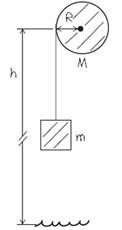
A stone is suspended from the free end of a wire that is wrapped around the...
A stone is suspended from the free end of a wire that is wrapped
around the outer rim of a pulley, as shown in the figure (see the
figure (Figure 1) ). The pulley is a uniform disk with mass 10.0kg
and radius 47.0cm and turns on frictionless bearings. You measure
that the stone travels a distance 12.3m during a time interval of
3.20s starting from rest.
A.
B.
Homework Answers
The concepts used to solve this problem are kinematic equation of motion, torque, andtension in the wire.
Initially, use the kinematic equation which relates the distance and acceleration to find the acceleration of the stone.
Then, use the torque on the pulley to find the tension in the wire.
Finally, use the net forces on the stone to find the mass of the stone.
The relationship between the distance and accelerationis as follows:

Here, the initial velocity is  , the displacement is s, the time is
  , and the acceleration is
  .
.
Newton’s second law states that the external applied force on an object is equal to the rate of change of momentum of the object.
The expression for the force from Newton’s second lawis as follows:

Here, the force is  and the mass is
  .
.
The expression for the torque on the pulley in terms of tension and distance is as follows:

Here, the torque is  , the tension is
  , and the distance is
  .
.
The expression for the torque on the pulley in terms of moment of inertia is as follows:

Here, the moment of inertia is  and the angular acceleration is
  .
.
The expression for the moment of inertia of the disk is as follows:

Here, the mass of the disk is  and the radius is
  .
.
The expression for the angular acceleration is as follows:

(A)
The relationship between the distance and acceleration is as follows:
Here, the initial velocity is zero. Then, the above equation will become as follows:

Rearrange the above expression for  .
.

Substitute  for
for  and
and  for
for  .
.

The expression for the torque on the pulley in terms of tension and distance is as follows:
…… (1)
The expression for the torque on the pulley in terms of moment of inertia is as follows:
…… (2)
CompareEquations(1) and (2).
 …… (3)
The expression for the moment of inertia of the disk is as follows:
The expression for the angular acceleration is as follows:
Substitute  for
for  and
and  for
for  in Equation (3).

Rearrange the above equation for  .
.

Substitute  for
for  and
and  for
for  .
.

The expression for net force on the stone is as follows:
 …… (4)
Here, the acceleration due to gravity is  .
.
The expression for the force from Newton’s second law is as follows:
…… (5)
Compare expressions (4) and (5).

Rearrange the above expression for  .
.

Substitute  for
for  ,
,  for
for  , and
, and  for .
for .

(B)
The expression for the tension in the wire is as follows:
Substitute for and  for .
for .

Therefore, the tension in the wire is  .
.
Thus, the mass of the stone is  .
.
Thus, the tension in the wire is  .
.
Add Answer to:
A stone is suspended from the free end of a wire that is wrapped
around the...
A stone is suspended from the free end of a wire that is wrapped around the...
A stone is suspended from the free end of a wire that is wrapped around the outer rim of a pulley, similar to what is shown in (Figure 1) . The pulley is a uniform disk with mass 13.0 kg and radius 39.0 cm and turns on frictionless bearings. You measure that the stone travels a distance 12.8 m during a time interval of 3.50 s starting from rest. a) Find the mass of the stone. b) Find the tension...
A stone with mass m is suspended from the free end of a wire that is wrapped around the outer rim of a pulley, similar...
 A stone with mass m is suspended from the free end of a wire
that is wrapped around the
outer rim of a pulley, similar to what is shown in the figure. The
pulley is a uniform disk with mass
M and radius R and turns on frictionless bearings. You measure that
the stone travels a distance h
during a time interval of t starting from rest.
A) Find the mass of the stone in terms of m, M, h...
A stone with mass m is suspended from the free end of a wire
that is wrapped around the
outer rim of a pulley, similar to what is shown in the figure. The
pulley is a uniform disk with mass
M and radius R and turns on frictionless bearings. You measure that
the stone travels a distance h
during a time interval of t starting from rest.
A) Find the mass of the stone in terms of m, M, h...
Answer गष्टट se.c Questions 4-8: A stone of mass, m 2kg is suspended from the free...
 Answer गष्टट se.c Questions 4-8: A stone of mass, m 2kg is suspended from the free end of a wire that is wrapped around the outer rim of a pulley similar to what is shown in the figure. The pulley is a uniform disk with unknown moment of inertial I and its radius R = 2 cm and turns on frictionless bearings. The stone was released from rest and it travels a height, h=1 m and its velocity is found...
A 2.00-kg stone is tied to a thin, light wire wrapped around the outer edge of...
A 2.00-kg stone is tied to a thin, light wire wrapped around the outer edge of the uniform 10.0-kg cylindrical pulley shown in the figure below (Figure 1). The inner diameter of the pulley is 60.0 cm, while the outer diameter is 1.00 m. The system is released from rest, and there is no friction at the axle of the pulley. (A) Find the acceleration of the stone. (m/s2 ) (B) Find the tension in the wire. (N) (C) Find...
A thin, light wire is wrapped around the rim of a wheel, as shown in the...
A thin, light wire is wrapped around the rim of a wheel, as shown in the following figure. The wheel rotates without friction about a stationary horizontal axis that passes through the center of the wheel. The wheel is a uniform disk with radius 0.270 m. An object of mass 4.40 kg is suspended from the free end of the wire. The system is released from rest and the suspended object descends with constant acceleration. (Figure 1) If the suspended...
A frictionless pulley has the shape of a uniform solid disk of mass 2.20 kg and...
 A frictionless pulley has the shape of a uniform solid disk of
mass 2.20 kg and radius 10 cm. A 1.90 kg stone is attached to a
very light wire that is wrapped around the rim of the pulley (the
figure (Figure 1) ), and the system is released from rest.
a)How far must the stone fall so that the pulley has 6.30 J of
kinetic energy?
h =_____________m
b)What percent of the total kinetic energy does the pulley
have?...
A frictionless pulley has the shape of a uniform solid disk of
mass 2.20 kg and radius 10 cm. A 1.90 kg stone is attached to a
very light wire that is wrapped around the rim of the pulley (the
figure (Figure 1) ), and the system is released from rest.
a)How far must the stone fall so that the pulley has 6.30 J of
kinetic energy?
h =_____________m
b)What percent of the total kinetic energy does the pulley
have?...
A bucket of water of mass 15.7 kg is suspended by a rope wrapped around a...
A bucket of water of mass 15.7 kg is suspended by a rope wrapped around a windlass, that is a solid cylinder with diameter 0.280 m with mass 11.4 kg . The cylinder pivots on a frictionless axle through its center. The bucket is released from rest at the top of a well and falls a distance 10.6 m to the water. You can ignore the weight of the rope. Part A What is the tension in the rope while...
A frictionless pulley has the shape of a uniform solid disk of mass 2.40 kg and radius 10 cm
 A frictionless pulley has the shape of a uniform solid disk of mass 2.40 kg and radius 10 cm. A 1.20 kg stone is attached to a very light wire that is wrapped around the rim of the pulley (the figure ), and the system is released from rest. Part A How far must the stone fall so that the pulley has 4.80 J of kinetic energy? Part B What percent of the total kinetic energy does the pulley have?
A frictionless pulley has the shape of a uniform solid disk of mass 2.20 kg and...
A frictionless pulley has the shape of a uniform solid disk of mass 2.20 kg and radius 10 cm. A 1.10 kg stone is attached to a very light wire that is wrapped around the rim of the pulley (the figure (Figure 1)), and the system is released from rest. a) How far must the stone fall so that the pulley has 4.60 J of kinetic energy? h = ... meters b) What percent of the total kinetic energy does...
A frictionless pulley has the shape of a uniform solid disk of mass 2.60 kg and radius 10 cm
 A frictionless pulley has the shape of a uniform solid disk of mass 2.60 kg and radius 10 cm. A 1.90 kg stone is attached to a very light wire that is wrapped around the rim of the pulley (the figure (Figure 1)), and the system is released from rest. Part A How far must the stone fall so that the pulley has 4.20 J of kinetic energy? Part B What percent of the total kinetic energy does the pulley have?...
 A stone with mass m is suspended from the free end of a wire
that is wrapped around the
outer rim of a pulley, similar to what is shown in the figure. The
pulley is a uniform disk with mass
M and radius R and turns on frictionless bearings. You measure that
the stone travels a distance h
during a time interval of t starting from rest.
A) Find the mass of the stone in terms of m, M, h...
A stone with mass m is suspended from the free end of a wire
that is wrapped around the
outer rim of a pulley, similar to what is shown in the figure. The
pulley is a uniform disk with mass
M and radius R and turns on frictionless bearings. You measure that
the stone travels a distance h
during a time interval of t starting from rest.
A) Find the mass of the stone in terms of m, M, h...
 Answer गष्टट se.c Questions 4-8: A stone of mass, m 2kg is suspended from the free end of a wire that is wrapped around the outer rim of a pulley similar to what is shown in the figure. The pulley is a uniform disk with unknown moment of inertial I and its radius R = 2 cm and turns on frictionless bearings. The stone was released from rest and it travels a height, h=1 m and its velocity is found...
 A frictionless pulley has the shape of a uniform solid disk of
mass 2.20 kg and radius 10 cm. A 1.90 kg stone is attached to a
very light wire that is wrapped around the rim of the pulley (the
figure (Figure 1) ), and the system is released from rest.
a)How far must the stone fall so that the pulley has 6.30 J of
kinetic energy?
h =_____________m
b)What percent of the total kinetic energy does the pulley
have?...
A frictionless pulley has the shape of a uniform solid disk of
mass 2.20 kg and radius 10 cm. A 1.90 kg stone is attached to a
very light wire that is wrapped around the rim of the pulley (the
figure (Figure 1) ), and the system is released from rest.
a)How far must the stone fall so that the pulley has 6.30 J of
kinetic energy?
h =_____________m
b)What percent of the total kinetic energy does the pulley
have?...
Most questions answered within 3 hours.
-
Where is the error in this code sequence?
String s1 = "Hello";
String s2 = "ello";...
asked 11 months ago -
Financial data for Joel de Paris, Inc., for last year
follow:
Joel de Paris, Inc.
Balance...
asked 11 months ago -
Consider this reaction:
Al2(SO4)3 (aq)+ BaCl3
(aq) Al2Cl6 (aq)- +
3BaSO4(s) . What is the...
asked 11 months ago -
Suppose that Savneet is considering increasing her
recent random sample from 20 car rentals to 40...
asked 11 months ago -
Trucks arrive at an unloading terminal at an average rate of 120
per hour.
Trucks arrive...
asked 11 months ago -
Why are methanol and ethanol completely soluble in water while
octanol is not very little soluble....
asked 11 months ago -
A facilities manager at a university reads in a research report
that the mean amount of...
asked 11 months ago -
When the CuSO4 is rehydrated by adding water to the anhydrous
compound, is this an endothermic...
asked 11 months ago -
A ray of sunlight is passing from diamond into crown glass; the
angle of incidence is...
asked 11 months ago -
A block of mass 0.249 kg is placed on top of a light, vertical
spring of...
asked 11 months ago -
how do the kidneys compensate in the presences of acidosis
a) trigger hyperventilate
b) reserve acid...
asked 11 months ago -
Question 501 pts
The rental rate of capital to the firm increases. Which of the
following...
asked 11 months ago