
Homework Answers
Add Answer to:
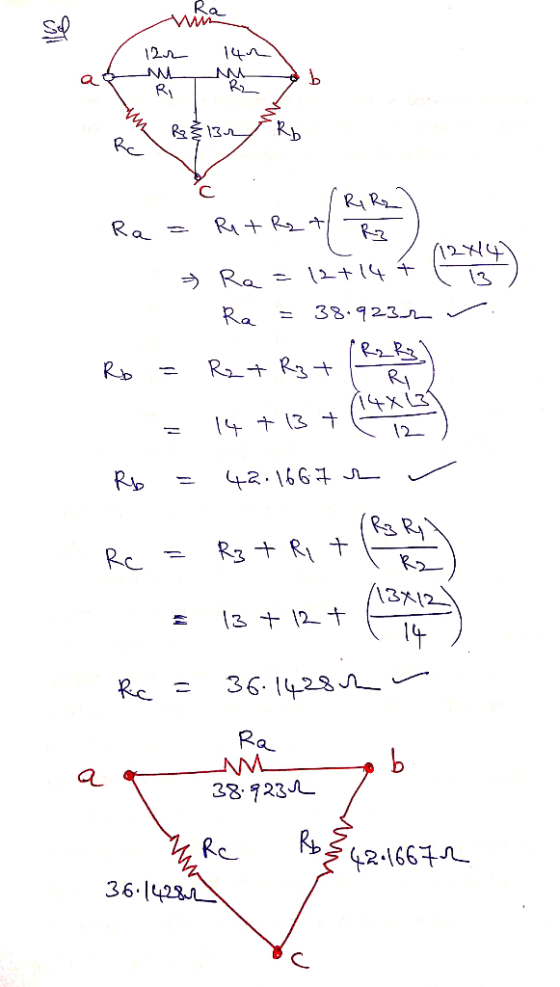
18. Transform Y to Delta for the circuit below. Be sure to label nodes a, b,...
1. For the circuit below: (a) Identify and label all distinct nodes. (b) Identify all combinations...
 1. For the circuit below: (a) Identify and label all distinct nodes. (b) Identify all combinations of 2 or more circuit elements that are connected in series. (c) Identify pairs of circuit elements that are connected in parallel. 312 222 2 20 V 1322 62
1.6 For the circuit in Fig. P1.6: (a) Identify and label all distinct nodes. (b) Which...
 1.6 For the circuit in Fig. P1.6: (a) Identify and label all distinct nodes. (b) Which of those nodes are extraordinary nodes? (c) Identify all combinations of 2 or more circuit elements that are connected in series. (d) Identify pairs of circuit elements that are connected in parallel. 40 12 V Figure P1.6: Circuit for Problem 1.6.
1.6 For the circuit in Fig, P1.6: (a) Identify and label all distinct nodes. (b) Which...
 1.6 For the circuit in Fig, P1.6: (a) Identify and label all distinct nodes. (b) Which of those nodes are extraordinary nodes? (c) Identify all combinations of 2 or more circuit elements that are connected in series. (d) Identify pairs of circuit elements that are connected in parallel. 4Ω 4 9 12 V(+ +8 V Figure P1.6: Circuit for Problem 1.6.
a.) Name and label the nodes in the above circuit on the diagram above. b.) Find...
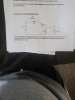 a.) Name and label the nodes in the above circuit on the diagram above. b.) Find the value of Vx using the node voltage technique (feel free to redraw the circuit elsewhere). Problem #2 (1 part SUPERPOSITION) 1ko 1kg 35000 1ΚΩΣ 6mA Use the principle of superposition to find the voltage across the 1k resistor that is in parallel with the current source. Make sure to designate the polarity of the voltage or label a reference node.
1) Find the Thévenin equivalent circuit across nodes a-b for the circuit below. Points: 15 5...
 1) Find the Thévenin equivalent circuit across nodes a-b for the circuit below. Points: 15 5 12 1012 15 V 0.5i 1012 o b
Problem 4.2-6 The circuit in (b) is equivalent to the circuit in (a). Circuit (b) is...
 Problem 4.2-6 The circuit in (b) is equivalent to the circuit in (a). Circuit (b) is obtained from Circuit (a) by replacing series and parallel combinations of resistors by equivalent resistors. 71 22 48 22 30 22 71 2 702 45.092 7012 22 2 30 mA (1 130 mA Ô 812 § 9012 Ž 30 mA 130mA Ô 42.631 S Voltages V1, V2 and V3 are the node voltages at nodes 1,2 and 3 of the equivalent circuit. Determine the...
Question 4 a) Find the Thevenin equivalent circuit for the network between nodes a and b...
 Question 4 a) Find the Thevenin equivalent circuit for the network between nodes a and b in 02A 01 T * $200 to b) Make sure to express the Thevinin source you found in part a in a phasor format
6. (20) Transform the circuit below to phasor domain. Sketch and completely label the transformed circuit....
 6. (20) Transform the circuit below to phasor domain. Sketch and completely label the transformed circuit. Find the steady state value of i(t). (Hint: Find the current (I) in the phasor domain then convert it back to the time domain to find i(t).) 15 F 375mH 30 cos (377t-15°) V
For the circuit below, calculate the resistance between nodes: (1) a and b (Ra-b) (2) a...
 For the circuit below, calculate the resistance between
nodes:
(1) a and b (Ra-b)
(2) a and c (Ra-c)
(3) c and d (Rc-d)
1kΩ 1kΩ - -_1kΩ 3.3kΩ εγκα 2.7kΩ 2.7kΩ
For the circuit below, calculate the resistance between
nodes:
(1) a and b (Ra-b)
(2) a and c (Ra-c)
(3) c and d (Rc-d)
1kΩ 1kΩ - -_1kΩ 3.3kΩ εγκα 2.7kΩ 2.7kΩ
Maya 2016 questions 1. Explain the following in terms of shape and transform nodes: (a) Grouping...
 Maya 2016 questions
1. Explain the following in terms of shape and transform nodes: (a) Grouping (b) Parenting (c) Instances 2. What is an object's pivot? How does its position affect rotation and scaling? 3. Explain the transformations for creating a mirrored copy of an object. 4. For polygon objects, what are the underlying components contained in the shape node?
Maya 2016 questions
1. Explain the following in terms of shape and transform nodes: (a) Grouping (b) Parenting (c) Instances 2. What is an object's pivot? How does its position affect rotation and scaling? 3. Explain the transformations for creating a mirrored copy of an object. 4. For polygon objects, what are the underlying components contained in the shape node?
 1. For the circuit below: (a) Identify and label all distinct nodes. (b) Identify all combinations of 2 or more circuit elements that are connected in series. (c) Identify pairs of circuit elements that are connected in parallel. 312 222 2 20 V 1322 62
 1.6 For the circuit in Fig. P1.6: (a) Identify and label all distinct nodes. (b) Which of those nodes are extraordinary nodes? (c) Identify all combinations of 2 or more circuit elements that are connected in series. (d) Identify pairs of circuit elements that are connected in parallel. 40 12 V Figure P1.6: Circuit for Problem 1.6.
 1.6 For the circuit in Fig, P1.6: (a) Identify and label all distinct nodes. (b) Which of those nodes are extraordinary nodes? (c) Identify all combinations of 2 or more circuit elements that are connected in series. (d) Identify pairs of circuit elements that are connected in parallel. 4Ω 4 9 12 V(+ +8 V Figure P1.6: Circuit for Problem 1.6.
 a.) Name and label the nodes in the above circuit on the diagram above. b.) Find the value of Vx using the node voltage technique (feel free to redraw the circuit elsewhere). Problem #2 (1 part SUPERPOSITION) 1ko 1kg 35000 1ΚΩΣ 6mA Use the principle of superposition to find the voltage across the 1k resistor that is in parallel with the current source. Make sure to designate the polarity of the voltage or label a reference node.
 1) Find the Thévenin equivalent circuit across nodes a-b for the circuit below. Points: 15 5 12 1012 15 V 0.5i 1012 o b
 Problem 4.2-6 The circuit in (b) is equivalent to the circuit in (a). Circuit (b) is obtained from Circuit (a) by replacing series and parallel combinations of resistors by equivalent resistors. 71 22 48 22 30 22 71 2 702 45.092 7012 22 2 30 mA (1 130 mA Ô 812 § 9012 Ž 30 mA 130mA Ô 42.631 S Voltages V1, V2 and V3 are the node voltages at nodes 1,2 and 3 of the equivalent circuit. Determine the...
 Question 4 a) Find the Thevenin equivalent circuit for the network between nodes a and b in 02A 01 T * $200 to b) Make sure to express the Thevinin source you found in part a in a phasor format
 6. (20) Transform the circuit below to phasor domain. Sketch and completely label the transformed circuit. Find the steady state value of i(t). (Hint: Find the current (I) in the phasor domain then convert it back to the time domain to find i(t).) 15 F 375mH 30 cos (377t-15°) V
 For the circuit below, calculate the resistance between
nodes:
(1) a and b (Ra-b)
(2) a and c (Ra-c)
(3) c and d (Rc-d)
1kΩ 1kΩ - -_1kΩ 3.3kΩ εγκα 2.7kΩ 2.7kΩ
For the circuit below, calculate the resistance between
nodes:
(1) a and b (Ra-b)
(2) a and c (Ra-c)
(3) c and d (Rc-d)
1kΩ 1kΩ - -_1kΩ 3.3kΩ εγκα 2.7kΩ 2.7kΩ
 Maya 2016 questions
1. Explain the following in terms of shape and transform nodes: (a) Grouping (b) Parenting (c) Instances 2. What is an object's pivot? How does its position affect rotation and scaling? 3. Explain the transformations for creating a mirrored copy of an object. 4. For polygon objects, what are the underlying components contained in the shape node?
Maya 2016 questions
1. Explain the following in terms of shape and transform nodes: (a) Grouping (b) Parenting (c) Instances 2. What is an object's pivot? How does its position affect rotation and scaling? 3. Explain the transformations for creating a mirrored copy of an object. 4. For polygon objects, what are the underlying components contained in the shape node?
Most questions answered within 3 hours.
-
Where is the error in this code sequence?
String s1 = "Hello";
String s2 = "ello";...
asked 10 months ago -
Financial data for Joel de Paris, Inc., for last year
follow:
Joel de Paris, Inc.
Balance...
asked 10 months ago -
Consider this reaction:
Al2(SO4)3 (aq)+ BaCl3
(aq) Al2Cl6 (aq)- +
3BaSO4(s) . What is the...
asked 10 months ago -
Suppose that Savneet is considering increasing her
recent random sample from 20 car rentals to 40...
asked 10 months ago -
Trucks arrive at an unloading terminal at an average rate of 120
per hour.
Trucks arrive...
asked 10 months ago -
Why are methanol and ethanol completely soluble in water while
octanol is not very little soluble....
asked 10 months ago -
A facilities manager at a university reads in a research report
that the mean amount of...
asked 10 months ago -
When the CuSO4 is rehydrated by adding water to the anhydrous
compound, is this an endothermic...
asked 10 months ago -
A ray of sunlight is passing from diamond into crown glass; the
angle of incidence is...
asked 10 months ago -
A block of mass 0.249 kg is placed on top of a light, vertical
spring of...
asked 10 months ago -
how do the kidneys compensate in the presences of acidosis
a) trigger hyperventilate
b) reserve acid...
asked 10 months ago -
Question 501 pts
The rental rate of capital to the firm increases. Which of the
following...
asked 10 months ago