
Homework Answers
Answer:
- Observed time (Average actual time) = 1.16 minutes [Observed time is the time taken to
perform a task when being observed for time study]
- Normal time= Observed time X rating factor = 1.16 x 86/100 = 1.00 min (approx.)
- Standard time= Normal time + allowance
= 1+ (100/100-11) = 2.12 min
Add Answer to:
3 A job was timed for 60 cycles and had an average of 1.16 minutes per...
A job was timed for 60 cycles and had an average of 1.9 minutes per piece....
A job was timed for 60 cycles and had an average of 1.9 minutes per piece. The performance rating was 90 percent, and workday allowances are 18 percent. Determine each of the following: a. Observed time. (Round your answer to 1 decimal place.) Observed time minutes b. Normal time. (Round your answer to 2 decimal places.) Normal time minutes c. Standard time. (Round your answer to 2 decimal places.) Standard time minutes
A widget assembly process was timed for 75 cycles and had an average of 1.5 minutes...
A widget assembly process was timed for 75 cycles and had an average of 1.5 minutes per piece. The performance rating was 95%, and workday allowances are 10 percent. Determine the following: a) Observed time b) Normal time c) Standard time d) How might this information be used?
A time study was conducted on a job that contains four elements. The observed times and...
A time study was conducted on a job that contains four elements. The observed times and performance ratings for six cycles are shown in the following table. OBSERVATIONS (minutes per cycle) Element Performance Rating 1 2 3 4 5 6 1 80 % 0.51 0.56 0.46 0.46 0.46 0.46 2 75 1.51 1.51 1.46 1.46 1.46 1.51 3 120 0.86 0.86 0.76 0.81 0.86 0.81 4 105 1.11 1.16 1.11 1.16 1.16 1.21 a. Determine the average cycle time for...
How many work cycles should be timed to estimate the average cycle time to within 2...
How many work cycles should be timed to estimate the average cycle time to within 2 percent of the sample mean with a confidence of 98.0 percent if a pilot study yielded these times (minutes): 4.1,4.6,5.1, 4.9, 5.9, and 4.4? The standard deviation is .631 minutes per cycle. (Use the "mean time" value to 2 decimal places and other values to 3 decimal places for intermediate calculations. Round up your final answer to the next whole number.) Number of work...
A worker-machine operation was found to involve 3.6 minutes of machine time per cycle in the...
A worker-machine operation was found to involve 3.6 minutes of machine time per cycle in the course of 40 cycles of stopwatch study. The worker’s time averaged 2.1 minutes per cycle, and the worker was given a rating of 111 percent (machine rating is 100 percent). Midway through the study, the worker took a 10-minute rest break. Assuming an allowance factor of 11 percent of work time which is applied only to the worker element (not the machine element), determine...
A worker-machine operation was found to involve 40 minutes of machine time per cycle in the...
 A worker-machine operation was found to involve 40 minutes of machine time per cycle in the course of 40 cycles of stopwatch study The worker's time averaged 25 minutes per cycle, and the worker was given a rating of 115 percent machine rating is 100 percent). Midway through the study, the worker took a 10-minute rest break. Assuming an allowance factor of 15 percent of work time which is applied only to the worker element not the machine element), determine...
A time study analysis shows an assembly operation for 50 cycles with an average cycle time of 15.00 minutes. If you ass...
A time study analysis shows an assembly operation for 50 cycles with an average cycle time of 15.00 minutes. If you assigned a performance rating of .95 and a work-day allowance factor of 20 percent, answer the following question: What is the Observed Time?
A job consists of three elements. Twenty observations for each element were timed, and the resulting...
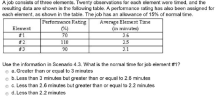 A job consists of three elements. Twenty observations for each element were timed, and the resulting data are shown in the following table. A performance rating has also been assigned for each element, as shown in the table. The job has an allowance of 15% of normal time. Performance Rating Element #1 #2 #3 70 110 90 Average Element Time (in minutes) 3.6 2.5 3.1 Use the information in Scenario 4.3. What is the normal time for job element #1?...
An initial time study resulted in an average observed time of 2.2 minutes per cycle, and...
An initial time study resulted in an average observed time of 2.2 minutes per cycle, and a standard deviation of 0.3 minutes per cycle. The performance rating was 1.20. What sample size, including the 20 observations in the initial study, would be necessary to have a confidence of 95.44 percent that the observed time was within 4 percent of the true value?
A time study analysis shows an assembly operation for 50 cycles with an average cycle time of 15.00 minutes. If you ass...
A time study analysis shows an assembly operation for 50 cycles with an average cycle time of 15.00 minutes. If you assigned a performance rating of .95 and a work-day allowance factor of 20 percent, answer the following question: What is the Allowance Factor?
 A worker-machine operation was found to involve 40 minutes of machine time per cycle in the course of 40 cycles of stopwatch study The worker's time averaged 25 minutes per cycle, and the worker was given a rating of 115 percent machine rating is 100 percent). Midway through the study, the worker took a 10-minute rest break. Assuming an allowance factor of 15 percent of work time which is applied only to the worker element not the machine element), determine...
 A job consists of three elements. Twenty observations for each element were timed, and the resulting data are shown in the following table. A performance rating has also been assigned for each element, as shown in the table. The job has an allowance of 15% of normal time. Performance Rating Element #1 #2 #3 70 110 90 Average Element Time (in minutes) 3.6 2.5 3.1 Use the information in Scenario 4.3. What is the normal time for job element #1?...
Most questions answered within 3 hours.
-
Where is the error in this code sequence?
String s1 = "Hello";
String s2 = "ello";...
asked 11 months ago -
Financial data for Joel de Paris, Inc., for last year
follow:
Joel de Paris, Inc.
Balance...
asked 11 months ago -
Consider this reaction:
Al2(SO4)3 (aq)+ BaCl3
(aq) Al2Cl6 (aq)- +
3BaSO4(s) . What is the...
asked 11 months ago -
Suppose that Savneet is considering increasing her
recent random sample from 20 car rentals to 40...
asked 11 months ago -
Trucks arrive at an unloading terminal at an average rate of 120
per hour.
Trucks arrive...
asked 11 months ago -
Why are methanol and ethanol completely soluble in water while
octanol is not very little soluble....
asked 11 months ago -
A facilities manager at a university reads in a research report
that the mean amount of...
asked 11 months ago -
When the CuSO4 is rehydrated by adding water to the anhydrous
compound, is this an endothermic...
asked 11 months ago -
A ray of sunlight is passing from diamond into crown glass; the
angle of incidence is...
asked 11 months ago -
A block of mass 0.249 kg is placed on top of a light, vertical
spring of...
asked 11 months ago -
how do the kidneys compensate in the presences of acidosis
a) trigger hyperventilate
b) reserve acid...
asked 11 months ago -
Question 501 pts
The rental rate of capital to the firm increases. Which of the
following...
asked 11 months ago