
Homework Answers
Add Answer to:
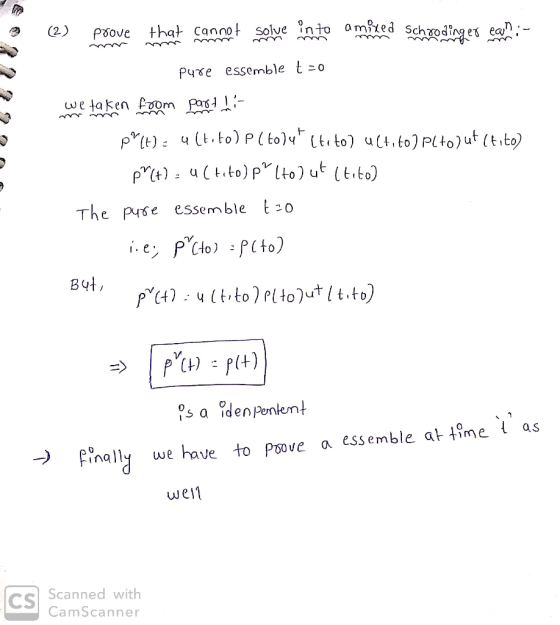
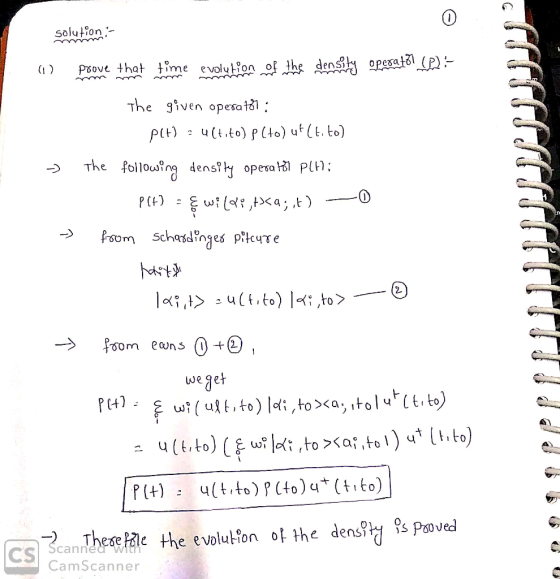
1. Prove that the time evolution of the density operator p (in the Schrödinger picture) is...
Recall that the time evolution of a wavefunction y(x, t) is determined by the Schrödinger equation,...
 Recall that the time evolution of a wavefunction y(x, t) is determined by the Schrödinger equation, which in position space reads iħ 4(x, t) = -24(x, t) + V(x, t)(x, t). ih vrt - h ? a) Consider any two normalized solutions to the Schrödinger equation, 41(2, t) and 02(3,t). Prove that their inner product is independent of time, doo 1 Vi (2, t)u2(x, t) dc = 0. dt J-00 Hint: prove the useful intermediate result, a 202 201 -...
Extra HW 1. Prove the following properties of the density matrix. (a) ? is a Hermitian...
 Extra HW 1. Prove the following properties of the density matrix. (a) ? is a Hermitian operator, i.e. ?-? (b) (A)) is invariant under unitary transformation. (c) Quantum Liouville's equation ih Ot (d) For pure states ?-? and for mixed states ?2 < p.
Consider a plane-wave solution to the free Schrödinger equation (V = 0) in one space dimension,...
 Consider a plane-wave solution to the free Schrödinger equation (V = 0) in one space dimension, with momentum pi. At time t = 0, the wavefunction takes the form Up (0,0) = P12/h. The lower index pı labels the momentum of this state. 1) What does the wavefunction look like at a later time t? 2) Next, consider another plane-wave state with a different momentum p2, with the wavefunction at t = 0 taking the form Up (2,0) = 1222/h....
2. The hydrogen atom [8 marks] The time-independent Schrödinger equation for the hydrogen atom in...
 2. The hydrogen atom [8 marks] The time-independent Schrödinger equation for the hydrogen atom in the spherical coordinate representation is where ao-top- 0.5298 10-10rn is the Bohr radius, and μ is the electon-proton reduced mass. Here, the square of the angular momentum operator L2 in the spherical coordinate representation is given by: 2 (2.2) sin θー sin θ 00 The form of the Schrödinger equation means that all energy eigenstates separate into radial and angular motion, and we can write...
*Please, answer all the literals and be detailed with the answer (do all the procedure and calculations) *Do it with a clear letter Homework (scattering) 1. Consider the time dependent Schrödinger eq...
 *Please, answer all the literals and be detailed with the answer
(do all the procedure and calculations)
*Do it with a clear letter
Homework (scattering) 1. Consider the time dependent Schrödinger equation written in the form where 0 2mo As it is well known the temporal evolution of a wave function ψ( t) known at a specific time t is uniquely determined for all future times t, > t as well as for all past times t' < t. Moreover,...
*Please, answer all the literals and be detailed with the answer
(do all the procedure and calculations)
*Do it with a clear letter
Homework (scattering) 1. Consider the time dependent Schrödinger equation written in the form where 0 2mo As it is well known the temporal evolution of a wave function ψ( t) known at a specific time t is uniquely determined for all future times t, > t as well as for all past times t' < t. Moreover,...
2. Schrodinger equation In quantum mechanics, physical quantities cor- respond to Hermitian operators. In particular, the...
 2. Schrodinger equation In quantum mechanics, physical quantities cor- respond to Hermitian operators. In particular, the total energy of the system corresponds to the Hamiltonian operator H, which is a hermitian operator The 'state of the system' is a time dependent vector in an inner product space, l(t)). The state of the system obeys the Schrodinger equation We assume that there are no time-varying external forces on the system, so that the Hamiltonian operator H is not itself time-dependent a)...
1. (30 points). Coupled spins. Spin-1/2 particles A and B evolve under the influence of the follo...
 1. (30 points). Coupled spins. Spin-1/2 particles A and B evolve under the influence of the following Hamiltonian (for simplicity takeh-1 so that energies are expressed in frequency units): We work in the uncoupled basis aba) Ib), where a,b E 0,1 and where states 0) (1)) correspond to single spins aligned (antialigned) with the z-direction. As we discussed in lecture, the eigenstates of the Hamiltonian are 100), 111), and 2-1/2 (101) 110)). a. We prepare the initial state t01). Since...
Problem 8.3 - A New Two-State System Consider a new two-level system with a Hamiltonian given...
 Problem 8.3 - A New Two-State System Consider a new two-level system with a Hamiltonian given by i = Ti 1461 – 12) (2) (3) Also consider an observable represented by the operator Ŝ = * 11/21 - *12/11: It should (hopefully) be clear that 1) and 2) are eigenkets of the Hamiltonian. Let $1) be an eigenket of S corresponding to the smaller eigenvalue of S and let S2) be an eigenket of S corresponding to the larger eigenvalue....
Problem 3. (1) Let H be a Hilbert space and S, TE B(HH). Then, prove that...
 Problem 3. (1) Let H be a Hilbert space and S, TE B(HH). Then, prove that ||ST|| ||||||||| (2) Let X, Y be Hilbert spaces and Te B(X,Y). Then, prove that ||1||| sup ||T3|1 TEX=1 Let X, Y be Banach spaces. Definition (review) We denote by B(X, Y) a set of all bounded linear operators T:X + Y with D(T) = X. B(X, Y) is a vector space. Definition (review) A linear operator T:X + Y is said to be...
1. Consider a system R(α, β) which can be represented by operators P,, Qß. R(α, β) Here P is a tr...
 Linear System
Time-invariant, impulse response function
1. Consider a system R(α, β) which can be represented by operators P,, Qß. R(α, β) Here P is a truncation operator. That is, it performs the following operation for given α 2 0 and u(1), - < t < 00, 11(1) İf12α And a is a shift operator. That is, it performs the following operation for given β 0 and v(1), - < t < ao Assume that R(α, β) is relaxed at...
Linear System
Time-invariant, impulse response function
1. Consider a system R(α, β) which can be represented by operators P,, Qß. R(α, β) Here P is a truncation operator. That is, it performs the following operation for given α 2 0 and u(1), - < t < 00, 11(1) İf12α And a is a shift operator. That is, it performs the following operation for given β 0 and v(1), - < t < ao Assume that R(α, β) is relaxed at...
 Recall that the time evolution of a wavefunction y(x, t) is determined by the Schrödinger equation, which in position space reads iħ 4(x, t) = -24(x, t) + V(x, t)(x, t). ih vrt - h ? a) Consider any two normalized solutions to the Schrödinger equation, 41(2, t) and 02(3,t). Prove that their inner product is independent of time, doo 1 Vi (2, t)u2(x, t) dc = 0. dt J-00 Hint: prove the useful intermediate result, a 202 201 -...
 Extra HW 1. Prove the following properties of the density matrix. (a) ? is a Hermitian operator, i.e. ?-? (b) (A)) is invariant under unitary transformation. (c) Quantum Liouville's equation ih Ot (d) For pure states ?-? and for mixed states ?2 < p.
 Consider a plane-wave solution to the free Schrödinger equation (V = 0) in one space dimension, with momentum pi. At time t = 0, the wavefunction takes the form Up (0,0) = P12/h. The lower index pı labels the momentum of this state. 1) What does the wavefunction look like at a later time t? 2) Next, consider another plane-wave state with a different momentum p2, with the wavefunction at t = 0 taking the form Up (2,0) = 1222/h....
 2. The hydrogen atom [8 marks] The time-independent Schrödinger equation for the hydrogen atom in the spherical coordinate representation is where ao-top- 0.5298 10-10rn is the Bohr radius, and μ is the electon-proton reduced mass. Here, the square of the angular momentum operator L2 in the spherical coordinate representation is given by: 2 (2.2) sin θー sin θ 00 The form of the Schrödinger equation means that all energy eigenstates separate into radial and angular motion, and we can write...
 *Please, answer all the literals and be detailed with the answer
(do all the procedure and calculations)
*Do it with a clear letter
Homework (scattering) 1. Consider the time dependent Schrödinger equation written in the form where 0 2mo As it is well known the temporal evolution of a wave function ψ( t) known at a specific time t is uniquely determined for all future times t, > t as well as for all past times t' < t. Moreover,...
*Please, answer all the literals and be detailed with the answer
(do all the procedure and calculations)
*Do it with a clear letter
Homework (scattering) 1. Consider the time dependent Schrödinger equation written in the form where 0 2mo As it is well known the temporal evolution of a wave function ψ( t) known at a specific time t is uniquely determined for all future times t, > t as well as for all past times t' < t. Moreover,...
 2. Schrodinger equation In quantum mechanics, physical quantities cor- respond to Hermitian operators. In particular, the total energy of the system corresponds to the Hamiltonian operator H, which is a hermitian operator The 'state of the system' is a time dependent vector in an inner product space, l(t)). The state of the system obeys the Schrodinger equation We assume that there are no time-varying external forces on the system, so that the Hamiltonian operator H is not itself time-dependent a)...
 1. (30 points). Coupled spins. Spin-1/2 particles A and B evolve under the influence of the following Hamiltonian (for simplicity takeh-1 so that energies are expressed in frequency units): We work in the uncoupled basis aba) Ib), where a,b E 0,1 and where states 0) (1)) correspond to single spins aligned (antialigned) with the z-direction. As we discussed in lecture, the eigenstates of the Hamiltonian are 100), 111), and 2-1/2 (101) 110)). a. We prepare the initial state t01). Since...
 Problem 8.3 - A New Two-State System Consider a new two-level system with a Hamiltonian given by i = Ti 1461 – 12) (2) (3) Also consider an observable represented by the operator Ŝ = * 11/21 - *12/11: It should (hopefully) be clear that 1) and 2) are eigenkets of the Hamiltonian. Let $1) be an eigenket of S corresponding to the smaller eigenvalue of S and let S2) be an eigenket of S corresponding to the larger eigenvalue....
 Problem 3. (1) Let H be a Hilbert space and S, TE B(HH). Then, prove that ||ST|| ||||||||| (2) Let X, Y be Hilbert spaces and Te B(X,Y). Then, prove that ||1||| sup ||T3|1 TEX=1 Let X, Y be Banach spaces. Definition (review) We denote by B(X, Y) a set of all bounded linear operators T:X + Y with D(T) = X. B(X, Y) is a vector space. Definition (review) A linear operator T:X + Y is said to be...
 Linear System
Time-invariant, impulse response function
1. Consider a system R(α, β) which can be represented by operators P,, Qß. R(α, β) Here P is a truncation operator. That is, it performs the following operation for given α 2 0 and u(1), - < t < 00, 11(1) İf12α And a is a shift operator. That is, it performs the following operation for given β 0 and v(1), - < t < ao Assume that R(α, β) is relaxed at...
Linear System
Time-invariant, impulse response function
1. Consider a system R(α, β) which can be represented by operators P,, Qß. R(α, β) Here P is a truncation operator. That is, it performs the following operation for given α 2 0 and u(1), - < t < 00, 11(1) İf12α And a is a shift operator. That is, it performs the following operation for given β 0 and v(1), - < t < ao Assume that R(α, β) is relaxed at...
Most questions answered within 3 hours.
-
Where is the error in this code sequence?
String s1 = "Hello";
String s2 = "ello";...
asked 10 months ago -
Financial data for Joel de Paris, Inc., for last year
follow:
Joel de Paris, Inc.
Balance...
asked 10 months ago -
Consider this reaction:
Al2(SO4)3 (aq)+ BaCl3
(aq) Al2Cl6 (aq)- +
3BaSO4(s) . What is the...
asked 10 months ago -
Suppose that Savneet is considering increasing her
recent random sample from 20 car rentals to 40...
asked 10 months ago -
Trucks arrive at an unloading terminal at an average rate of 120
per hour.
Trucks arrive...
asked 10 months ago -
Why are methanol and ethanol completely soluble in water while
octanol is not very little soluble....
asked 10 months ago -
A facilities manager at a university reads in a research report
that the mean amount of...
asked 10 months ago -
When the CuSO4 is rehydrated by adding water to the anhydrous
compound, is this an endothermic...
asked 10 months ago -
A ray of sunlight is passing from diamond into crown glass; the
angle of incidence is...
asked 10 months ago -
A block of mass 0.249 kg is placed on top of a light, vertical
spring of...
asked 10 months ago -
how do the kidneys compensate in the presences of acidosis
a) trigger hyperventilate
b) reserve acid...
asked 10 months ago -
Question 501 pts
The rental rate of capital to the firm increases. Which of the
following...
asked 10 months ago